What is OpenChat?
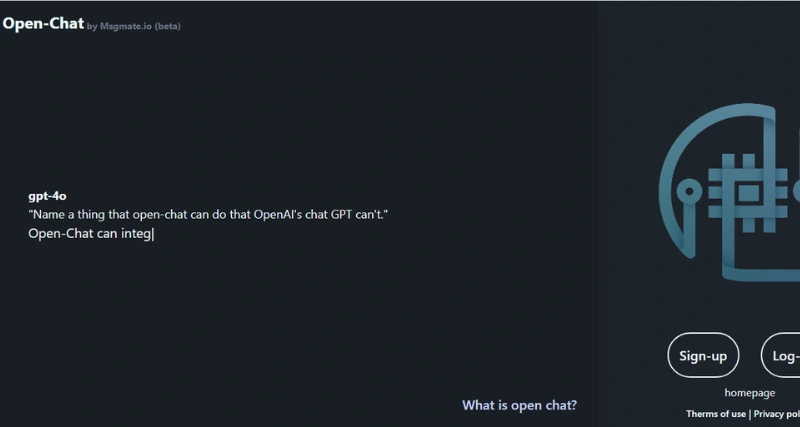
OpenChat is an AI tool that provides users with the ability to build customized chatbots without any coding knowledge. The chatbot console is open-source and user-friendly, allowing easy management and deployment of chatbots on various platforms. With powerful crawlers and language models, making it a versatile platform for various applications such as customer support, private tutoring, internal knowledge bases, and personal libraries. Live demos are available to explore the possibilities of this in just a few minutes.
OpenChat Features:
Code-free chatbot creation: Users can build customized chatbots without any coding knowledge.
Embed and share anywhere: Chatbots can be easily embedded on websites, PDF files, Notion, and other platforms.
Open-source chatbot console: The chatbot console is open-source and user-friendly, allowing easy management and deployment of chatbots.
Powerful crawlers and LLMs: Its uses powerful crawlers and language models to transform crawled data into knowledge.
Versatile applications: Its can be used for various applications such as customer support, private tutoring, internal knowledge bases, and personal libraries.
OpenChat Benefits:
Easy to use: Its is user-friendly and requires no coding knowledge, making it accessible to everyone.
Customizable: Users can build customized chatbots according to their needs and requirements.
Versatile: Its can be used for various applications, making it a versatile platform.
Cost-effective: this is an open-source platform, which means it’s free to use and modify.
Use Cases:
Customer support: Users can create a customized AI chatbot for customer support on their website.
Private tutoring: it can be used as a private tutor by uploading books and asking the bot questions.
Internal knowledge base: Organizations can build an internal knowledge base for easy access to information.
Personal library: Users can develop a personal library where they can upload books and texts and interact with the chatbot.
Specialized applications: Chatbots can be trained on specific data, such as legal documents or domain-specific content, for specialized applications.