

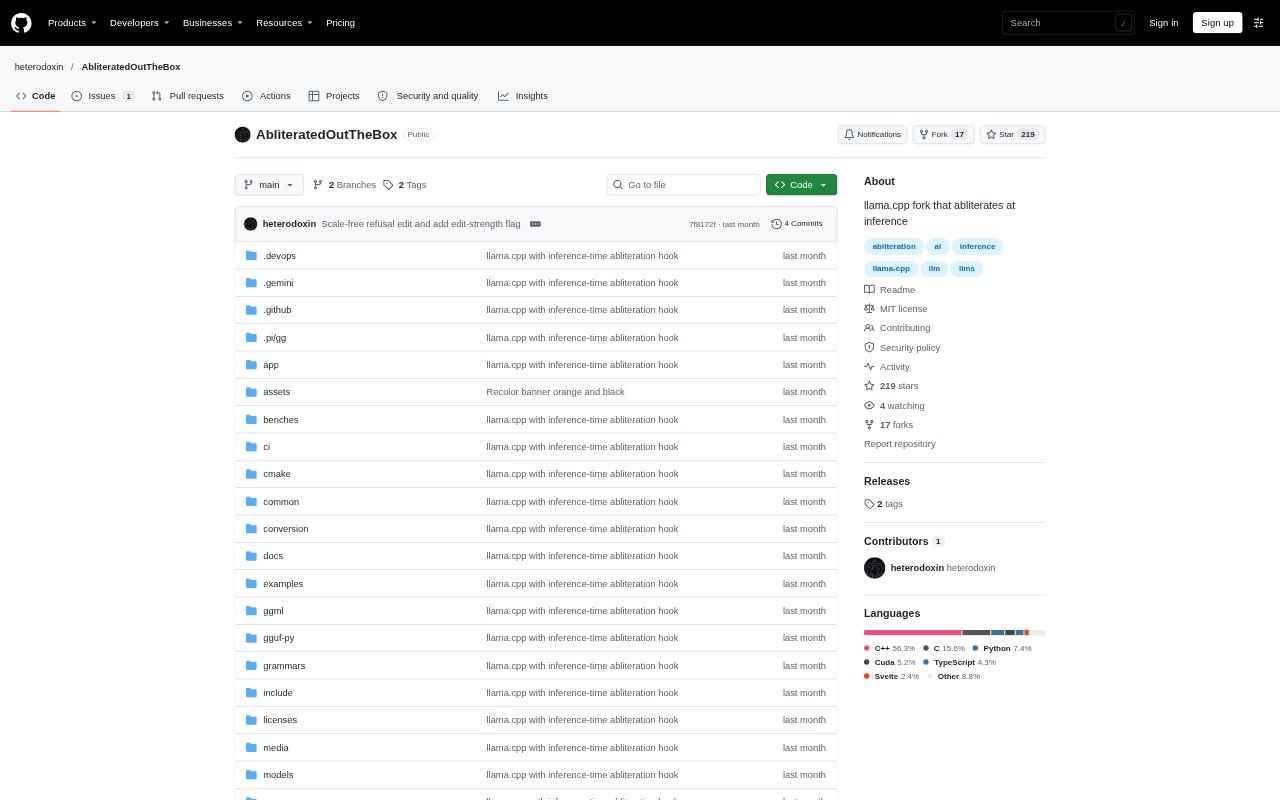
What is AbliteratedOutTheBox?
AbliteratedOutTheBox is a llama.cpp fork that changes how supported language models respond at inference time, without modifying the model weights stored on disk. It is designed to suppress refusal behavior and safety disclaimers for prompts the runtime flags, so it is suitable only for controlled evaluation of model behavior. The project provides a command-line runtime for GGUF models and supports CPU and other llama.cpp backends.
AbliteratedOutTheBox Features:
Prompt-Level Gate: A look-ahead gate checks each prompt using model activations and applies the refusal edit only when its refusal signal passes a configurable threshold.
Inference-Time Editing: The runtime edits activations during inference, leaving the original model weights unchanged and requiring no training or separate sidecar files.
Refusal Direction: The refusal direction is derived from differences between forced comply and refuse openings, then used to detect and reduce refusal behavior.
Disclaimer Direction: A separate direction derived from clean and disclaimered openings can reduce safety-disclaimer language, with its strength controlled by a setting.
Model Coverage: The project describes one shared editing approach for 131 model architectures, without per-model code, and reports tests on Qwen3-8B, Llama-3.1-8B, and Gemma-4-e4b.
Runtime Controls: Command-line settings adjust the gate threshold, refusal-edit strength, and disclaimer-edit strength, while the runtime processes one sequence at a time.
AbliteratedOutTheBox Benefits:
Weights Stay Intact: Keeping edits out of stored weights lets evaluators retain the original model files and compare behavior without baking a change into every prompt.
Targeted Testing: Applying edits only when the gate fires can help researchers examine flagged behavior while reducing changes to prompts the gate leaves alone.
Flexible Hardware: Using the llama.cpp runtime allows experiments on CPU or supported backends, including quantized models, rather than requiring a separate editing system.
Tunable Behavior: Separate controls for refusal and disclaimer edits let evaluators vary the intervention and observe how stronger settings affect generated responses.
Cross-Model Comparison: A shared approach across model architectures makes it easier to compare inference-time interventions without writing model-specific editing code.
Use Cases:
Refusal Evaluation: Researchers can measure how an inference-time intervention changes refusal behavior on controlled, held-out prompt sets.
Benign Prompt Checks: Model evaluators can check whether ordinary prompts remain unchanged when the gate does not activate.
Disclaimer Analysis: Teams studying response style can compare compliant generations with and without the separate disclaimer-direction edit.
Model Comparisons: Researchers can run the same intervention approach across supported model families and compare how each responds.
Local Runtime Experiments: Developers can test inference-time activation editing with GGUF models on a CPU or another backend already supported by llama.cpp.