
What is AegisKernel?
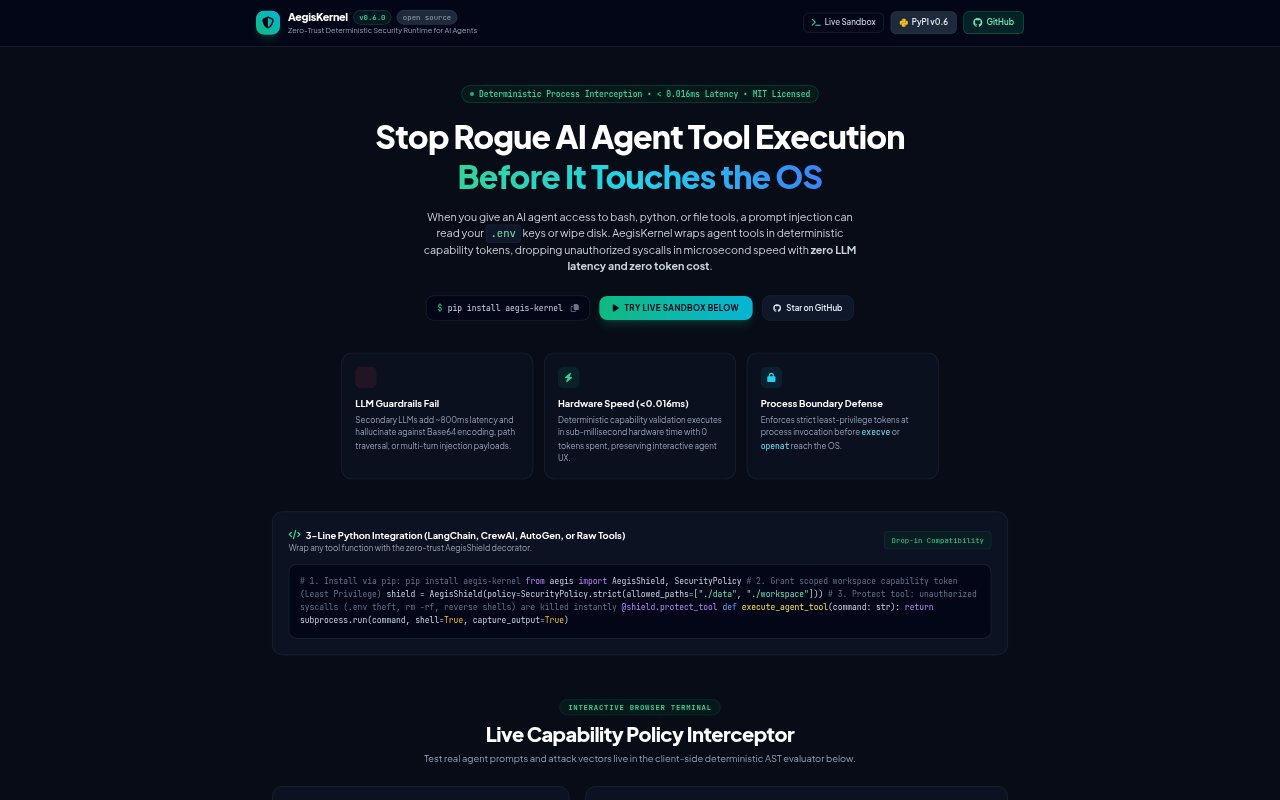
AegisKernel is a deterministic security runtime for AI agents that can call tools such as bash, Python, or file operations. It wraps tool functions with a capability-checking decorator, then validates permissions before process calls can reach the operating system. The product is aimed at teams building agents with LangChain, CrewAI, AutoGen, or raw tool functions. Its approach uses deterministic checks rather than a secondary language model to decide whether a tool action is allowed.
AegisKernel Features:
Capability Tokens: Tool calls are wrapped in deterministic capability tokens that define which actions an agent is authorized to perform.
Syscall Filtering: Unauthorized system calls are blocked before operations such as execve or openat reach the operating system.
Tool Wrapping: AegisShield wraps a tool function through a short Python integration for LangChain, CrewAI, AutoGen, or raw tools.
Deterministic Checks: A capability policy interceptor evaluates tool permissions without asking a secondary language model to judge each action.
Attack Testing: A client-side deterministic AST evaluator lets builders test agent prompts and attack vectors in a live interface.
Low-Latency Validation: Capability validation is stated to run in under 0.016 milliseconds, with no LLM latency or token cost for the check.
AegisKernel Benefits:
Limit Tool Exposure: Restricting agent actions to authorized capabilities can reduce the risk that a compromised prompt leads to unwanted system access.
Avoid Extra Model Calls: Deterministic permission checks avoid the latency and token use of adding a second language model as a guardrail.
Preserve Responsiveness: Fast validation helps teams add a security check to interactive agent workflows without introducing a model-based review step.
Catch Attacks Earlier: Blocking unauthorized calls before they reach the operating system gives teams a control point ahead of tool execution.
Test Policies Directly: The live evaluator gives builders a way to examine how prompts and attack vectors interact with their capability policies.
Use Cases:
Bash Agent Access: Add capability checks to an agent that can run shell commands, limiting which system actions its tool calls may perform.
Python Tool Agents: Wrap Python tools used by an autonomous agent so calls are checked against deterministic capabilities before execution.
File Tool Protection: Use process-boundary checks for agents with file tools, including calls that could otherwise reach openat.
Framework Integration: Integrate the decorator into a LangChain, CrewAI, or AutoGen project that exposes functions as agent tools.
Prompt Attack Testing: Try prompts and attack vectors in the client-side evaluator while reviewing how deterministic policy checks handle them.