

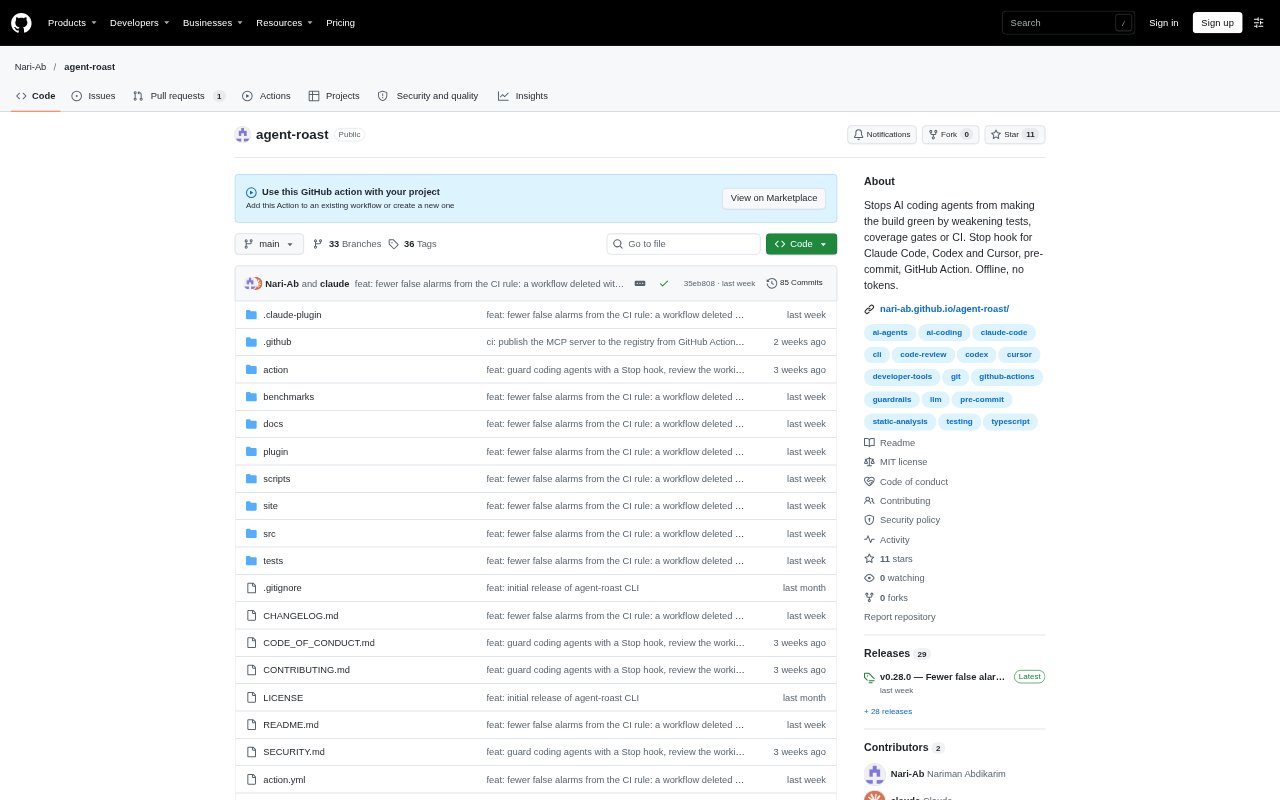
What is agent-roast?
agent-roast is an offline tool for reviewing code changes that might make tests pass by weakening the tests or their surrounding checks. It compares changes before and after, and can run as a command-line review, an agent hook, a Git hook, or a pull request check. It is intended for teams using coding agents as well as developers who want an extra review of test, coverage, and CI changes. It works without a model, tokens, or a network connection.
agent-roast Features:
Test Change Detection: It flags existing tests that are skipped, removed, focused, or changed to use weaker assertions, and identifies trivial assertions.
CI Guard Checks: It checks for changes such as lowered coverage thresholds, relaxed lint rules, CI steps allowed to fail, and workflows that stop running tests.
Agent Hooks: Hooks for several coding agents review changes before an agent finishes, send it back once to address a finding, and then warn rather than loop.
Pull Request Review: A GitHub Action or command-line review can check a pull request against a base branch, with optional comments and SARIF output.
Rule Configuration: A repository configuration file sets rule severity and ignored paths, while rules are read from the base branch so a change cannot relax its own review.
Language Coverage: Full before-and-after comparison covers JavaScript, TypeScript, Python, and Go, while selected skip and placeholder checks extend to other languages.
agent-roast Benefits:
Earlier Review: Potentially weakened checks are surfaced during development or pull request review, before a passing build is treated as proof that the code is sound.
Less Manual Scanning: Automated comparisons help reviewers focus on suspicious test and CI edits instead of searching every change for altered safeguards.
Agent Oversight: Teams can add a review step to agent workflows and give an agent a chance to correct a flagged change before it completes.
Local Operation: Offline execution avoids sending repository changes to a model or relying on network access for this review.
Adjustable Adoption: Advisory mode, configurable rules, and baselines let teams assess findings and existing debt before making checks block work.
Use Cases:
Agent Code Review: Install an agent hook to check whether a coding agent has weakened an assertion or disabled a test before it finishes a task.
Pull Request Checks: Add a review job to a repository’s pull requests to report changes to tests, coverage gates, or CI behavior.
Pre-Commit Review: Run the check before committing test or configuration edits, using a Git hook or the pre-commit framework.
CI Pipeline Audit: Run a command-line review in continuous integration when a team wants findings without setting up the GitHub Action.
Existing Repository Trial: Replay recent commits or use advisory mode to see what the tool flags before making findings fail a build or pull request.