
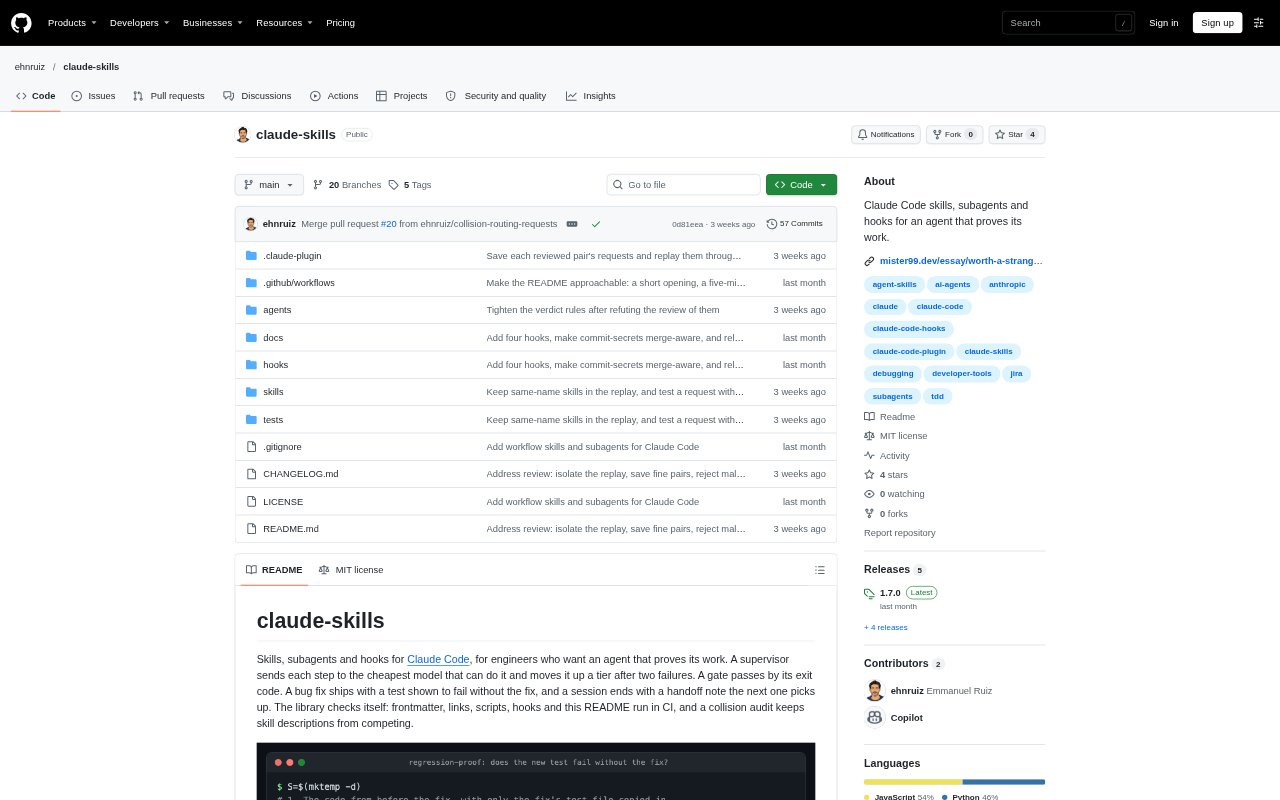
What is Agent Workflow?
Agent Workflow is a Claude Code plugin that adds skills, subagents, and hooks for engineering work organized around verifiable steps. It supports a process for routing tasks, checking results through commands and tests, and carrying context between sessions with handoff notes. The collection includes guidance for test-driven development, debugging, research, ticket writing, and code review. Developers can install it as a plugin, use the skills CLI, or copy selected components into their setup.
Agent Workflow Features:
Task Routing: The supervisor breaks multi-step work into tickets, assigns them to subagents, and moves a worker up a model tier after two failures.
Regression Checks: The regression-proof skill checks gates by exit code and verifies a new test fails against the code before a fix.
Code Review: A reviewer examines the diff against the request and project standards, while a second reviewer tries to refute each finding.
Session Handoffs: The handoff skill records completed work, verification, decisions, open questions, and next steps for the following session.
Ticket Writing: Ticket skills draft and trim work items, and a lint script checks drafts against limits for length, headings, and acceptance criteria.
Workflow Checks: Scripts and hooks check repository files, links, skills, and other components, while a collision audit flags overlapping skill descriptions.
Agent Workflow Benefits:
Clearer Verification: Command results and tests give developers concrete evidence to assess instead of relying on a general claim that work is complete.
Focused Delegation: Breaking work into defined tickets helps keep responsibilities and expected results clear as tasks move between agents.
Fewer Regressions: Requiring a test to fail without a fix helps distinguish a test that proves the change from one that merely passes afterward.
Session Continuity: Recorded decisions and next steps make it easier to resume work without reconstructing the previous session from scratch.
More Consistent Tickets: Word budgets and draft checks help keep work items concise and make acceptance criteria easier to review.
Use Cases:
Debugging Flaky Tests: Use the debugging workflow to reproduce an intermittent failure, test possible causes, and verify the fix with a targeted test.
Planning Code Changes: Use the supervisor when a change needs several steps, such as locating code, implementing a fix, running checks, and reviewing a diff.
Resuming Development: Write a handoff at the end of a coding session, then pick up the work later and check the repository for changes made in between.
Preparing Work Tickets: Draft or shorten a bug, task, story, spike, or epic and check its wording before filing it in Jira, Linear, or GitHub Issues.
Auditing Agent Skills: Run a collision audit when a collection of skills has grown and descriptions may direct similar requests to different workflows.