
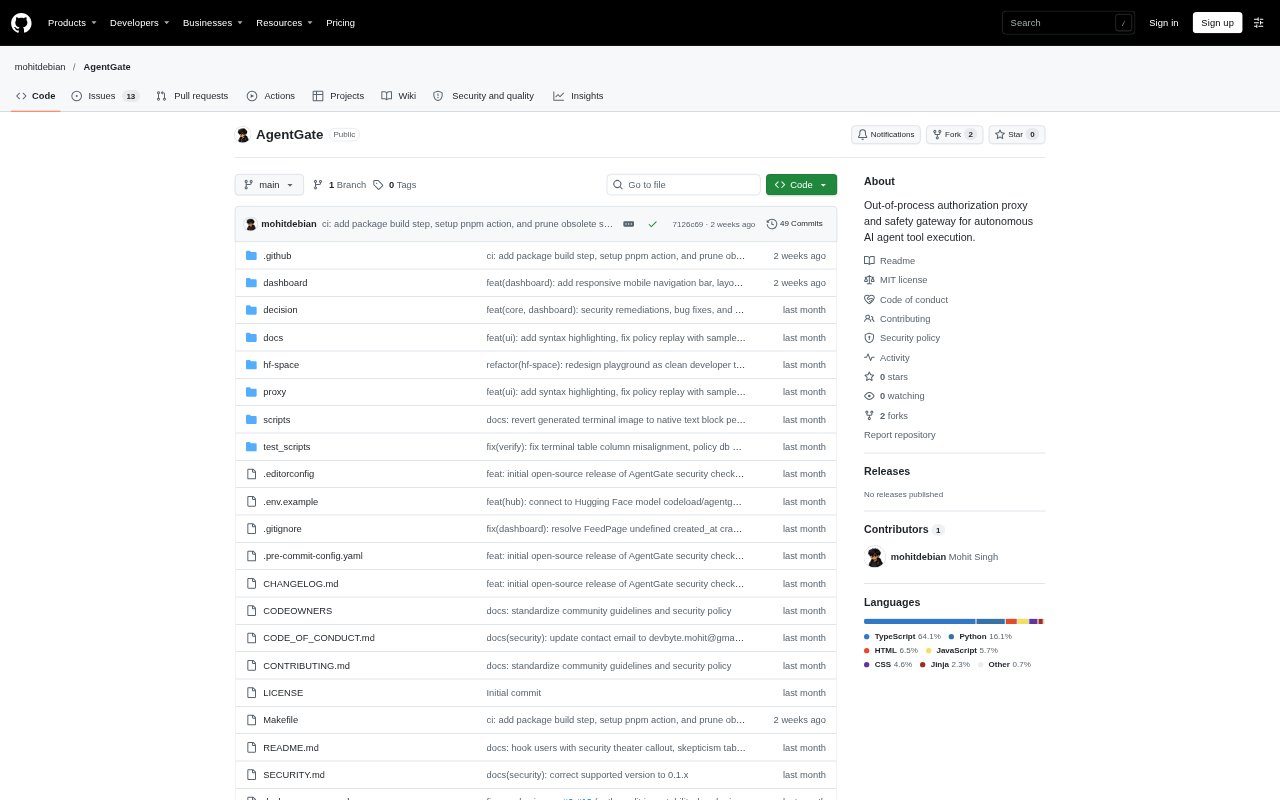
What is AgentGate?
AgentGate is a self-hosted authorization gateway that checks an AI agent’s tool calls before they reach the systems the agent can act on. It combines a local risk-classification model with configurable policy rules to allow, deny, or pause actions for review. It is designed for developers and teams building autonomous agents who need an independent control point for tool execution, rather than relying only on instructions in an agent’s prompt.
AgentGate Features:
Tool Call Interception: The out-of-process proxy assesses calls such as shell commands, database queries, and webhooks before the agent can proceed with them.
Risk Classification: A local model evaluates possible untrusted prompt influence, alignment with the session goal, action reversibility, and outbound data transmission.
Policy Rules: Rules in policy.yaml determine how assessed actions are handled, with the gateway returning allow, deny, or ask verdicts.
Human Approvals: Actions that need operator review can be queued for approval in the web console before they are allowed to continue.
Audit Records: PostgreSQL stores decision traces, audit logs, and operator approvals for later inspection.
Integration Options: The gateway exposes a REST API and has integration examples for MCP, Python, TypeScript, LangChain, and CrewAI.
AgentGate Benefits:
Independent Controls: Keeping authorization outside the agent’s context gives teams a separate point for enforcing tool-use rules.
Faster Decisions: Local classification lets teams assess calls without adding a separate text-generating judge to every decision.
Fewer Unnecessary Blocks: Separating prompt-injection risk from action impact allows risky but legitimate operations to be reviewed instead of automatically rejected.
Clearer Reviews: Stored decisions and approval records give operators context for examining how tool calls were handled.
Deployment Control: Self-hosting the gateway lets teams run the authorization service alongside their own agent infrastructure.
Use Cases:
Shell Command Checks: Place a review step between an autonomous agent and shell access when it may run commands that change or remove files.
Database Access: Assess an agent’s database queries against its stated session goal before allowing them to reach a database.
Webhook Review: Inspect agent actions that send information to external services and block calls flagged for possible exfiltration.
Prompt Injection Defense: Check tool calls that may have been influenced by untrusted content, such as instructions found in a scraped email.
Operator Approval: Route an irreversible maintenance action, such as cleaning temporary files, to an operator before execution.