

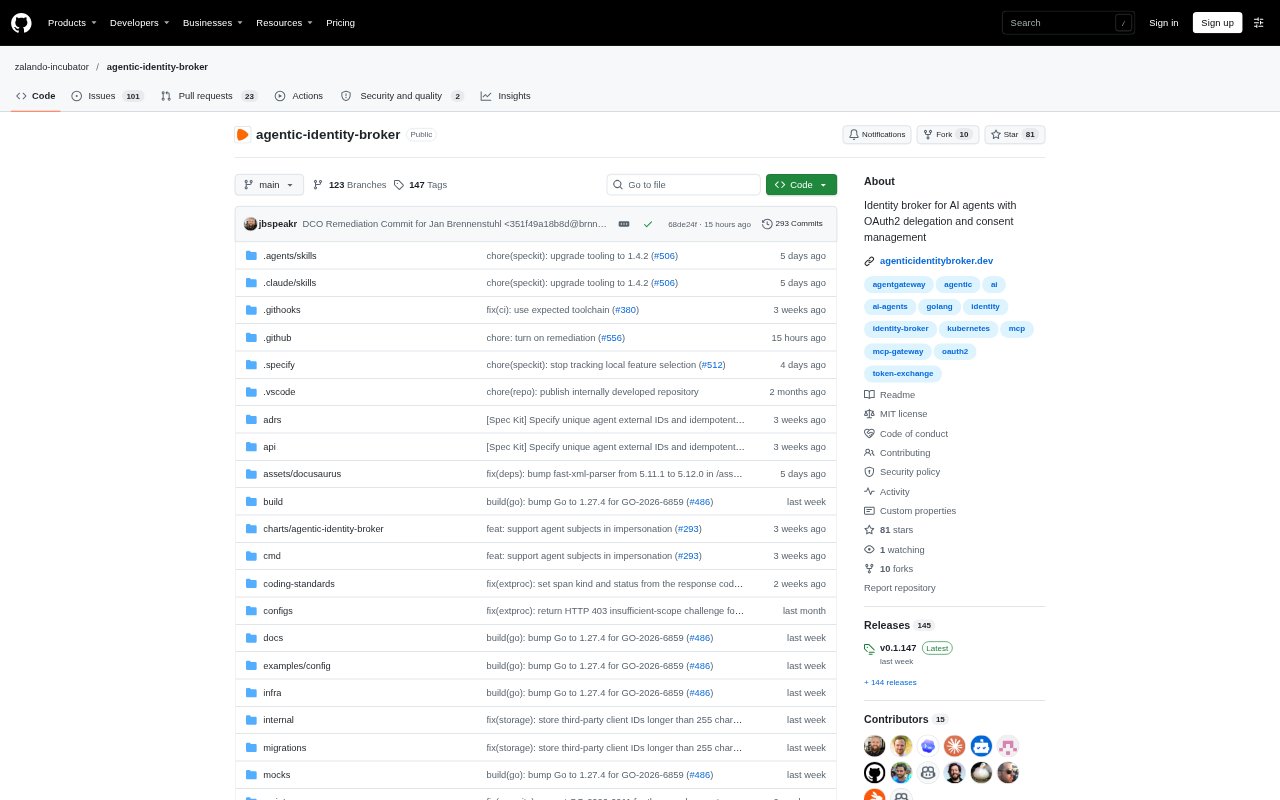
What is Agentic Identity Broker?
Agentic Identity Broker is an open-source OAuth2 delegation and consent broker for teams building or operating AI agents that access third-party services on a user's behalf. It manages which agent can access which service and permission set, while keeping provider credentials out of the agent. IAM teams and platform operators can deploy it with a gateway to handle token exchange and centralized authorization across agents and MCP servers.
Agentic Identity Broker Features:
Scoped Delegation: Users can grant an agent access to specific third-party services with selected permissions and optional expiry.
Revocable Grants: The broker maintains a grant for each user and agent, which users can revoke at any time.
Encrypted Token Vault: Third-party access and refresh tokens are stored encrypted at rest using envelope encryption bound to each service.
Gateway Token Exchange: A gateway can exchange an agent token for the appropriate provider token per request under policy, using RFC 8693.
Consent Interface: A built-in user interface provides a central place to approve and manage OAuth2 delegations.
Identity and Audit: The broker supports agent registration, principal authentication, session management, structured JSON logging, and security measures such as sensitive-value redaction.
Agentic Identity Broker Benefits:
Fewer Exposed Credentials: Agents can request access without holding long-lived provider credentials, reducing the chance that those secrets are exposed through agent workflows.
Tighter Access Control: Permission choices, optional expiry, and revocation let users limit how much access an agent has and how long it lasts.
Less Repeated Auth Work: Centralizing OAuth ceremonies, token storage, and translation can reduce the authentication work required for each MCP server.
Consistent Oversight: A central consent and authorization layer helps teams review approvals across different agents and MCP server interfaces.
Clearer Security Review: Structured logs and centralized authorization give security teams a more consistent record to use for monitoring and compliance.
Use Cases:
Internal MCP Servers: Use a broker and gateway when deploying multiple internal MCP servers that need to access services on behalf of employees.
Customer SaaS Access: Add a consent surface to a SaaS product's MCP server so customers can approve agent access and the provider can record approvals.
Hosted Agents: Use a single user token with a gateway when a hosted agent needs to reach multiple MCP servers.
Chat-Based Delegation: Start a delegation chain from a company chat bridge, such as Google Chat or Slack, using trusted machine identities for a user.
Central Tool Approval: Require a centrally governed approval before an agent sends email or shares documents, regardless of the agent interface.