
What is Agentic Radar?
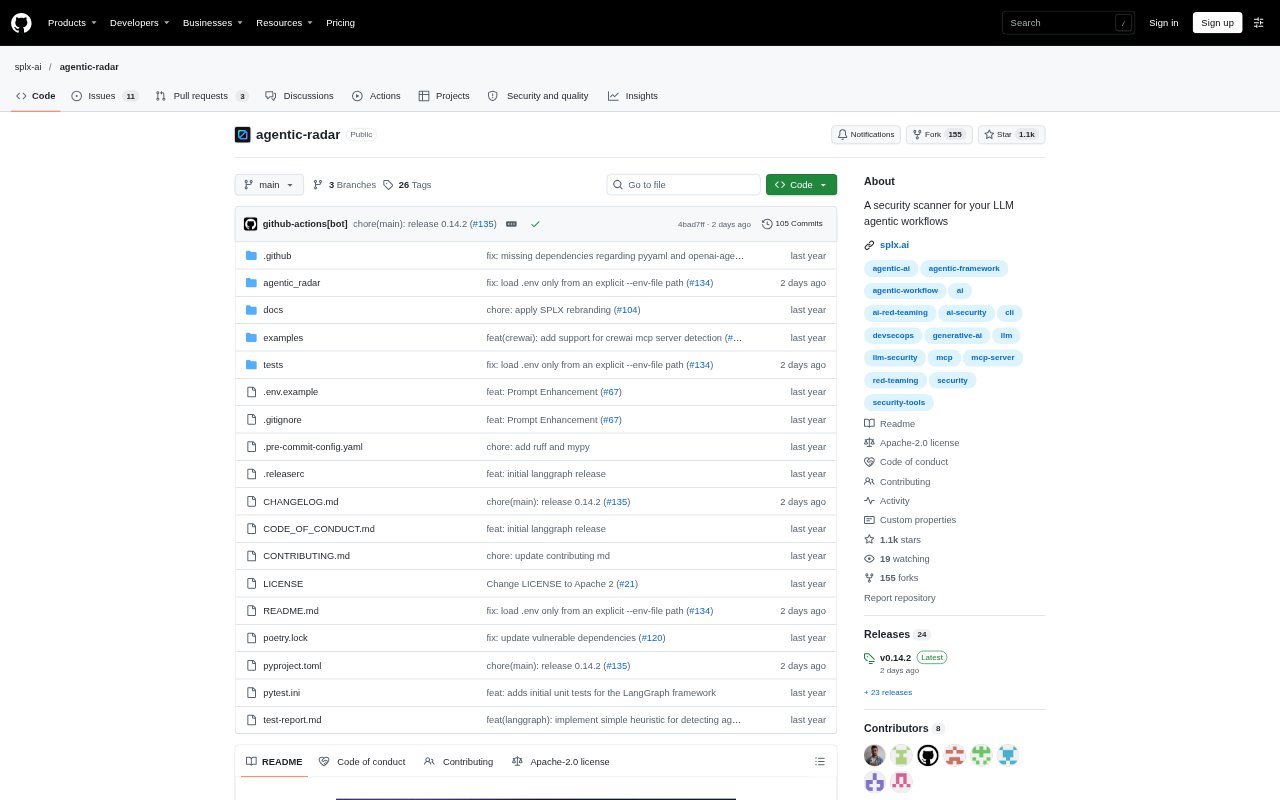
Agentic Radar is a command-line security scanner for agentic workflows, aimed at developers, researchers, and security professionals. It scans code for agent structures and produces an HTML report covering workflow design, tools, MCP servers, and mapped vulnerabilities. The tool also offers prompt hardening and runtime vulnerability tests for supported frameworks. It can be used locally and includes an example GitHub Actions workflow for running scans when repository changes are pushed.
Agentic Radar Features:
Workflow Scanning: Scan code for agentic workflows built with LangGraph, CrewAI, n8n, OpenAI Agents, or AutoGen.
Workflow Visualization: Generate a graph of the agentic system’s workflow as part of a comprehensive HTML report.
Tool and MCP Detection: Identify external and custom tools used by a system, along with MCP servers used by its agents.
Vulnerability Mapping: Connect identified tools to known vulnerabilities and map findings to OWASP LLM and agentic AI security resources.
Prompt Hardening: Improve detected system prompts and include hardened versions in the report for OpenAI Agents, CrewAI, and AutoGen.
Runtime Security Tests: Test OpenAI Agents workflows with simulated adversarial inputs for prompt injection, PII leakage, harmful content, and fake news generation.
Agentic Radar Benefits:
Faster Security Reviews: A consolidated report gives developers and security reviewers a shared place to inspect workflow structure and security findings.
Clearer Risk Picture: Seeing agent workflows, connected tools, MCP servers, and mapped vulnerabilities together can make potential exposure easier to assess.
Actionable Findings: Readable reports and terminal test results help teams understand what was checked and where a workflow may need attention.
Earlier Issue Discovery: Scanning code during development or through a repository workflow can surface security concerns before changes move further along.
More Consistent Checks: Default and configurable adversarial tests give teams a repeatable way to examine agent behavior against selected attack scenarios.
Use Cases:
Reviewing Agent Code: A developer can scan a LangGraph, CrewAI, n8n, OpenAI Agents, or AutoGen project before sharing it for a security review.
Checking Tool Exposure: A security professional can use the report to review which external tools, custom tools, and MCP servers an agent workflow uses.
Testing Agent Defenses: A team building with OpenAI Agents can run adversarial tests to check for prompt injection, PII leakage, harmful content, or fake news.
Hardening System Prompts: A developer can inspect improved system prompts for a supported OpenAI Agents, CrewAI, or AutoGen workflow.
Scanning Repository Changes: A team can adapt the provided GitHub Actions example to run scans when code changes are pushed and save the report as a workflow artifact.