

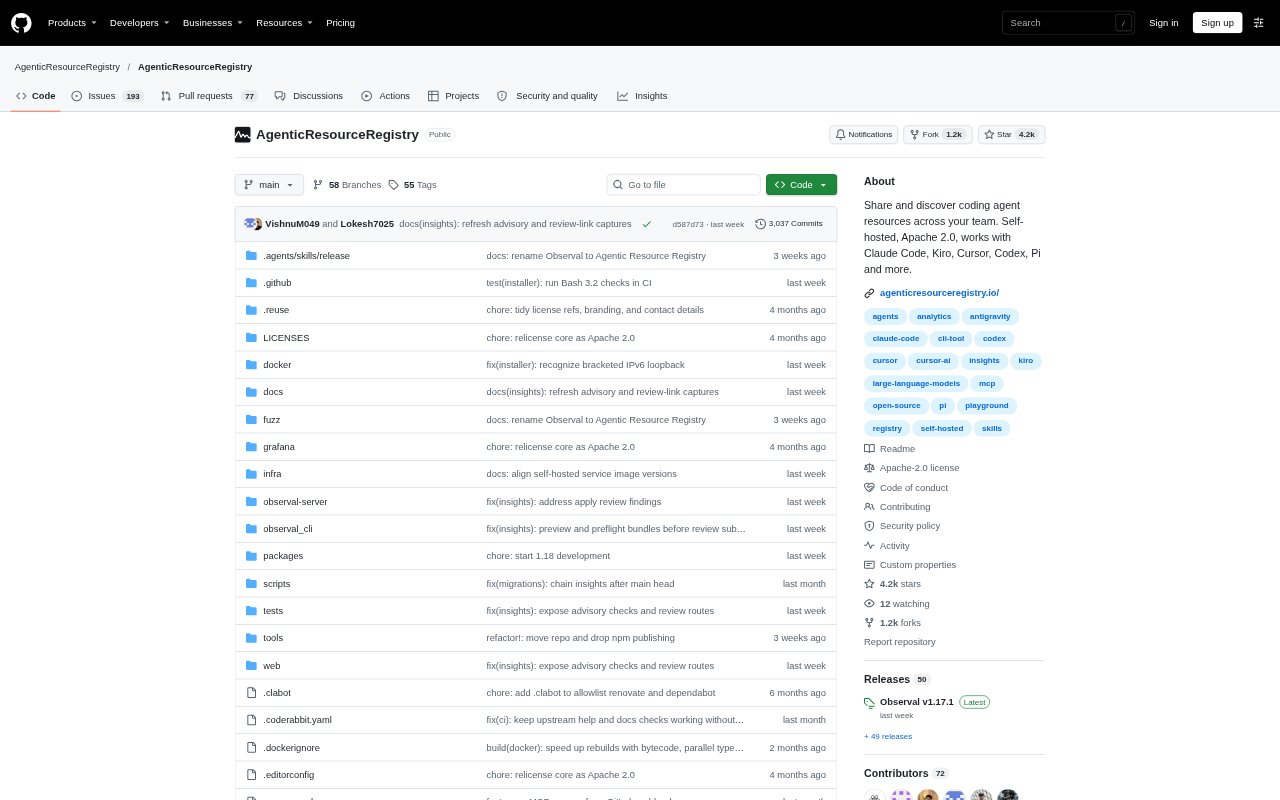
What is Agentic Resource Registry?
Agentic Resource Registry is a self-hosted registry for the resources teams build and use with coding agents. It brings skills, MCP servers, hooks, prompts, sandboxes and agent definitions into a shared, versioned place, with review and discovery tools for internal use. Teams can install approved agents across supported coding tools, while session traces and reports provide feedback on how those agents perform. It is designed for organizations working across multiple coding-agent harnesses that want to share and improve their internal resources.
Agentic Resource Registry Features:
Resource Registry: Store skills, MCP servers, hooks, prompts and sandboxes in one registry, and bundle resources into agent definitions.
Teamspaces and Review: Give teams separate namespaces, keep resources private or make them public after review, and inspect versions before approval.
Harness Configuration: Generate each supported coding tool’s configuration from a shared agent definition, so teams can install the agent in different harnesses.
ARD Discovery: Let ARD clients search the registry by describing a task, rather than needing to know the name of a resource in advance.
Session Traces: Capture structured sessions from supported harnesses, including prompts, tool calls, MCP round trips, token use and errors.
Agent Insights: Analyze real agent sessions to identify recurring problems and suggest prompt changes, which can be applied as a new version for review.
Self-Hosted Setup: Run the registry with Docker Compose on your own infrastructure, using PostgreSQL, ClickHouse and Redis for its data services.
Agentic Resource Registry Benefits:
Less Duplicate Work: A shared catalog helps teams find and reuse existing internal resources instead of separately rebuilding similar skills, agents or MCP setups.
Consistent Setup: Teams can maintain one agent definition for multiple coding tools, rather than keeping separate configuration instructions for each harness.
Safer Sharing: Review and version history give teams a way to check changes before making resources available for others to install.
Clearer Feedback: Session evidence and reports help resource authors see where agents struggle and make changes based on how they are actually used.
Data Control: Self-hosting keeps registry components, sessions and traces on the organization’s own infrastructure.
Use Cases:
Share Team Skills: Publish a code review skill or another recurring workflow so developers can discover and install an approved version instead of creating their own.
Manage MCP Resources: Keep the MCP servers used by different teams in a shared registry, with separate team namespaces and review before broader sharing.
Support Multiple Tools: Maintain an agent definition for a team that works across coding tools such as Claude Code, Cursor, Codex or Kiro.
Find Task Resources: Use an ARD client to ask what resources are available for a task when the user does not know the package or agent name.
Improve an Agent: Review session traces to investigate recurring errors or weak results, then revise the agent’s prompts and submit the changes for review.