
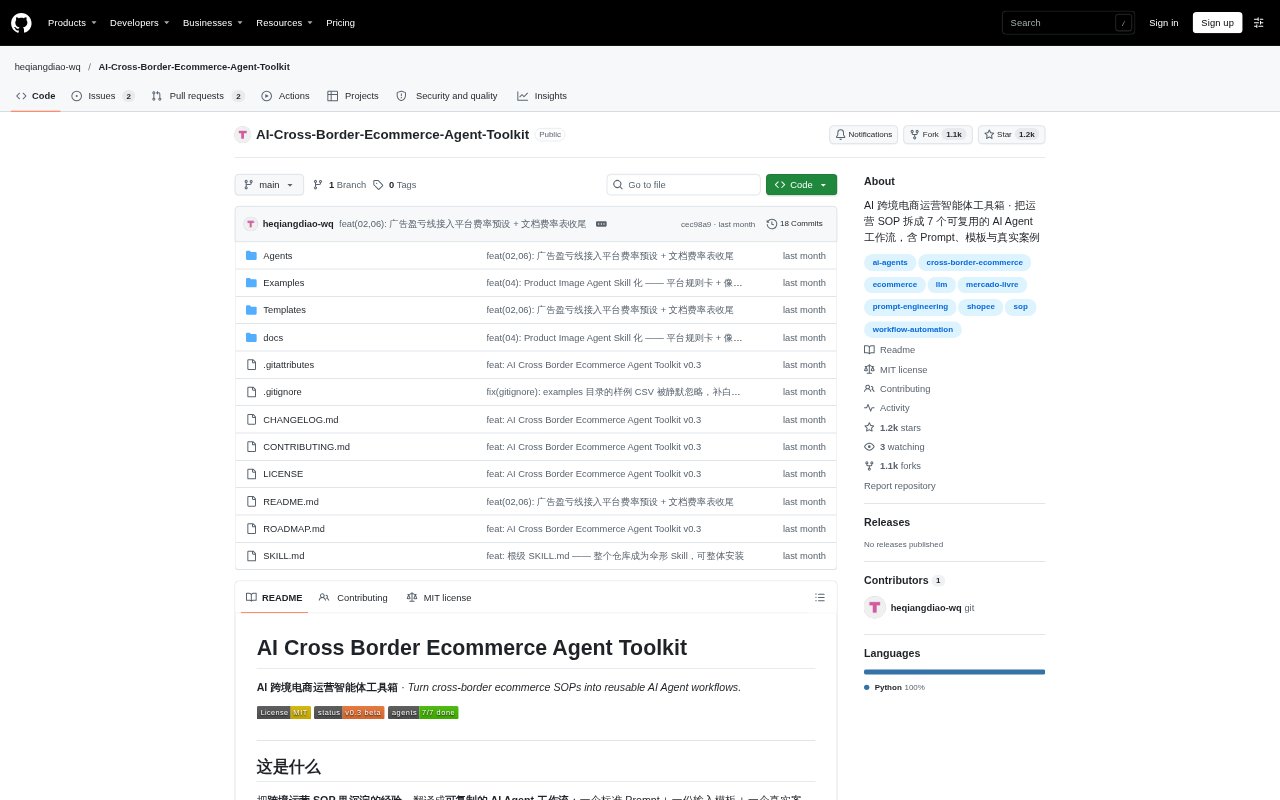
What is AI Cross-Border Ecommerce Agent Toolkit?
AI Cross-Border Ecommerce Agent Toolkit is a repository of reusable prompts, input templates, scripts and worked examples that turn ecommerce operating procedures into AI-assisted workflows. Its seven modules span market research and product strategy, listing and creative production, advertising diagnostics and review analysis, with a process for feeding findings back into listing and image revisions. It is a hands-on toolkit rather than hosted software, intended for cross-border sellers and operators who can provide product or marketplace data and run the prompts in an LLM.
AI Cross-Border Ecommerce Agent Toolkit Features:
Market Metrics: The market research workflow includes scripts for parsing data and calculating measures such as concentration, price bands and product configuration combinations.
Product Pricing: Product strategy materials model net margin, break-even and target prices, coupon room and four distinct SKU roles.
Listing Validation: Listing tools classify keywords and draft titles and descriptions, with checks for character limits, restricted terms and source-backed specifications.
Creative Planning: Image and video workflows plan a nine-image set, create image prompts, and prepare video scripts, storyboards, voice and subtitles.
Ad Diagnostics: Advertising tools diagnose four funnel types and calculate break-even lines, allowable CPC and priority-ranked actions.
Review Analysis: Review analysis groups feedback into eight attribution categories and identifies misunderstandings, with recommendations that can feed listing revisions.
Platform Guidance: Output references cover Shopee and Mercado Livre, with adapted fields for Amazon, TikTok Shop and Shopify.
AI Cross-Border Ecommerce Agent Toolkit Benefits:
More Consistent Work: Structured inputs, prompts and checks help teams apply the same operating criteria across products and tasks.
Fewer Unsupported Claims: Required product information and specification checks help reduce the risk of publishing details that cannot be substantiated.
Clearer Decisions: Calculated market and pricing measures give operators concrete inputs for choosing products, positioning and prices.
Less Rework: Advertising and review findings can guide focused revisions instead of leaving teams to guess what needs improvement.
Reusable Know-How: Documented workflows make operating procedures easier to reuse than relying on individual team members to remember each step.
Use Cases:
Assess a Category: Use category data to examine price bands, market concentration and product configurations before deciding whether to pursue an opportunity.
Plan a Product Launch: Develop a product position, select SKU roles and calculate pricing inputs before preparing marketplace materials.
Prepare Listing Assets: Create and check a listing, image plan and short-video brief for a new product launch.
Review Ad Results: Diagnose marketplace advertising data, compare performance with break-even measures and prioritize follow-up actions.
Improve Existing Listings: Analyze customer reviews and campaign results, then use the findings to revise listing copy or image content.