

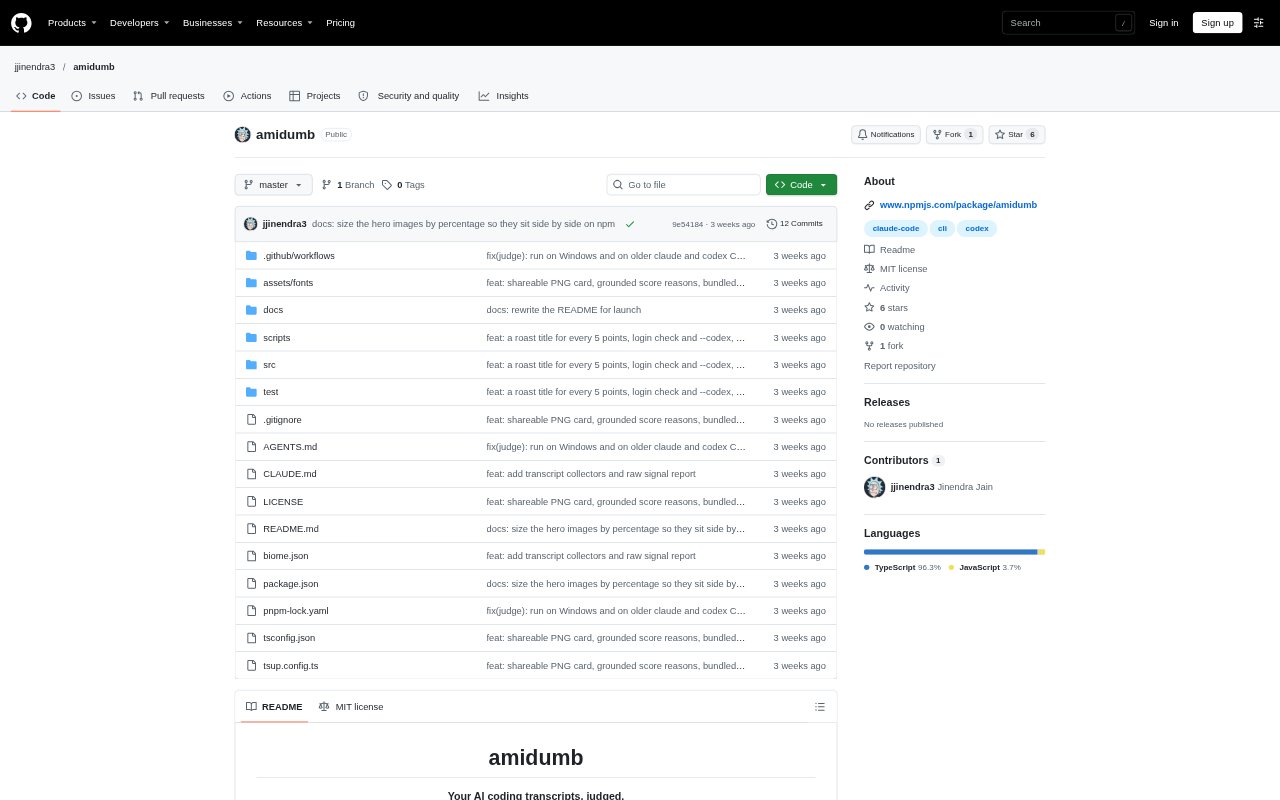
What is Amidumb?
Amidumb is a command-line tool that reviews local Claude Code and Codex transcripts to assess how a person directs coding agents. It calculates a score from 0 to 100 using a fixed rubric, then adds a title, an AI-written roast, and a shareable image card. It is for developers who want to reflect on their prompting and agent workflows; the scoring runs on their machine, without an account or API key.
Amidumb Features:
Direction Score: A versioned local rubric scores specification, steering, verification, discipline, and leverage, with an overall result from 0 to 100.
Session Analysis: The tool reads Claude Code and Codex histories, classifies prompts in the context of the agent's preceding message, and can limit analysis by date.
Score Breakdown: Five sub-scores show how specific instructions, steering, checks, prompt discipline, and workflow setup contribute to the result.
Roast and Reasons: A connected Claude or Codex CLI writes a one-line verdict and three score explanations that must cite prompts found in the history.
Shareable Scorecard: Amidumb saves a 1080-by-1350 PNG with the score, title, sub-scores, reasons, rage meter, and secret-leak count.
Privacy Controls: The score is computed locally, while dry-run previews the roast sample and no-roast produces results without sending anything for a roast.
Amidumb Benefits:
Targeted Reflection: Separate scores make it easier to see whether improvement should focus on clearer requests, better checks, or more deliberate follow-up.
Consistent Comparison: Because the same transcripts use a fixed rubric, rerunning the analysis does not change the score just because an AI judge phrased its opinion differently.
Local Scoring: Keeping score calculation on the machine lets developers review their habits without uploading their full coding history for scoring.
Safer Roast Review: Prompt truncation and secret redaction reduce what is shared with the connected CLI, and users can inspect the exact sample before sending.
Actionable Habits: Suggested rules can be pasted into CLAUDE.md or AGENTS.md, giving users a practical way to carry lessons into later sessions.
Use Cases:
Prompting Self-Review: A developer can examine whether their requests specify files, constraints, and completion criteria or rely on vague instructions.
Agent Workflow Audit: A developer using Claude Code or Codex can check whether they steer after plans, verify code changes, and avoid repeated bare retries.
History Check: Someone reviewing a recent period of coding can use the date window to score only sessions from the last month or another chosen span.
Team Habit Discussion: A developer can bring the generated scorecard to a peer discussion about how they direct coding agents, without putting prompt text on the card.
Workflow Rule Updates: After spotting recurring weaknesses, a developer can turn the suggested habits into instructions for future Claude Code or Codex work.