
What is Architect Training?
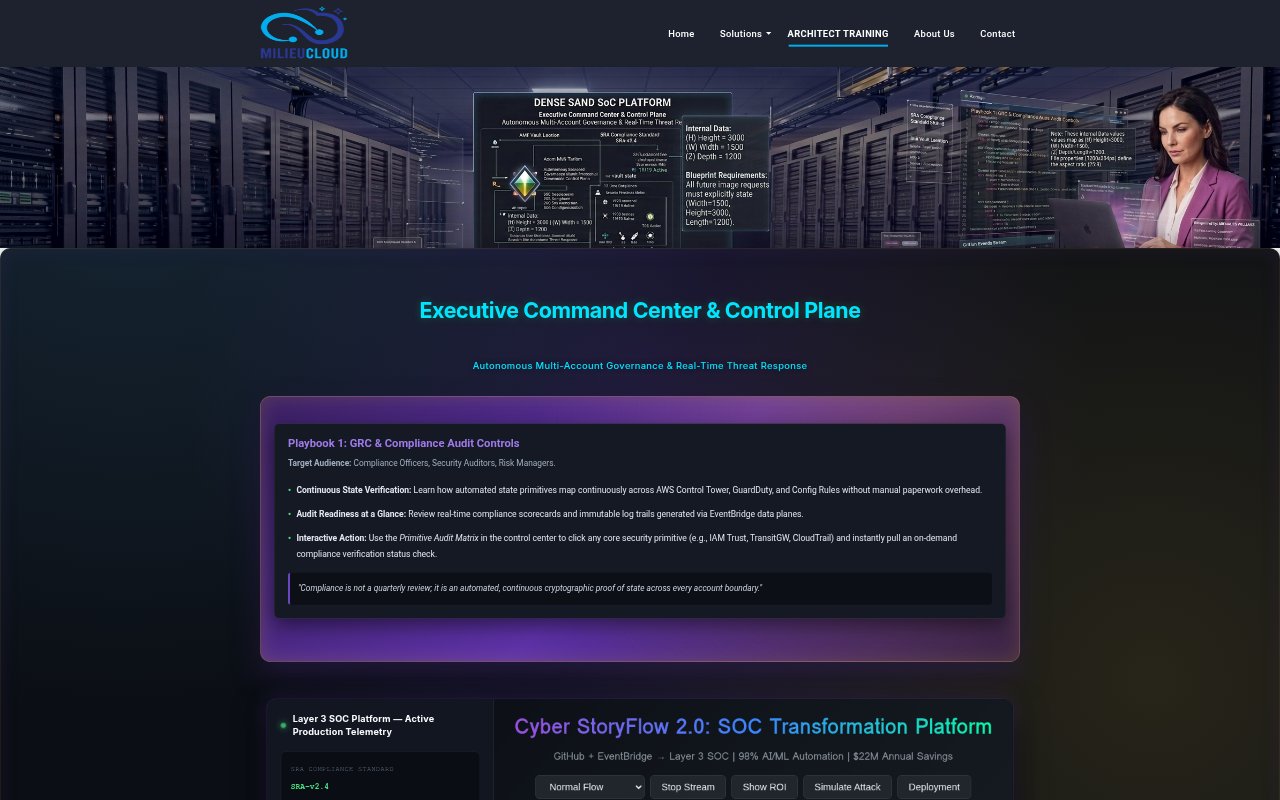
Architect Training is a set of guided playbooks for people working with AWS multi-account environments, including compliance officers, cloud engineers, security teams, and enterprise buyers. It uses a command center to demonstrate governance checks, telemetry flows, incident remediation, and procurement-related metrics. The training includes interactive actions, such as checking a security primitive’s compliance status and simulating an attack to observe isolation and recovery.
Architect Training Features:
Compliance Playbook: The GRC playbook covers continuous verification across AWS Control Tower, GuardDuty, and Config Rules, alongside compliance scorecards and immutable log trails.
Primitive Audit Checks: In the control center, learners can select security primitives such as IAM Trust, TransitGW, or CloudTrail to view an on-demand compliance status check.
Telemetry Pipelines: The incident-remediation playbook follows telemetry from multi-region infrastructure nodes into automated threat-response buffers.
Drift Remediation: Training explains how the backend heal.py actuators detect configuration drift and run automated remediation workflows.
Attack Simulation: A simulated unauthorized role elevation lets learners observe the AI SOC isolating a node and the heal.py sequence restoring it to nominal status.
Executive Runbook: A procurement-focused playbook covers AWS Marketplace ResolveCustomer API token synchronization, secure vault bounding, and a command-center ROI display.
Architect Training Benefits:
Less Manual Auditing: Continuous verification and on-demand checks can reduce the paperwork involved in reviewing security controls and preparing for audits.
Clearer Compliance Status: Scorecards, log trails, and primitive-level checks give teams a more direct view of their control status than manual review alone.
Faster Incident Learning: A guided attack simulation helps technical teams see how isolation and restoration fit together before they need to assess a real incident.
More Consistent Recovery: Understanding automated drift correction helps operators assess how infrastructure can return to its intended state after a change.
Stronger Business Case: The executive runbook gives buyers a way to review operational efficiency and architectural return when discussing procurement with stakeholders.
Use Cases:
Audit Preparation: Compliance officers and auditors can use the playbook to review security primitive status, compliance scorecards, and the associated log trails.
Incident Response Training: SOC analysts can simulate unauthorized role elevation and follow the sequence from node isolation through automated restoration.
Cloud Operations: Cloud engineers and SREs can learn how multi-region telemetry reaches response buffers and how automated workflows correct state drift.
Executive Reviews: CTOs, enterprise buyers, and financial stakeholders can use the runbook to examine procurement mechanics and present ROI metrics.
AWS Architecture Planning: Teams aligning an AWS organization with the Well-Architected Framework can review landing-zone prerequisites, IAM trust, telemetry, and event ingestion.