

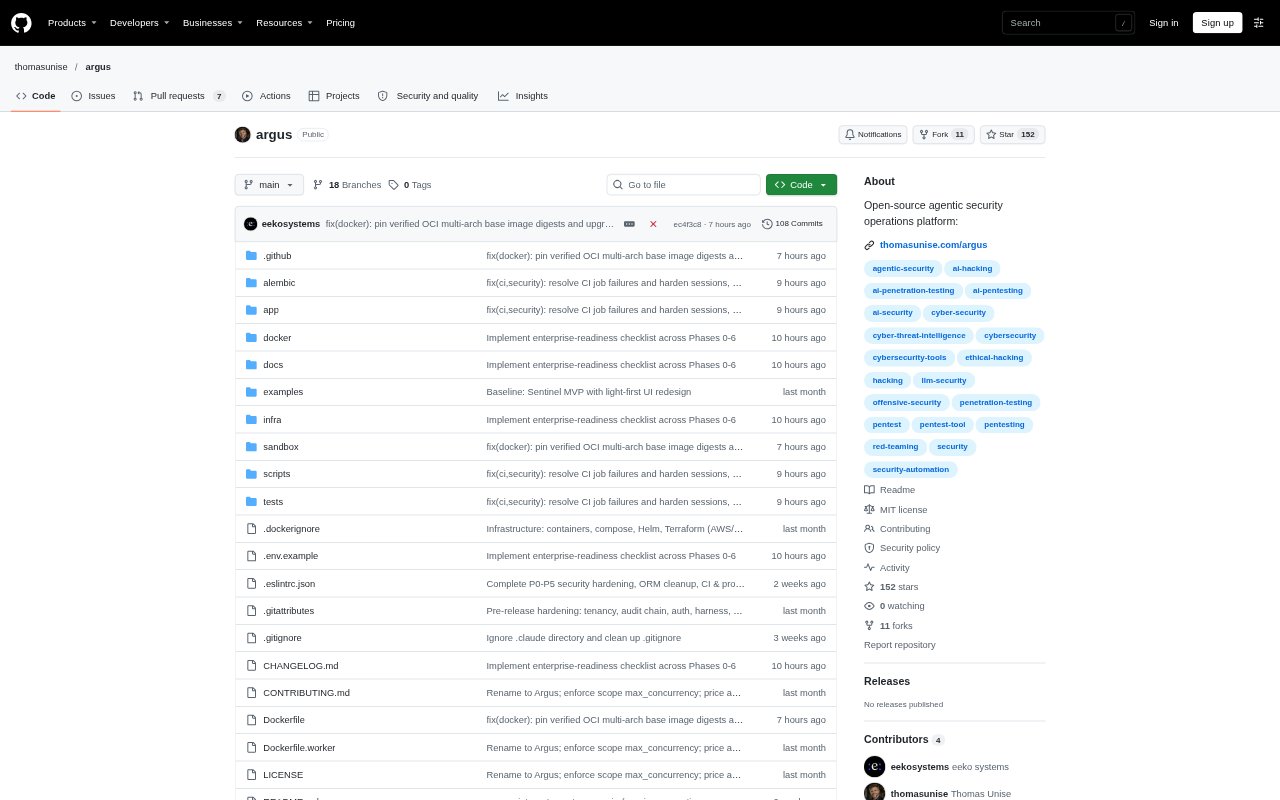
What is Argus?
Argus is a self-hosted, open-source security operations platform for organizations that want to connect cloud, identity, code, endpoint, network and Kubernetes security data. It builds an evidence graph, detects threats and uses AI agents to investigate incidents; response actions pass through a policy-controlled broker rather than being executed directly by agents. Teams can also govern company AI use through an AI gateway and shadow-AI discovery. Argus is MIT licensed and can be deployed with Docker Compose, Helm or Terraform.
Argus Features:
Evidence Graph: Argus maps assets and security events across cloud, identity, code, devices, network and Kubernetes into a graph with attack paths and exposure scoring.
AI Investigation: Nine specialist agents triage, investigate and hunt using read-only tools, then can propose actions for review.
Action Broker: A broker checks actions against policy and supports approvals, dry runs, rollback and a kill switch; response playbooks can start in shadow mode.
AI Gateway: The gateway routes OpenAI and Anthropic traffic through company-held keys, model allowlists, data-loss prevention rules, budgets and usage logging.
Shadow AI Discovery: Argus finds AI services in network, cloud and SSO telemetry, maintains an inventory and can flag services that have not been reviewed.
Attack Simulation: An isolated sandbox replays eight AI-driven attack scenarios, with optional evasion variants, and reports which detections catch them.
Security Integrations: Collectors ingest data from cloud, identity, endpoint and network sources, while outbound alerts can go to Slack, Jira, ServiceNow, PagerDuty, email or webhooks.
Argus Benefits:
Faster Investigations: Related evidence from multiple parts of an environment is easier to review together, helping security teams build incident context without piecing together separate feeds.
Controlled Response: Teams can introduce automated response gradually, review proposed changes and keep a way to reverse actions that should not remain in place.
Safer AI Use: Company-held provider keys and usage controls give organizations a clearer way to oversee employee use of supported AI models.
Visible AI Exposure: An inventory of unreviewed AI services helps teams identify where company AI use may need attention before setting or updating internal policies.
Data Ownership: Self-hosting keeps the platform and its security data in the organization’s infrastructure, rather than handing that data to a hosted security service.
Use Cases:
Cloud Incident Response: Investigate suspicious cloud or identity activity and use a policy-checked playbook to propose or carry out a reversible response.
Endpoint Containment: Respond to a compromised laptop by initiating containment through CrowdStrike or SentinelOne, with approvals, dry runs and rollback available.
AI Policy Oversight: Review which AI services employees use and route supported OpenAI or Anthropic traffic through company-managed keys and controls.
Detection Readiness: Run the attack simulator to check whether current detection rules catch AI-driven attack scenarios before relying on them in an incident.
Authorized Security Testing: Run scoped security tests against approved assets, then use the findings to prioritize vulnerabilities and plan follow-up work.