
What is Artificial Analysis?
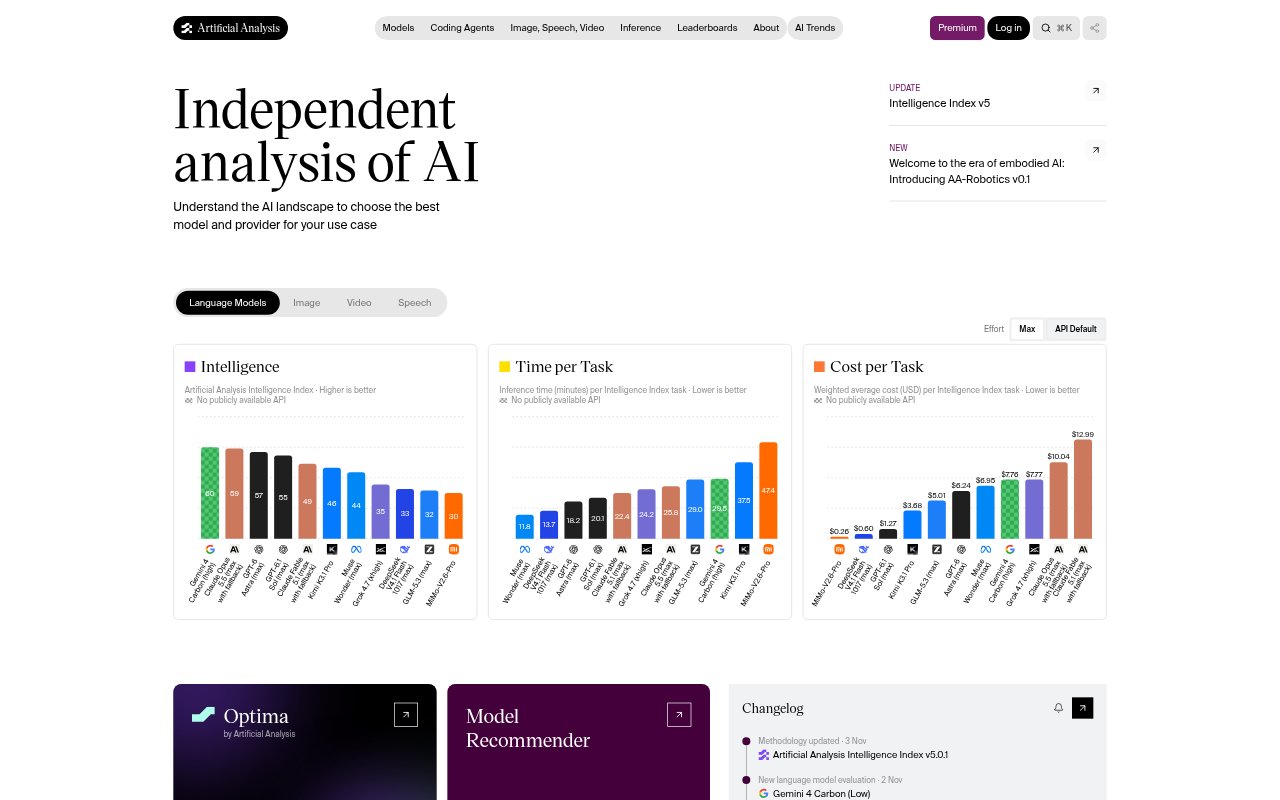
Artificial Analysis is a benchmarking and analysis platform for AI models and API providers. It compares performance across measures such as intelligence, quality, price, speed, latency, and time per task, with evaluations covering language and agent capabilities as well as image, speech, and video models. Founders, developers, and business teams can use its leaderboards, data tools, and recommendations to assess options and make decisions about AI models, providers, and deployment.
Artificial Analysis Features:
Model Benchmarks: Independent evaluations compare language models on intelligence, quality, cost per task, speed, and specialized capabilities such as coding, reasoning, and business operations.
Provider Comparisons: Provider data compares API hosting options on speed, latency, price, and endpoint accuracy for individual models.
Media Leaderboards: Leaderboards cover image, video, and speech models, with comparisons for tasks including text-to-image, image editing, text-to-video, and speech-to-text.
Custom Benchmarking: Optima lets users build custom benchmarks, while the Data Playground and Table Builder support creating tables and charts from available data.
Model Recommender: The recommender provides personalized model suggestions based on priorities across intelligence, speed, and cost.
Data and Reports: Users can access benchmark data through an API, export it for local analysis, and consult reports and guides on AI.
Artificial Analysis Benefits:
Quicker Shortlisting: Comparing models and providers across shared measures can help teams narrow a crowded field before spending time on individual trials.
Cost Awareness: Task-level cost and provider pricing comparisons help teams weigh likely expense alongside model quality and response speed.
Less Manual Research: Consolidated leaderboards and benchmark data reduce the need to gather performance details from separate model and provider sources.
Clearer Tradeoffs: Seeing intelligence, speed, latency, and price together helps decision-makers understand what they may gain or give up with each option.
Reusable Analysis: Exportable data, charts, and reports make it easier to share findings and revisit model choices as needs change.
Use Cases:
Choosing an LLM: A product team comparing language models can use intelligence, cost, and speed results to shortlist candidates for a new AI feature.
Selecting an API Provider: A developer deciding where to host a model can compare providers on latency, price, speed, and endpoint accuracy.
Evaluating Media Models: A marketing team exploring image or video generation can compare model quality and price across relevant media leaderboards.
Planning AI Agents: A team building an agent can review coding, business operations, or other agentic evaluations when assessing model capabilities.
Preparing AI Research: An analyst preparing an internal AI assessment can export benchmark data, build charts, and draw on industry reports and guides.