
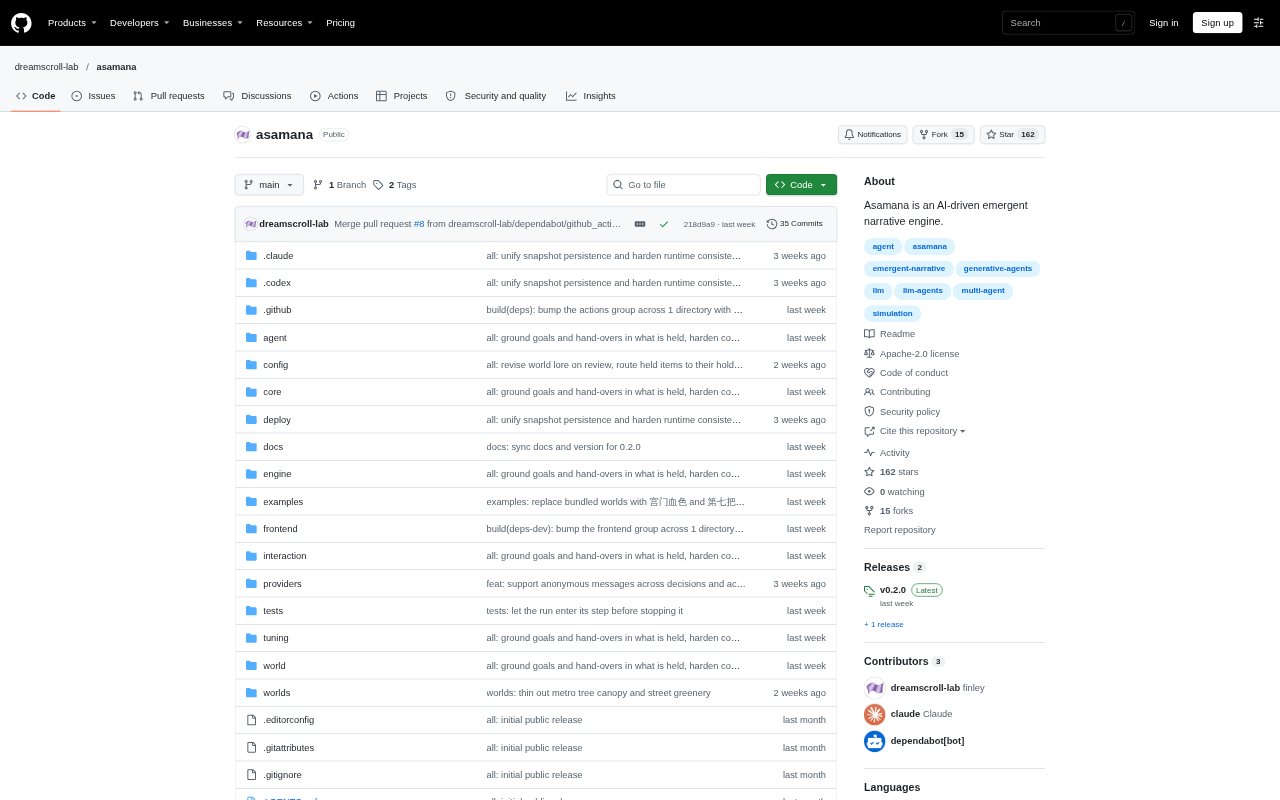
What is Asamana?
Asamana is a self-hosted engine for creating and exploring stories that emerge from interactions among AI characters, rather than from a fixed script. Give it a theme and it builds a shared world with characters that have distinct personas, memories, emotions, needs and goals. Creators can watch the world from a director view or step into it as one character. The project is in early development, and generated prompts and narratives are currently in Chinese.
Asamana Features:
Theme-Based Worlds: Enter a theme to generate a bounded setting and cast, with the story developing through character interactions instead of a predefined plot.
Character Cognition: Characters have personalities, values, emotions, needs, goals, relationships and memories, and can reason, decide and act.
Staged Decision Pipeline: Character cognition runs through perception, motivation, decision, action and feedback stages, with structured outputs passed between them.
Director Mode: View characters’ inner lives, their outward actions and world events, then intervene to steer what happens.
Actor Mode: Take the role of any character and explore the AI world from their perspective, influencing the story from inside.
World Map and Replay: Use a 2D map to view a world and revisit completed stories, including example worlds supplied with the project.
Model Routing: Connect an OpenAI-compatible endpoint and route different scenes to different models without changing code.
Asamana Benefits:
Stories Without Scripts: Creators can explore unexpected character choices and conflicts instead of writing every scene and plot turn in advance.
More Consistent Characters: Giving each character a shared context of goals, relationships and memories helps their decisions stay grounded in their situation.
Control From Two Views: Switching between observing the whole world and inhabiting one character lets users choose how closely to shape or experience a story.
Review Without API Keys: Existing worlds can be browsed and replayed without configuring model access, making it possible to inspect the experience before creating a world.
Use Cases:
Interactive Fiction: Create a themed fictional world and follow how its characters generate dialogue, decisions and plot developments over time.
In-Character Exploration: Play one character in an unfamiliar world and discover its events through that character’s limited perspective.
Narrative Prototyping: Test how a cast with different goals and relationships might generate conflict and story moments around a single theme.
Agent Behavior Review: Inspect character reasoning, actions and memories across a run to understand how the simulated world and its narrative unfold.
Story Replay: Browse completed example worlds, follow their characters and relationships, and review the resulting narrative without starting a new run.