
What is Bifrost?
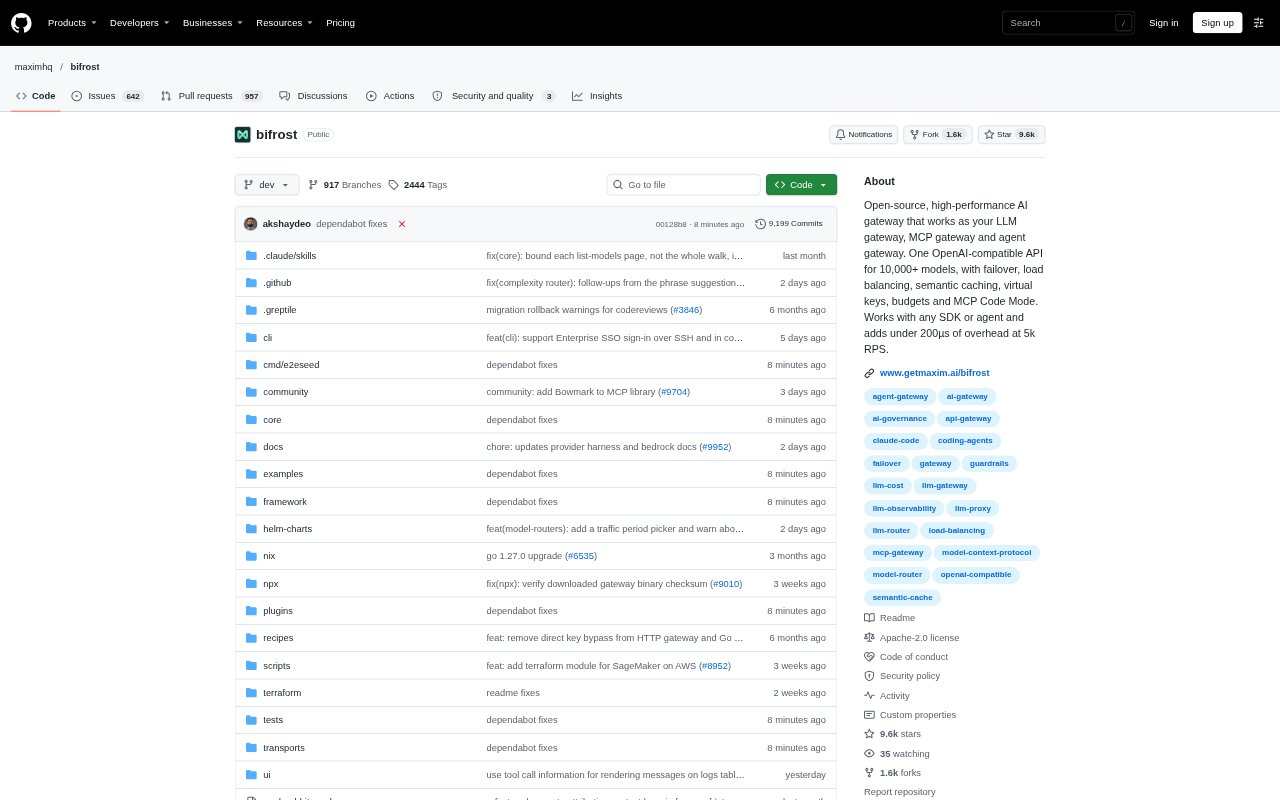
Bifrost is an AI gateway that gives applications one OpenAI-compatible API for sending requests to models from multiple providers. Developers can use it as an HTTP service or integrate its Go SDK, and teams can add routing, usage controls, and monitoring around their AI workloads. It also provides an MCP gateway for connecting AI applications to external tools. Bifrost is aimed at developers and organizations building or operating AI applications, from self-managed setups to enterprise deployments.
Bifrost Features:
Unified Model API: Send requests to models from multiple providers through one OpenAI-compatible API, with support for popular AI SDKs.
Fallback Routing: Configure routing rules, automatic fallbacks, and load balancing across providers, models, and API keys.
MCP Gateway: Connect to MCP tool servers, execute tools, and manage tool access through a centralized gateway.
Usage Controls: Set budgets, rate limits, permissions, and routing rules for virtual keys, teams, and customers.
Request Monitoring: Inspect AI requests through a built-in dashboard, with OpenTelemetry, Prometheus metrics, and request logging.
Semantic Caching: Cache responses to semantically similar queries to reduce repeated inference requests and their associated latency and cost.
Bifrost Benefits:
Simpler Model Changes: A consistent API lets teams switch models or providers without rebuilding the application’s provider-specific request path.
More Resilient Apps: Fallbacks and traffic distribution help applications continue handling requests when a provider or key has problems.
Clearer Cost Ownership: Budgets and usage controls help teams see and manage AI consumption across projects and customers.
Faster Troubleshooting: Request logs, metrics, and traces give operators information to investigate errors and performance issues.
Less Repeated Work: Semantic caching can avoid sending new inference requests for queries with similar meaning, reducing latency and spend.
Use Cases:
Provider Migration: Move an existing application to Bifrost by changing its API endpoint instead of replacing its SDK integration.
Multi-Provider Apps: Route requests for a production application across model providers and configure alternate routes for failures.
Tool-Using Agents: Connect an AI agent to MCP tools such as databases or web search while managing access through a gateway.
Team Cost Limits: Set separate budgets and permissions for virtual keys used by different teams, projects, or customers.
AI Request Support: Review request logs and telemetry when investigating a model error, latency problem, or unexpected usage.