

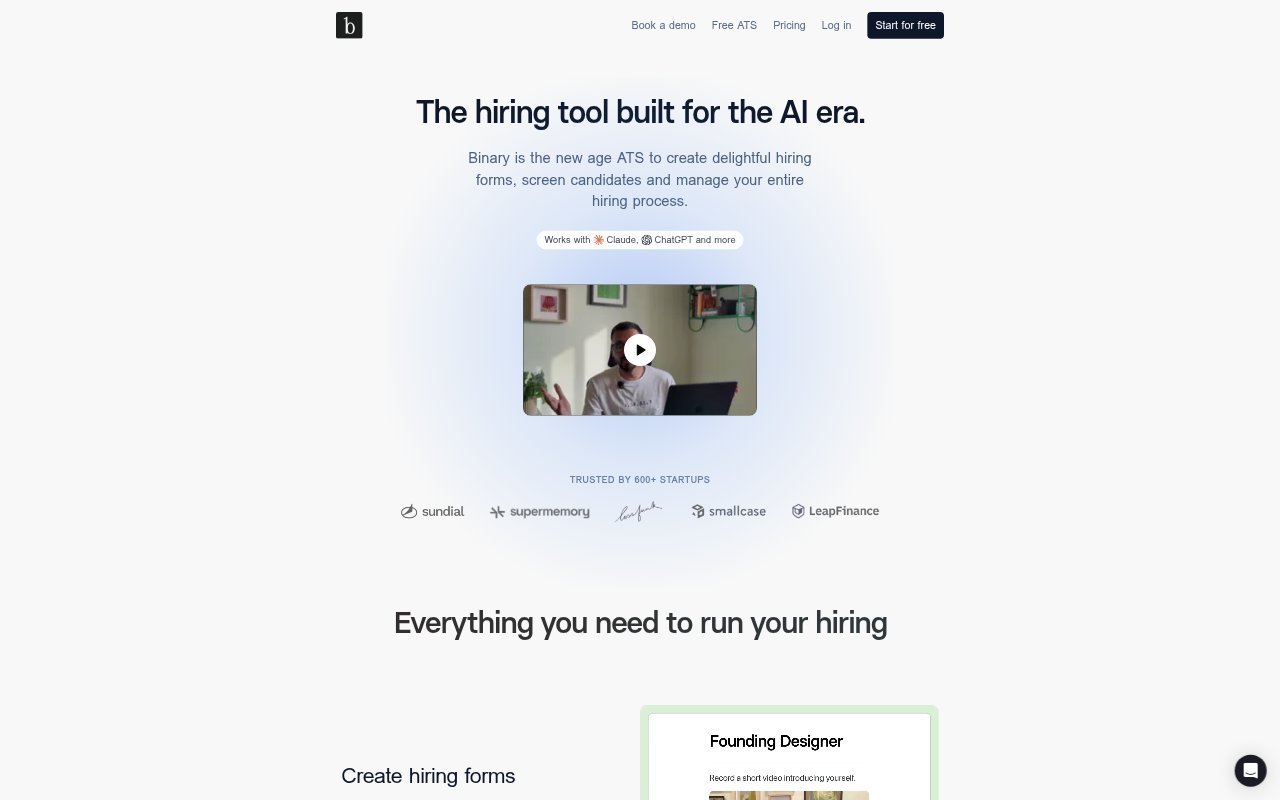
What is Binary?
Binary is an applicant tracking system for startups that brings job applications, candidate screening and hiring workflows into one place. Teams can create application forms, attract candidates, track their progress and coordinate interviews. Its AI tools review candidates against criteria set by the hiring team, and screening can be run in Binary or through connected AI agents.
Binary Features:
Hiring Forms: Create application forms with video questions and widgets to collect candidate information in a format suited to each role.
Candidate Sourcing: Promote roles on job boards, publish a careers page or find candidates through Binary’s Chrome extension.
AI Candidate Screening: Set criteria in plain English and have AI review resumes, video answers and assignments, returning scores with criterion-by-criterion reasoning.
Hiring Pipeline: Track where candidates are in the hiring funnel and view screening results as filterable columns in the dashboard.
Interview Coordination: View interviewer calendars, send booking links and collect interview feedback within the hiring workflow.
AI Agent Access: Screen candidates from Binary’s dashboard or Slack, or connect its MCP server to tools including Claude, ChatGPT, Codex, Grok and Cursor.
Team and Plan Limits: Every plan supports unlimited team members, jobs and candidates, and the free plan also includes unlimited hiring forms.
Binary Benefits:
Faster Candidate Review: Batch screening helps teams assess large applicant pools quickly, with Binary stating that hundreds of candidates can be screened in under 60 seconds.
Clearer Hiring Decisions: Scores accompanied by reasoning for each criterion give hiring teams more context than a ranking number alone.
Consistent Evaluation: Applying criteria chosen by the team helps keep candidate comparisons tied to the requirements for the role.
Predictable Team Costs: Unlimited team members on every plan mean adding hiring collaborators does not add a per-user charge.
Shared Candidate Context: Keeping candidate stages and screening results in a common workspace gives hiring teams a shared view of progress.
Use Cases:
Startup Hiring: A startup can publish roles, collect applications and manage its candidate pipeline without setting up separate tools for each step.
High-Volume Screening: A team receiving many applications can screen a full pipeline against role-specific criteria and identify candidates for closer review.
Role-Based Evaluation: Hiring managers can create or adjust screening criteria for a job and reuse a saved rubric as an AI Skill.
Interview Scheduling: Recruiters coordinating interviews across several interviewers can check calendars, send booking links and gather feedback.
ATS Migration: Teams moving from another applicant tracking system can import existing candidate data or ask AI to connect through MCP.