

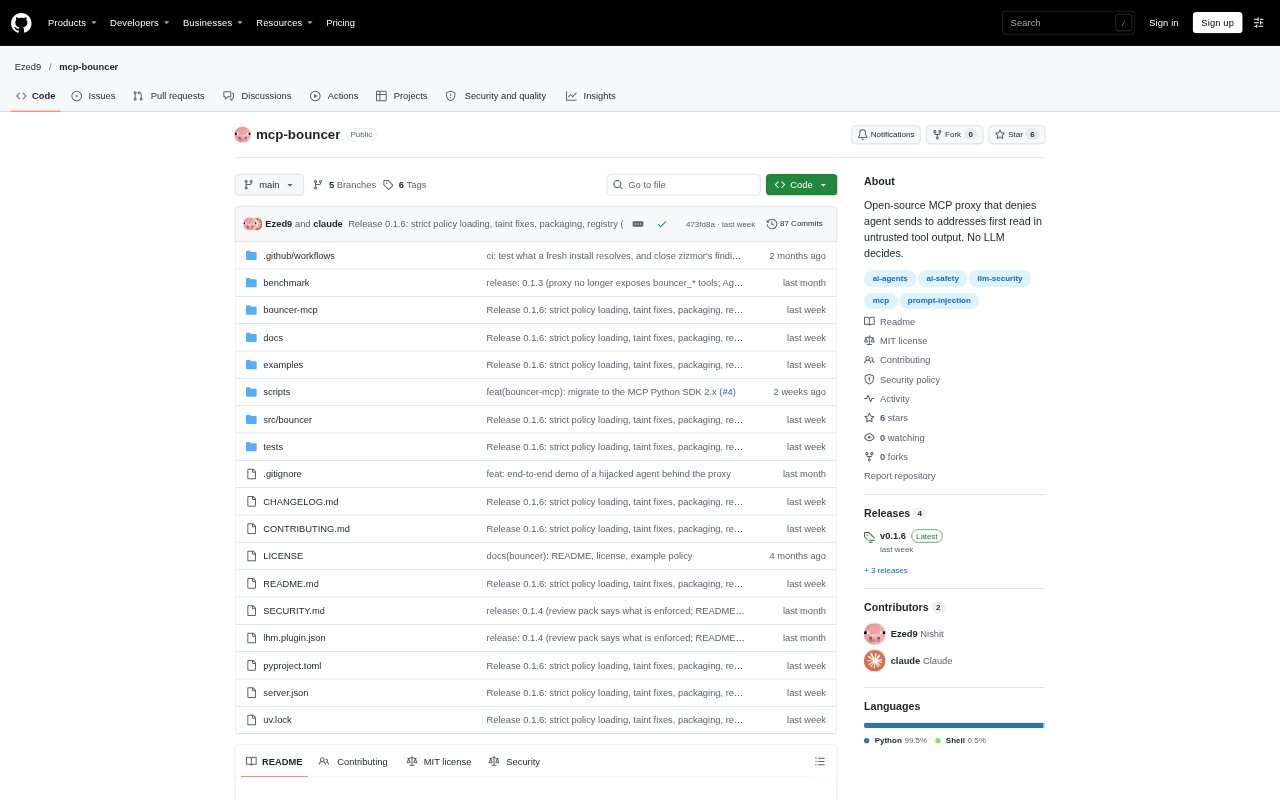
What is Bouncer?
Bouncer is a local proxy that checks MCP tool calls before forwarding them to a server, with a focus on preventing agents from sending data to destinations found in untrusted tool output. It also applies configurable limits to write tools and records each allow, deny, or human approval request. It is intended for people running agents with MCP tools that can send, share, write, or delete; it does not detect prompt injection and currently proxies local stdio servers on one machine.
Bouncer Features:
Destination Provenance: Bouncer records server output as untrusted and denies a later send or share when its destination appears in that output, using case- and whitespace-normalized literal matching.
Human Approval: A destination Bouncer cannot place goes to the client for MCP elicitation or, if the client cannot ask, is denied with a code for terminal approval.
Write Constraints: Policies can confine file paths, check arguments against regular expressions, and set per-session call budgets, while tools added after startup are refused.
YAML Policies: Users can define sending and writing rules, destination arguments, trusted destinations, allowed path prefixes, and call limits in YAML.
Audit Reports: Bouncer writes each allow, deny, and ask decision to a JSONL audit log, and can create a review pack with OWASP LLM Top 10 and AIUC-1 mappings.
Stdio Setup: The init command wraps local stdio servers in supported MCP client configurations and preserves the original server command, arguments, environment, and working directory.
Bouncer Benefits:
Fewer Unsafe Sends: A destination copied from a poisoned email, ticket, or document is less likely to become an unintended message or shared file.
Controlled Side Effects: Denied calls are not forwarded to the upstream server, reducing the chance that a blocked action changes files or other server data.
Predictable Decisions: Because enforcement uses deterministic rules rather than a model or classifier, the same call and history receive the same verdict.
Bounded Operations: Path restrictions and call budgets help keep mistakes or agent misuse within limits set for a session.
Reviewable Evidence: Recorded decisions and evidence-linked mappings give security reviewers a concrete basis for examining how calls were handled.
Use Cases:
Helpdesk Email: Put Bouncer between an agent and a helpdesk MCP server so an address copied from a customer ticket cannot silently become an email recipient.
Project File Writes: Set allowed path prefixes when an agent uses an MCP filesystem server to create project outputs, keeping writes within the chosen workspace.
Limited Deletions: Set a per-session call budget for a delete tool when an agent needs to remove records but should not repeat the operation without limit.
New Recipients: Require a person to approve an unfamiliar destination when an agent sends messages or shares files through an MCP server.
Local Client Setup: Wrap local stdio MCP servers used with clients such as Claude Code, Cursor, or Claude Desktop, then inspect the resulting decisions in a review pack.