

What is Brian2 Atlas?
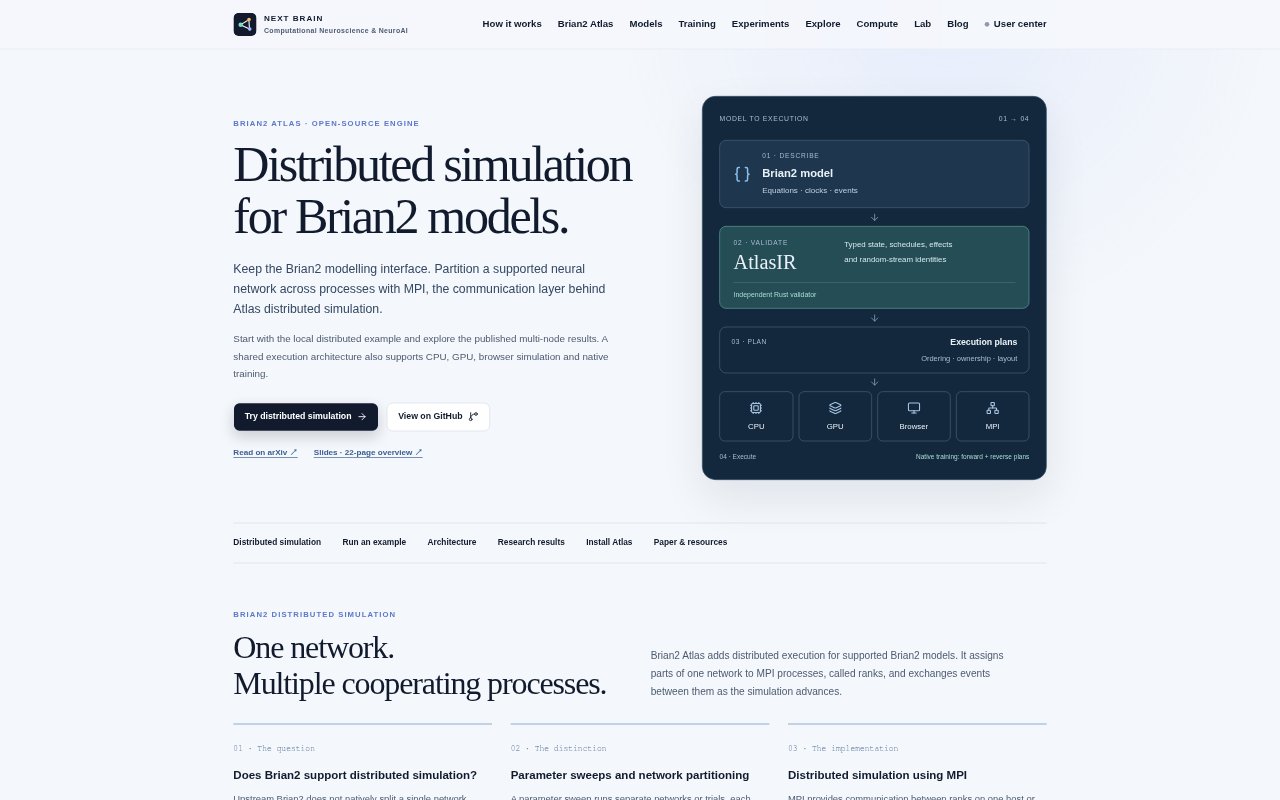
Brian2 Atlas is an open-source execution engine for supported Brian2 neural models. It keeps Brian2’s modelling interface and adds backends for local simulation, GPU and browser execution, native training, and MPI-based network partitioning. Researchers can install and run the engine on their own machine; Next Brain also offers supported Atlas models in an online workflow. Model features and hardware determine which execution paths are available, so it is aimed at computational neuroscience and NeuroAI work that fits those support boundaries.
Brian2 Atlas Features:
Brian2 Frontend: Define neurons, synapses, clocks and monitors using Brian2, then use Atlas execution backends for supported models.
MPI Partitioning: Assign parts of one supported network to MPI ranks and exchange events as the simulation advances.
AtlasIR Validation: Represent typed state, scheduling, effects and event identities explicitly, then validate the model before execution-plan transformations.
CPU and GPU: Run models with a reference CPU engine or compile a model-specialized native executable; supported Apple and NVIDIA GPU paths use float32.
Browser Export: Export a supported model bundle for execution in a browser worker.
Native Training: Use the bounded training extension’s forward and reverse execution plans with surrogate spike gradients.
Brian2 Atlas Benefits:
Familiar Modelling: Researchers can work from Brian2 model definitions rather than adopting a separate modelling interface for Atlas execution.
Inspectable Execution: Explicit model state and scheduling make execution choices easier to examine and validate before running a workload.
Local Experimentation: A source installation runs on a researcher’s own machine without requiring a Next Brain account.
Evidence Checking: The distributed example compares outputs against a reference and reports mismatches, helping researchers check that example runs agree.
Backend Choice: Researchers can select an execution path to match supported model features and available hardware instead of relying on one runtime.
Use Cases:
Local Model Test: Run the included single-neuron example on the reference CPU engine to check a local installation.
MPI Correctness Check: Use the CUBA example to compare one excitatory-inhibitory network across one, two and four MPI ranks on a single host.
Multi-Node Research: Reproduce the documented four-node neural simulation using the manuscript’s source versions and reproduction materials.
GPU Simulation: Execute a supported neural model on an Apple or NVIDIA GPU when its operations and platform toolchain match the documented path.
Browser Demonstration: Export a supported model bundle to run a neural simulation in a browser worker.
Spiking Network Training: Explore the digit-recognition training experiment through Next Brain’s Atlas CPU training workflow.