
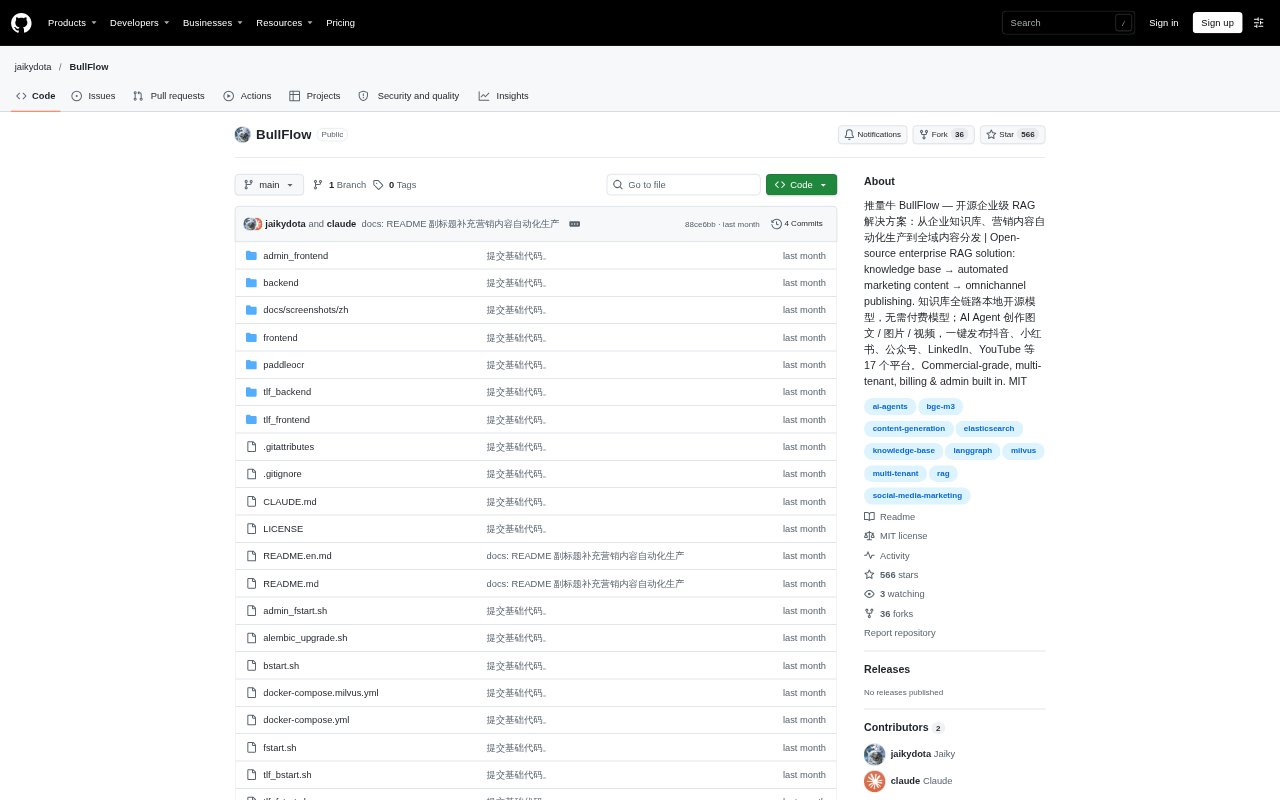
What is BullFlow?
BullFlow is an open-source, self-hosted platform for building a company knowledge base, creating marketing content with AI, and managing its distribution. It combines an AI writing agent, document and media search, content generation, publishing workflows, analytics, and an operations dashboard. It is aimed at businesses and agencies that want to create content from their own company materials and operate social media across multiple accounts. Publishing depends on separate third-party services for domestic and overseas platforms.
BullFlow Features:
Knowledge Ingestion: The platform parses 12 document formats and can also process images, video, and audio, with OCR and speech transcription available through locally run open-source models.
Hybrid Retrieval: Knowledge searches combine vector and full-text results, can apply reranking, and can show matching source passages with relevance scores alongside answers.
AI Content Creation: An AI agent can create articles, mixed text-and-image articles, image sets, and short videos using company profiles, knowledge-base searches, reference materials, and built-in creative skills.
Scheduled Publishing: Users can schedule content generation and publishing, select multiple supported platforms, and check platform-specific content requirements before submitting.
Social Distribution: A separate publishing gateway supports 17 domestic and international platforms, including Douyin, Xiaohongshu, WeChat Official Accounts, LinkedIn, Instagram, YouTube, and X; publishing requires third-party services.
Operations Dashboard: The product includes a user-facing workspace and an admin system with role controls, tenant separation, billing, payment, invoice, audit, and analytics functions.
BullFlow Benefits:
Less Reformatting: Creating platform-appropriate formats and sending one piece of content to several channels can reduce the repetitive work of adapting and posting materials separately.
More Verifiable Content: Answers and generated work can draw on company documents and show retrieved passages, making it easier to check whether claims reflect source materials.
Lower Retrieval Costs: Because the knowledge-base processing and search models can run locally, document ingestion and retrieval do not require paid model calls, though content generation uses model APIs.
Greater Data Control: Self-hosting the knowledge and storage components lets organizations keep company materials within their own environment.
Ready for Service Operations: Built-in tenant management and commercial administration can reduce the additional product work involved in offering a content service to multiple customers.
Use Cases:
Brand Social Media: A marketing team can create posts from its brand and product materials, schedule them across supported social accounts, and review publishing results.
B2B Content Marketing: A company can upload white papers, case studies, and product documents, then use the agent to draft sourced industry articles or long-form posts.
Cross-Border Marketing: An export business can turn product information into content for platforms such as LinkedIn, Facebook, Instagram, Reddit, YouTube, and X.
Agency Client Work: A marketing agency can keep each customer's knowledge base, accounts, and content separated through the platform's multi-tenant setup.
Local Store Promotion: A local business can use product images and a short brief to create a multi-image Xiaohongshu post, promotional copy, or a short-video script.