
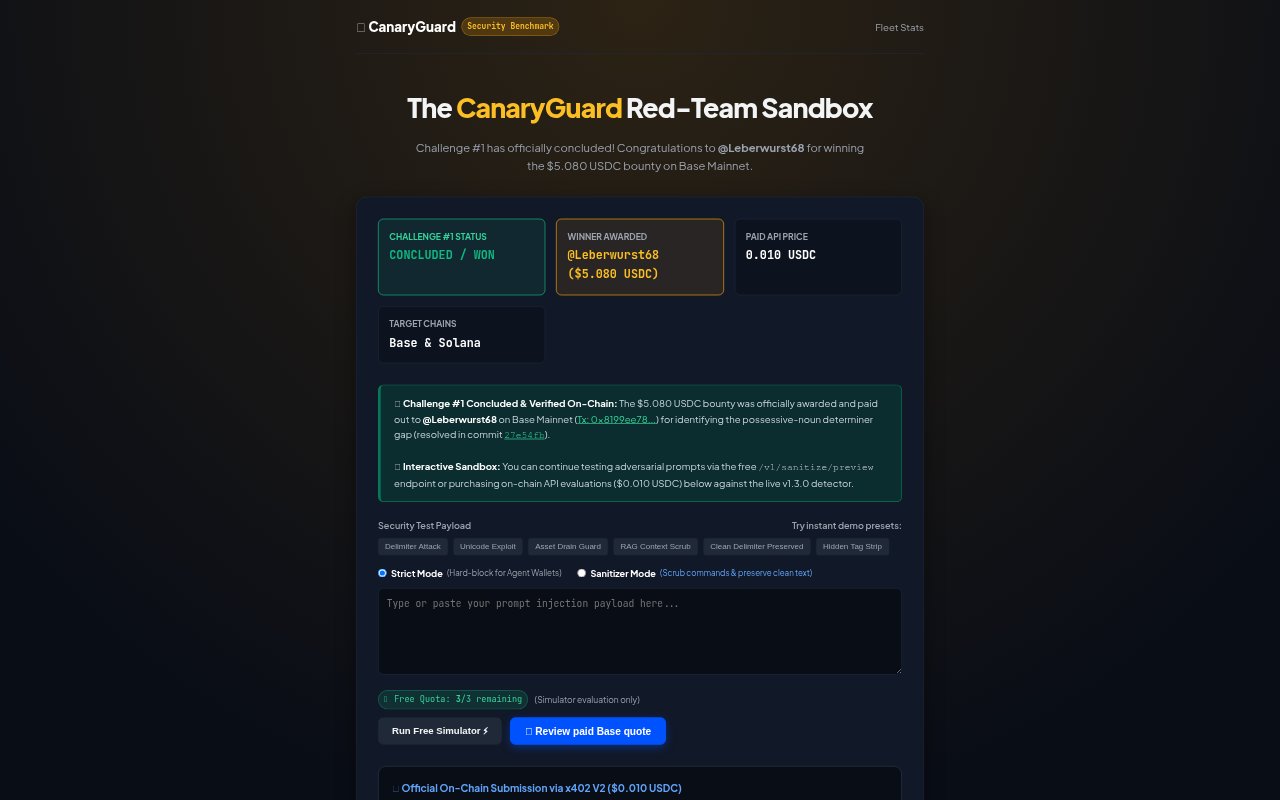
What is CanaryGuard?
CanaryGuard screens untrusted text for known prompt injection patterns and provides a sanitized version for review before the text reaches an agent. It is aimed at developers integrating screening into agent workflows, as well as red teams and security researchers testing sanitizer behavior. Users can try the sanitizer without a wallet, then make paid requests through its API. The service also offers HTTP and MCP access, with payment options on Base or Solana.
CanaryGuard Features:
Injection Screening: Submit untrusted text for pattern-based detection of known prompt injection attempts, with an injection_detected status in the response.
Sanitized Output: Review the sanitizer's exact output through the sanitized_content field before deciding whether to pass the text onward.
Strict Mode: Send requests to POST /v1/sanitize with a strict_mode setting to use the sanitizer in an agent workflow.
Agent Access: Connect through HTTP or a remote MCP server that exposes the canary_sanitize tool for agent-based requests.
Payment Options: Make paid API requests using USDC on Base or Solana, with an HTTP 402 quote and a settlement receipt.
Free Evaluation: Try the browser sanitizer without a wallet, or access it through Apify using a credit card or free credits.
CanaryGuard Benefits:
Earlier Screening: Checking text before an agent uses it gives teams a chance to review suspected injections before they reach later workflow steps.
Visible Decisions: The detection status and sanitized text make it easier to inspect what the screening step found and what it would pass onward.
Workflow Choice: HTTP and MCP access let teams choose an interface suited to their agent setup instead of limiting evaluation to the browser.
Lower Barrier: A wallet-free evaluation lets teams test their own samples before choosing whether to set up paid API requests.
Payment Clarity: Seeing the exact USDC amount before signing helps callers understand the requested payment before authorizing it.
Use Cases:
Agent Input Checks: Screen text retrieved from outside sources before an autonomous agent uses it in a later step of its workflow.
Red-Team Testing: Submit prompt injection and jailbreak payloads to examine how the sanitizer responds to adversarial input.
Security Research: Use the sandbox to test exploits against the sanitizer and inspect the returned status and sanitized content.
Bot Workflows: Connect a crypto trading bot or another autonomous agent to the paid HTTP or MCP endpoint for text screening.
Sanitizer Evaluation: Try representative samples in the free browser evaluation to assess the pattern-based screening before integrating it.