

What is Canopy?
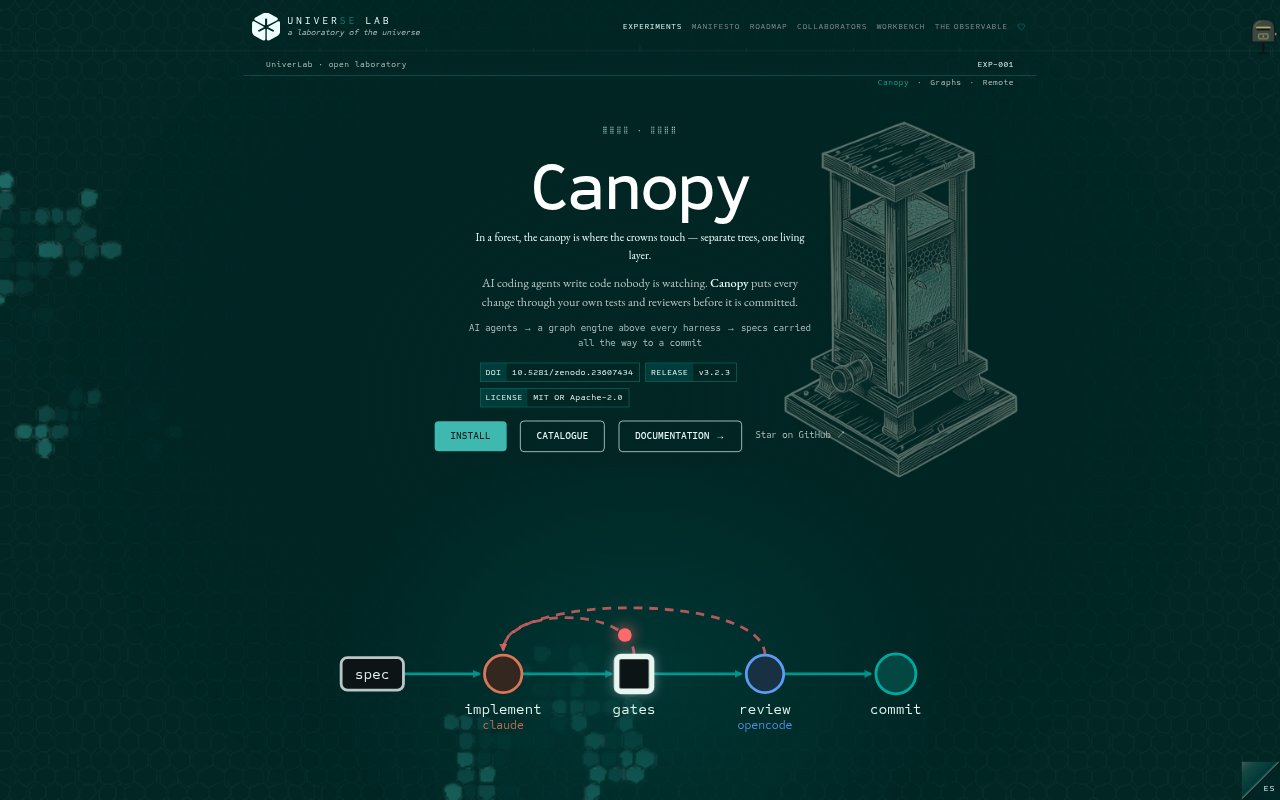
Canopy is an open-source graph engine for running AI coding agents through workflows you define. It combines a Rust daemon and terminal interface, with agent nodes that can use different coding-agent harnesses and check nodes that run commands such as tests. Developers can route work from an initial spec through implementation and review, with the workflow determining what happens next based on checks and verdicts.
Canopy Features:
Workflow Graphs: Build workflows from agent, check, gate, and router nodes connected by pass, fail, or always edges.
Harness Support: Run agent nodes on a range of coding-agent harnesses, including Claude Code, Codex CLI, Cursor, Gemini CLI, and opencode.
Command Checks: Use check nodes to run your own commands, then route work according to their exit codes and verdicts.
Model Ensembles: Fan a workflow step out across models and harnesses in parallel, in a cascade, or by round-robin, with quorum support.
Quota Recovery: Use a resilience node to recognize quota errors and schedule the graph to resume at the quota reset.
Memory and Scheduling: Store project facts, patterns, and decisions in a knowledge graph, and run queued work on schedules or file-change triggers.
Remote Sessions: Pair a browser as a revocable device to view live graphs from a phone, with end-to-end encrypted sessions over WebRTC.
Canopy Benefits:
More Controlled Changes: Requiring checks and review in the workflow helps keep unverified agent output from reaching a commit.
Less Manual Routing: Failed checks and quota limits can send work to a retry or scheduled wake-up without requiring you to intervene at each step.
Reusable Project Context: Persistent project memory lets later sessions refer to recorded decisions instead of rediscovering the codebase.
Broader Review: Ensembles let you compare work across models and harnesses rather than relying on a single agent's response.
Clearer Run Status: Live graph views show how specs move through a workflow, including where checks pass or send work back.
Use Cases:
Spec to Commit: Define a coding task as a spec and route it through implementation, checks, review, and a commit.
Consensus Planning: Ask several models on different harnesses to draft a plan, then use a quorum to select the agreed direction.
Test and Repair: Run project tests after an agent change and send failures, with their output, back to an implementer.
Scheduled Tasks: Put specs in an ordered queue or use a cron schedule to have a graph work through tasks in the background.
Phone Monitoring: Watch a running graph from a paired browser on your phone or share a live view with a trusted guest.
Shared Agent Work: Coordinate multiple agent sessions in one workspace by having them report status and message one another.