

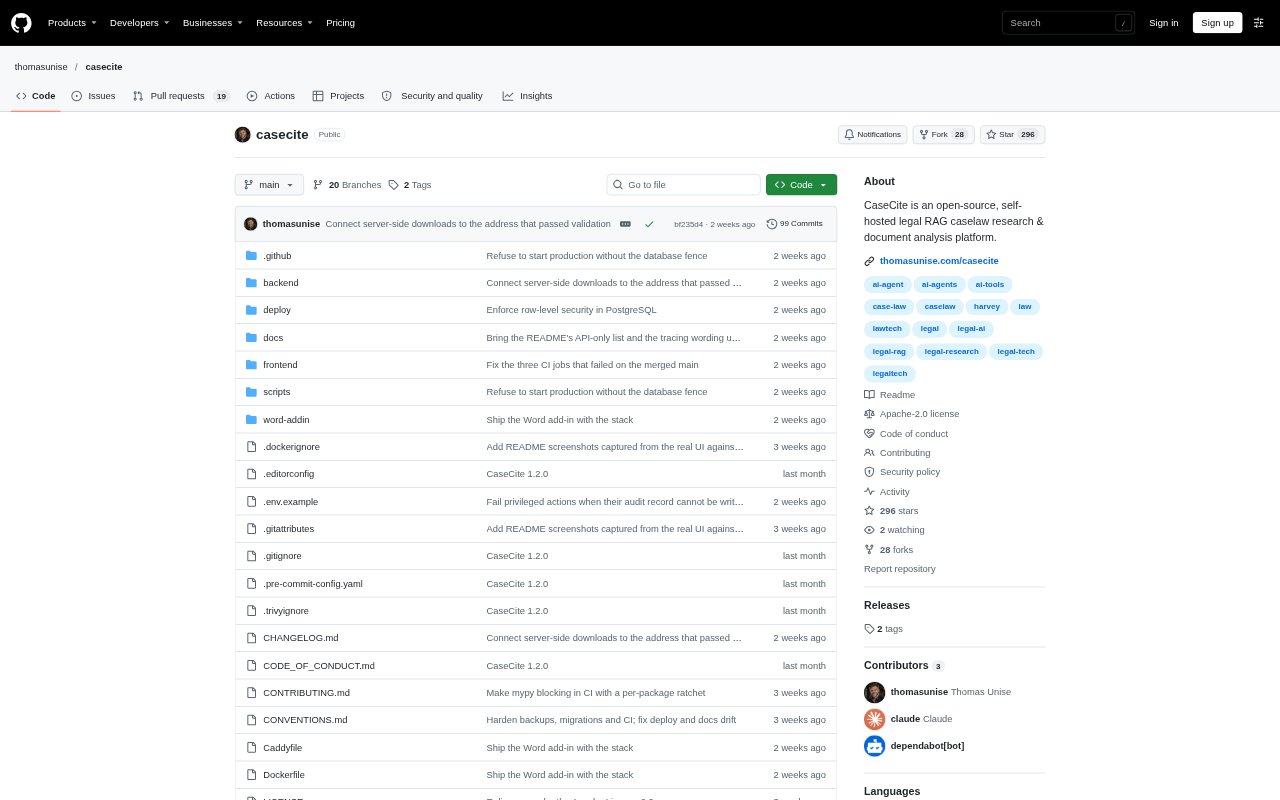
What is CaseCite?
CaseCite is a self-hosted legal AI platform for law firms that want to research their own documents, review contracts and draft agreements on infrastructure they control. Its tools use a shared document corpus and include case-law and judge research. Firms configure their own AI providers and API keys; they can also run chat and embedding models on their own servers. The software is open source under the Apache 2.0 license and is intended for firms able to manage a self-hosted deployment.
CaseCite Features:
Document Research: Ask questions across firm documents using vector and keyword search, with inline citations that point back to source passages.
Contract Review: Analyze contracts, compare two to four agreements clause by clause, and export reviews, drafts or redlines as Word tracked changes.
Tabular Review: Extract selected fields across document sets into a review table, with each value tied to its supporting passage and exportable to Excel, CSV or JSON.
Saved Workflows: Combine research, extraction, comparison, drafting and approval steps into document-set jobs, with conditional steps and the option to resume failed runs.
Long-Form Drafting: Draft from up to four knowledge-base documents, review a section plan first, and revise long documents section by section.
Case Law Tools: Look up cases, check citations for negative-treatment language, chat with opinions, and access judge analytics using CourtListener.
Matter Workspaces: Group documents, research chats and contract analyses by client engagement, with access controls and an activity feed.
CaseCite Benefits:
Controlled Data: Keeping documents, search indexes and histories on the firm's deployment gives the firm control over where its work product is stored.
Traceable Answers: Source-linked responses make it easier for lawyers to check the support for an answer before relying on it.
Repeatable Reviews: Saved workflows help teams apply the same review process across document sets instead of rebuilding each sequence of steps.
Fewer Rechecks: Table values linked to exact passages let reviewers inspect evidence directly and preserve their approvals or flags when results are rerun.
Team Accountability: Matter-level access controls and a signed audit trail help firms track who can see work and what actions were recorded.
Use Cases:
Firm Knowledge Research: A lawyer can ask questions about a client's matter documents and check cited passages before using the findings in legal work.
Incoming Agreement Review: A team can review opposing counsel's draft against a practice profile or firm standard, then prepare a Word redline.
Contract Portfolio Review: A legal operations team can extract key terms from a collection of agreements, inspect supporting quotes and export selected results.
Client Matter Handover: A firm can keep documents, analysis and research together for an engagement and transfer the matter when its owner leaves.
Case And Judge Research: A lawyer can look up a case, examine citing opinions for negative-treatment language or explore judge analytics.