

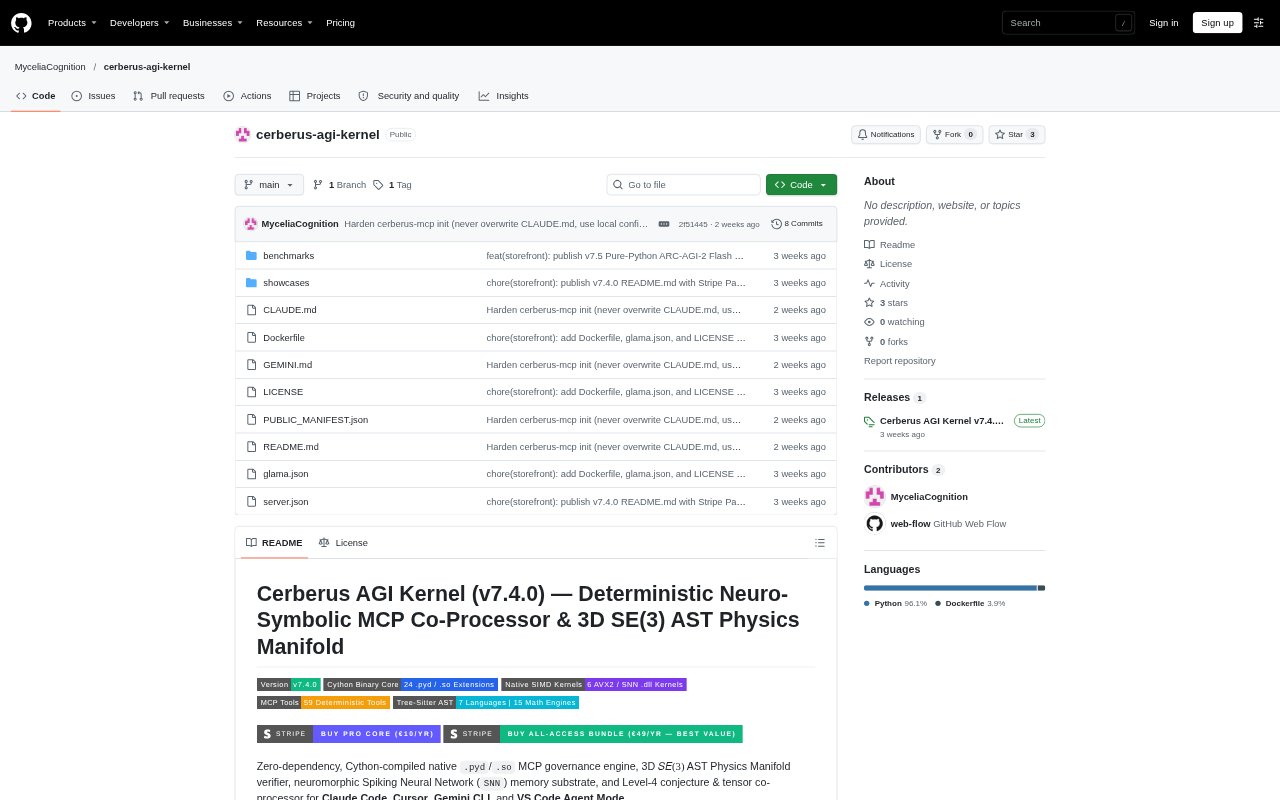
What is Cerberus MCP?
Cerberus MCP is a local MCP server and coding-agent co-processor for retrieving project context, analyzing code, and running deterministic checks. It is intended for developers using Claude Code, Cursor, Gemini CLI, or VS Code Agent Mode who want agents to work with files and knowledge across multiple local repositories. A command-line setup registers the server and configures agent instructions and hooks in each workspace.
Cerberus MCP Features:
Cross-Project Recall: Cerberus indexes documents and source files from registered workspaces, then retrieves relevant verbatim chunks using BM25-based search.
Context Ledger: Agents can save task summaries to a persistent ledger, while a stop-guard hook re-indexes modified files at the end of a turn.
Document and Data Access: The MCP tools can read supported local files, ingest long text for indexing, and analyze CSV data with row counts, numeric summaries, and filtered results.
Code Analysis: Code tools include call-graph blast-radius analysis, AST equivalence checks, complexity analysis, and structural checks for code changes.
Formal Checks: The math co-processor provides graph algorithms and state-machine verification, including checks for deadlocks, livelocks, and unreachable states.
Workspace Governance: The command-line interface can save code-quality baselines and run a workspace CI gate, while setup adds local configuration for supported coding agents.
Cerberus MCP Benefits:
Less Context Rebuilding: Developers can bring relevant details from other repositories into an agent conversation without repeatedly searching files or pasting their contents.
More Focused Prompts: Retrieving selected document chunks and analyzing data outside the prompt helps keep conversations focused on the material needed for a task.
Earlier Risk Checks: Graph and state-machine checks can surface dependency or transition problems before a refactor or service extraction is deployed.
Preserved Project Knowledge: A persistent ledger and workspace indexing give agents a way to recover prior task notes and updated file context across work sessions.
Consistent Change Review: Saved baselines and checks on touched code help teams distinguish new issues from existing complexity in a legacy repository.
Use Cases:
Multi-Repository Planning: Ask a coding agent to find roadmap decisions, migration risks, or implementation details spread across planning documents and several project repositories.
Large Transcript Review: Ingest a long meeting transcript or product requirements document, then retrieve relevant passages while drafting a plan or tracking decisions.
CSV Investigation: Analyze a local metrics file to check numeric ranges and averages or find rows matching a latency or other text query without loading the full file into chat.
Monolith Decomposition: Map callers and shared-state dependencies, find a low-coupling cut, and check a proposed service state machine during a microservice migration.
Legacy Code Modernization: Set a baseline for an older codebase, then use checks on changed functions while refactoring or migrating selected code to Rust.