

What is ChaosIntelligence?
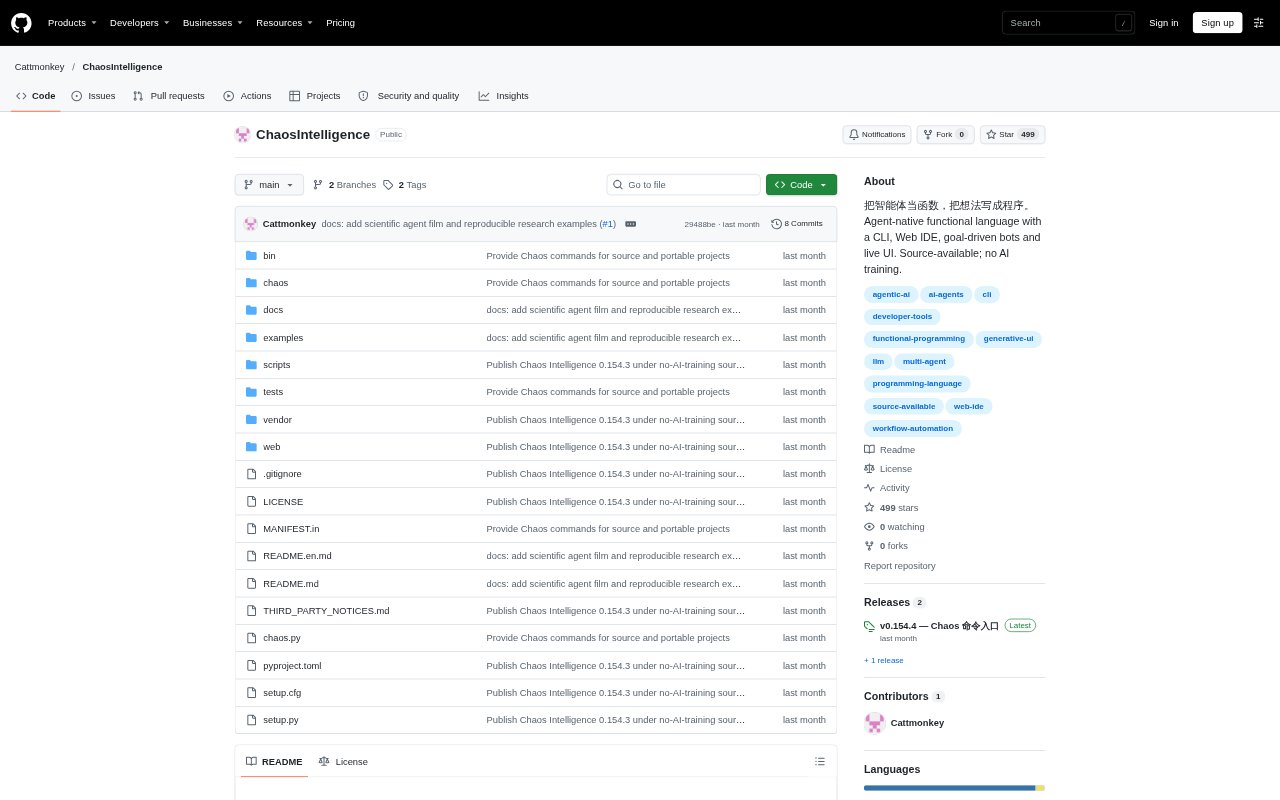
ChaosIntelligence is a functional programming language and runtime for building systems that combine ordinary code with AI agents. It treats agents as callable values, letting developers express computation and workflow logic as functions while assigning understanding and generation tasks to configured models. The project includes a command-line interface and a browser-based IDE, and is intended for developers creating agent workflows, goal-driven bots, and interactive reports or pages.
ChaosIntelligence Features:
Callable Agents: Declare an agent with a role, prompt, model provider, tools, and step limit, then invoke it from a Chaos program like a function.
Function Composition: Pass functions as values and combine them with closures, modules, patterns, macros, generators, and asynchronous tasks.
Workflow Building: Connect planning, execution, and review in one program, using functions for precise computation and models for understanding or generation.
Goal-Driven Bots: Create bots with goals, context, and acceptance criteria, using persistent state to continue work and receive additional guidance.
Web IDE: Edit and run source in a browser-based IDE with language-aware coloring, name completion, parameter hints, and save-time formatting.
Generated Interfaces: Return pages and reports containing components such as tables and charts, with runtime graphs that can display project structure and observed execution.
Execution Visibility: Inspect public execution events, relationship networks, and node details, and view pages that update as runtime events arrive.
ChaosIntelligence Benefits:
Clear Division: Keep exact calculations in program logic and reserve model calls for tasks that require interpretation or generated content.
Reusable Workflows: Build from small functions and combine them into larger agent systems without treating each workflow step as a separate application.
Continued Work: Persistent bot state lets goal-focused processes carry work forward instead of starting each run without their prior context.
Readable Results: Turn program output into visual pages and reports, making results easier to inspect than raw execution output alone.
Traceable Runs: Use visible events and runtime relationships to understand what ran and distinguish declared connections from observed activity.
Use Cases:
Research Workflow: Build a research sequence in which agents propose hypotheses, functions run calculations, and results inform the next step.
Content Pipeline: Create a multi-role process that plans a piece of writing, drafts it, and sends it through a review step.
Persistent Assistant: Develop a goal-oriented bot that retains working state and accepts further direction at defined points in its process.
Interactive Report: Generate a report with tables, charts, or a live runtime graph to present program results and execution status.
Agent Prototyping: Use the CLI or web IDE to test a small function-and-agent program before expanding it into a more complex system.