
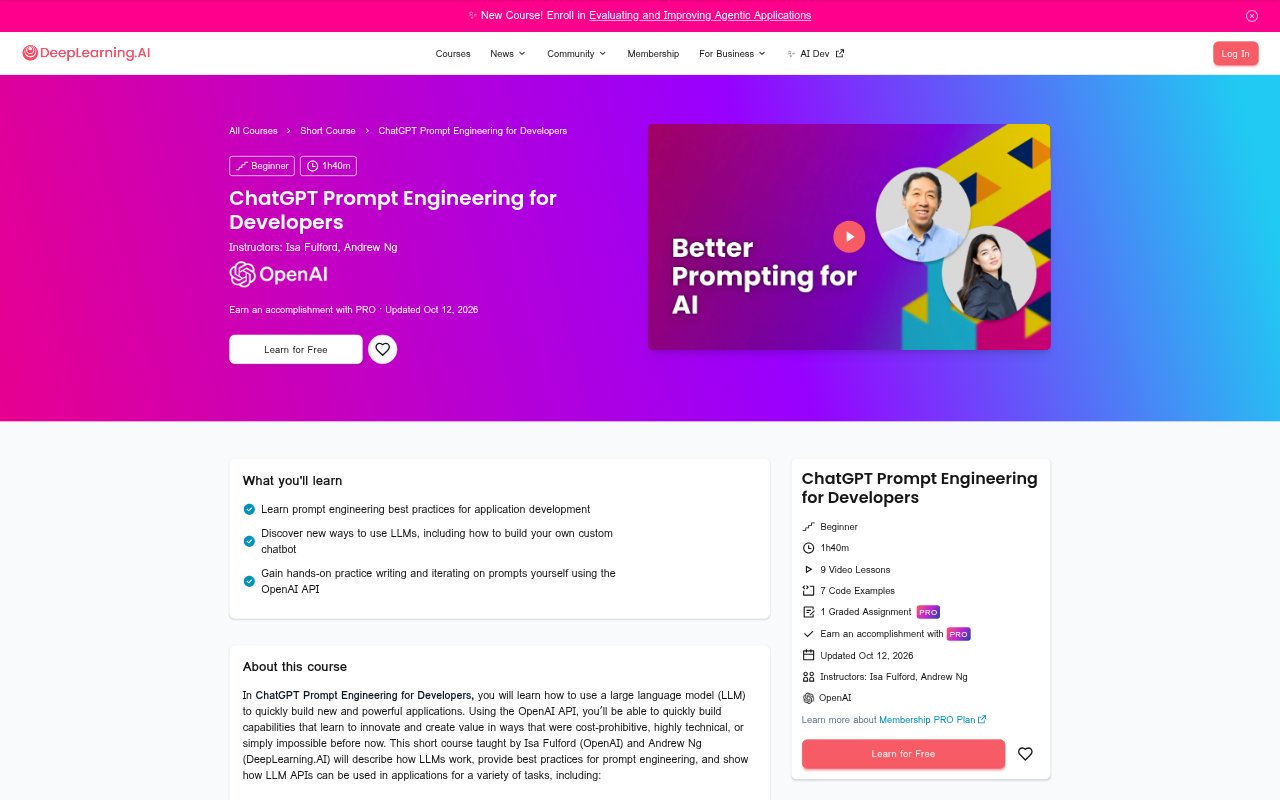
What is ChatGPT prompt engineering for developers?
ChatGPT Prompt Engineering for Developers is a beginner-friendly short course for developers who want to use large language models in applications. It teaches prompt engineering practices and demonstrates how to work with the OpenAI API for tasks such as summarizing, classification, translation, and chatbot building. Lessons include code examples that learners can try in a Jupyter notebook environment. Basic Python knowledge is enough to get started, and the material is also aimed at experienced machine learning engineers.
ChatGPT prompt engineering for developers Features:
Prompt Guidelines: The course introduces principles for writing effective prompts and offers guidance on applying them when developing applications with language models.
Iterative Prompting: A lesson with a code example covers iterating on prompts, giving learners a practical way to refine instructions for a desired result.
Text Summarization: A dedicated lesson demonstrates using language models to condense text, including user reviews, with a code example.
Text Inference: The inference lesson covers tasks such as sentiment classification and topic extraction, showing how prompts can draw information from text.
Text Transformation: Learners explore prompts for changing text, with examples that include translation and spelling or grammar correction.
Chatbot Building: The course walks through building a custom chatbot and includes code examples learners can explore in the notebook environment.
ChatGPT prompt engineering for developers Benefits:
Faster Prototyping: Working through API examples gives developers a starting point for building LLM-powered application capabilities without beginning each task from scratch.
Clearer Prompt Design: Learning prompt principles and iteration helps developers make deliberate changes when an application’s responses do not meet their needs.
Broader Task Range: Practicing summarization, inference, transformation, and expansion helps learners see how one model interface can support different text workflows.
Hands-On Practice: Trying code examples in a notebook lets learners connect the course concepts to API use rather than relying on explanations alone.
Accessible Starting Point: The beginner-friendly structure and basic Python prerequisite give developers a manageable entry into prompt engineering for applications.
Use Cases:
Review Summaries: Use the course examples as a starting point for an application that turns lengthy customer reviews into shorter summaries.
Sentiment Sorting: Explore how to prompt a model to classify feedback by sentiment when reviewing comments or other text.
Topic Extraction: Apply the inference material to experiment with extracting recurring topics from a collection of written responses.
Text Localization: Practice using a language model to translate text as part of a workflow that prepares written content for different languages.
Custom Chatbot: Follow the chatbot material when prototyping a conversational interface that uses an LLM through the OpenAI API.