

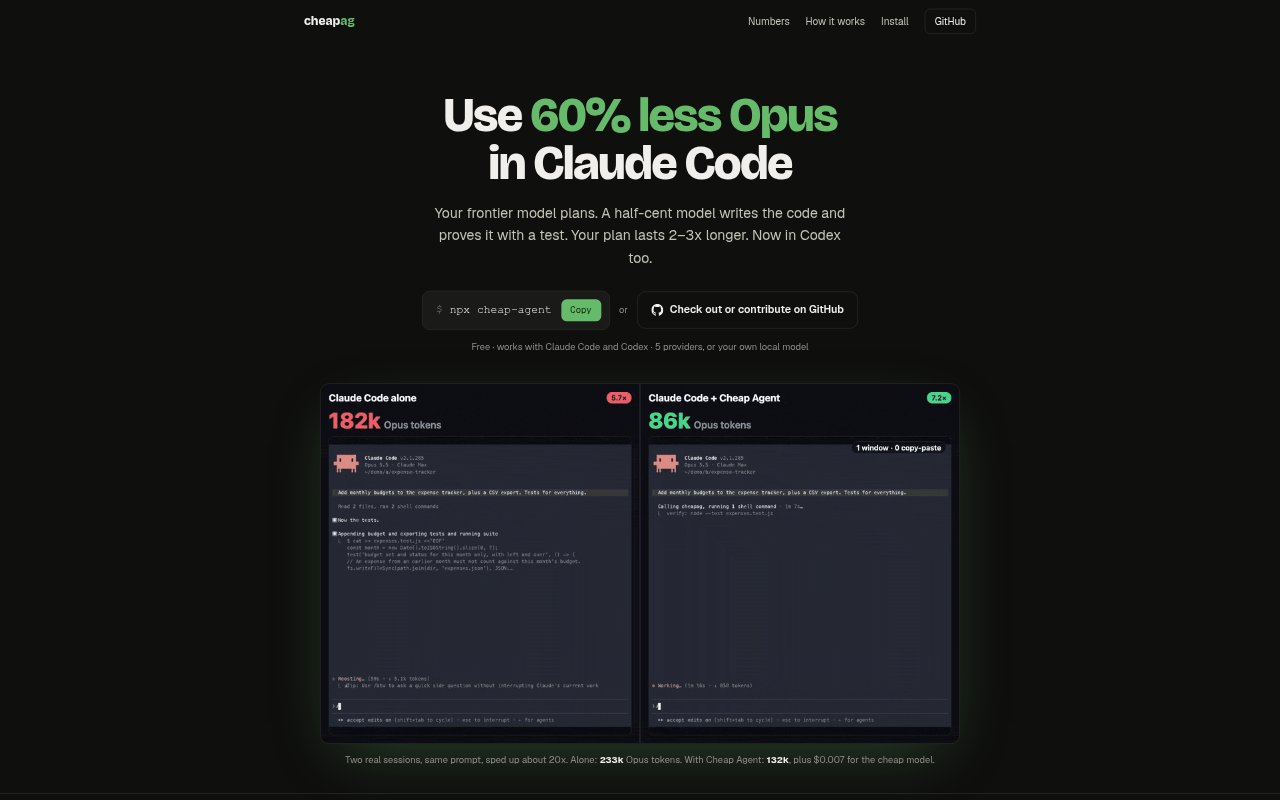
What is Cheap Agent?
Cheap Agent is an open-source coding assistant for people who use Claude Code or Codex and want to reserve their main model for planning and decisions. It hands coding tasks to a lower-cost model, runs tests on the changes, and leaves passing work uncommitted for review. It supports several model providers as well as compatible custom endpoints and local models, so you can choose a setup that fits your budget and environment.
Cheap Agent Features:
Task Planning: Your frontier model turns a request into a short task without reading the project code, then delegates the typing to a cheaper model.
Test-Driven Changes: The coding model works in its own Git worktree, writes a failing test, changes the code, and works to make the test pass.
Test Verification: Cheap Agent runs the tests itself and only brings passing work back to the project, leaving changes uncommitted.
Progress Reports: It provides a short result and reports when the cheaper model gets stuck, so you can decide whether to continue before spending more tokens.
Model Choices: Choose from supported providers or configure a custom OpenAI-compatible endpoint, including local model servers such as Ollama, LM Studio, or llama.cpp.
Editor Compatibility: Use it with Claude Code or Codex, with setup through a command-line installer and project-level permission steps.
Cheap Agent Benefits:
Lower Model Spend: Delegating code writing to a cheaper model can reduce how much you pay for coding tasks while keeping your main model in the planning role.
Longer Plan Usage: Using fewer frontier-model tokens can help coding plans with usage limits last longer; tests with Opus reported 55–63% fewer tokens for the same work.
Reviewable Output: Because changes remain uncommitted, you can inspect the diff and decide what to keep before it becomes part of your project.
Fewer Untested Changes: Having tests run before work returns gives you a check on whether the delegated change passes, rather than relying only on the coding model's claim.
Flexible Model Costs: Provider and local endpoint options let you choose a coding model based on your available budget and infrastructure.
Use Cases:
Routine Feature Work: Delegate implementation of a project feature when you want your main model to shape the task but a lower-cost model to write the code.
Bug Fixes: Use it to tackle a reproducible bug by asking the coding model to write a failing test, make a fix, and run the tests.
Limited Usage Plans: Stretch a Claude Code or Codex plan with usage limits by shifting code-writing work away from its frontier model.
Local Model Workflows: Connect a compatible local model endpoint when you want to run coding tasks without sending them to one of the listed hosted providers.
Diff Review: Use it when you want delegated code changes to remain uncommitted so you can examine and approve them as part of your normal review.