

What is Continuum Verifier?
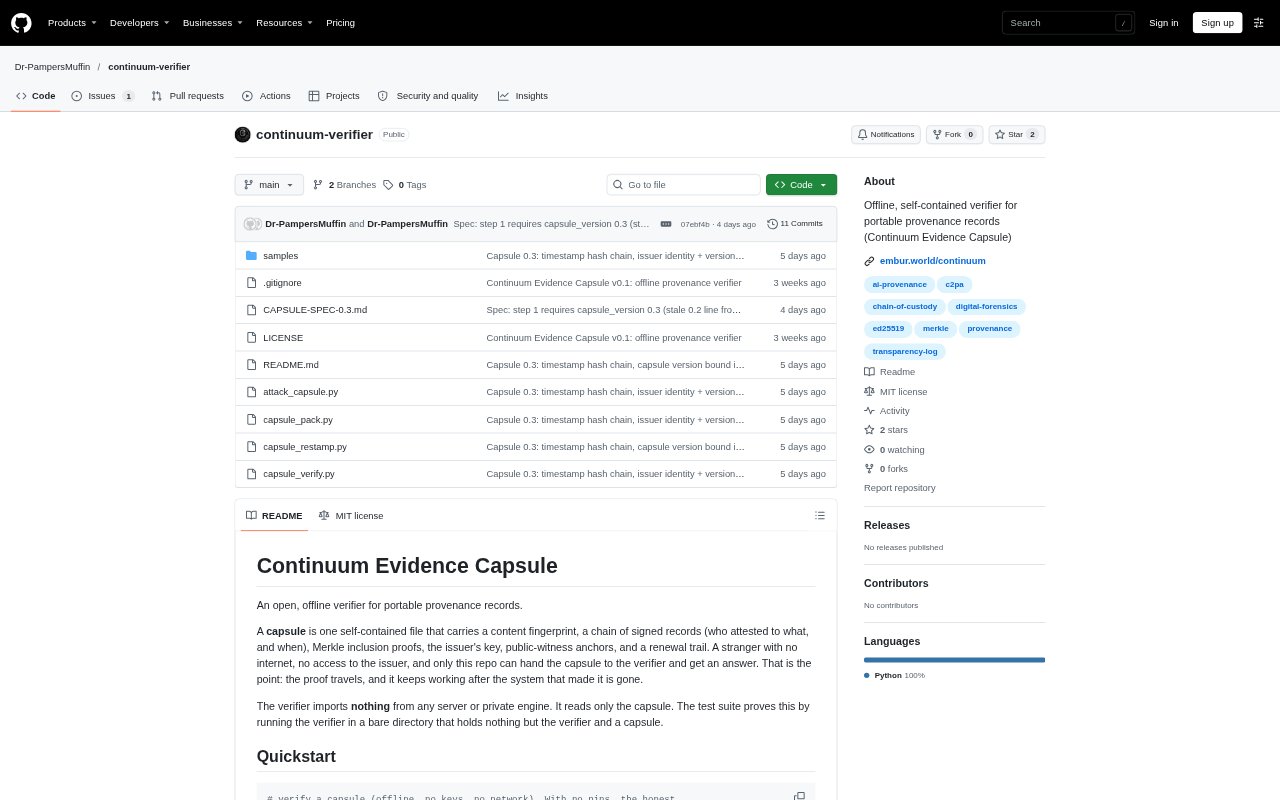
Continuum Verifier is an open-source command-line tool for checking self-contained provenance capsules without contacting an issuer or using private keys. Each capsule carries a content fingerprint and records that can be checked for integrity, signatures, timestamps, inclusion proofs, and renewal status. It is aimed at people who need to inspect or validate portable provenance records; it does not establish whether the claims inside a record are true. The project is a reference implementation, and its sample public-witness anchors use simulated local keys rather than a live witness.
Continuum Verifier Features:
Offline Verification: The verifier reads a capsule locally and can run without network access, issuer access, or a server connection.
Capsule Checks: It checks capsule structure, content fingerprints, signatures, Merkle inclusion proofs, the presented record set, and timestamp chains.
Pinned Trust Roots: Issuer, witness, and timestamp-authority keys can be supplied as out-of-band pins, rather than trusted just because they appear in a capsule.
Clear Verdicts: Results distinguish VERIFIED, SELF_CONSISTENT, RESTAMP_NEEDED, WITHHELD, and FAILED, including cases where a record is internally consistent but unauthenticated.
Capsule Renewal: Included tools can re-stamp a capsule or renew its hash tree, with the verifier checking the renewal chain and cryptographic trust horizons.
Adversarial Tests: The repository includes a test script for clean capsules, tampering attempts, renewal paths, and verification-boundary regressions.
Continuum Verifier Benefits:
Independent Review: A recipient can inspect a record without relying on the system that issued it, making verification practical even when the issuer is unavailable.
Fewer False Assurances: Separate verdicts make it easier to see when a record is only internally consistent and when its trust roots have actually been authenticated.
Tampering Detection: Checks for changed, missing, duplicated, or reordered records help reviewers catch alterations before relying on a capsule.
Visible Limits: The distinction between custody and truth helps users avoid treating an intact provenance record as proof that its underlying claims are accurate.
Longer-Term Checks: Renewal paths give operators a way to address aging timestamps or hash algorithms instead of treating every old capsule as permanently current.
Use Cases:
Received Capsule Review: A recipient can check a provenance capsule from a partner on an offline machine before accepting its record of custody.
Issuer Authentication: An auditor can supply known issuer, witness, and stamper keys to distinguish an authenticated record from one that only verifies against its own contents.
Tamper Investigation: A reviewer can test whether edits, missing events, duplicate records, or reordered entries cause the capsule to be withheld.
Aging Record Renewal: A records operator can re-stamp a capsule or rebuild its hash tree when the existing timestamp or hash approaches its trust horizon.
Verification Tool Testing: A developer or security reviewer can run the included adversarial suite to examine how the verifier handles attacks and renewal cases.