
What is Devika?
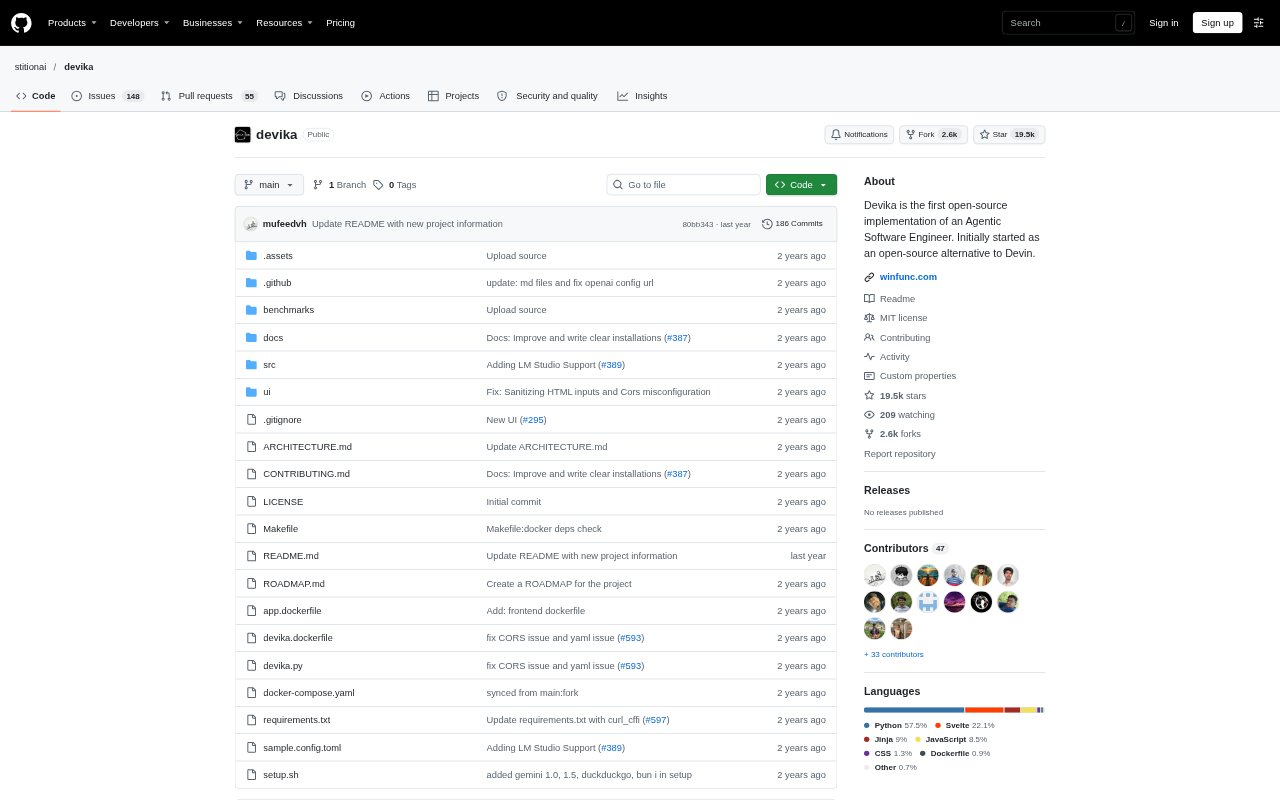
Devika is an experimental, open-source AI software engineering tool for people who want an agent to work from a high-level coding objective. It breaks tasks into steps, researches relevant information, and writes code, with users able to monitor progress and guide the work in a browser interface. It supports several hosted language models as well as local models through Ollama. The project is explicitly described as being in an early stage, with some features unimplemented or broken, so expect hands-on setup and review.
Devika Features:
Task Planning: Give Devika a high-level objective and it uses planning and reasoning capabilities to break the work into steps before beginning.
Web Research: Devika extracts contextual keywords and uses web browsing and information gathering to research material relevant to a coding task.
Code Generation: The agent can write code in multiple programming languages to carry out a requested objective, from a feature to a project.
Model Choices: Choose from Claude, GPT-4, Gemini, Mistral, Groq, or local language models accessed through Ollama.
Project Workspace: Organize work by project, select a model and search configuration, and interact with the agent through a chat interface.
Progress Tracking: View dynamic agent state and generated code while Devika works, then provide guidance or feedback and review project files.
Devika Benefits:
Less Task Decomposition: You can start with an overall goal rather than manually turning every coding request into a sequence of smaller instructions.
Focused Research: Keyword-led information gathering helps keep research connected to the development objective instead of requiring a separate research workflow.
Faster First Drafts: Having the agent produce code gives you a starting point to inspect and refine rather than requiring every initial line to be written by hand.
Flexible Model Setup: The range of hosted and local model options lets users choose a setup that suits their available model access and preferences.
Visible Work in Progress: Seeing the agent's state and generated code makes it easier to follow its progress and decide when to offer additional direction.
Adaptable Project Work: Project-based organization gives ongoing tasks a dedicated place for configuration, instructions, and subsequent rounds of refinement.
Use Cases:
Feature Prototyping: Describe a feature at a high level and use Devika to research the task, plan its steps, and draft code for review.
Bug Fix Drafting: Ask the agent to work on a reported bug, then inspect its generated code and provide further direction as you refine the result.
Project Scaffolding: Use a broad project objective to have Devika begin researching and writing code for a new software project.
Coding Research: Use web browsing and contextual keyword extraction when a development task needs information gathered alongside code work.
Local Model Experiments: Configure Ollama and try local language models for agent-assisted coding instead of relying only on hosted model options.
Guided Code Iteration: Watch the agent's progress, review its project files, and give follow-up instructions to adjust or refine generated work.