
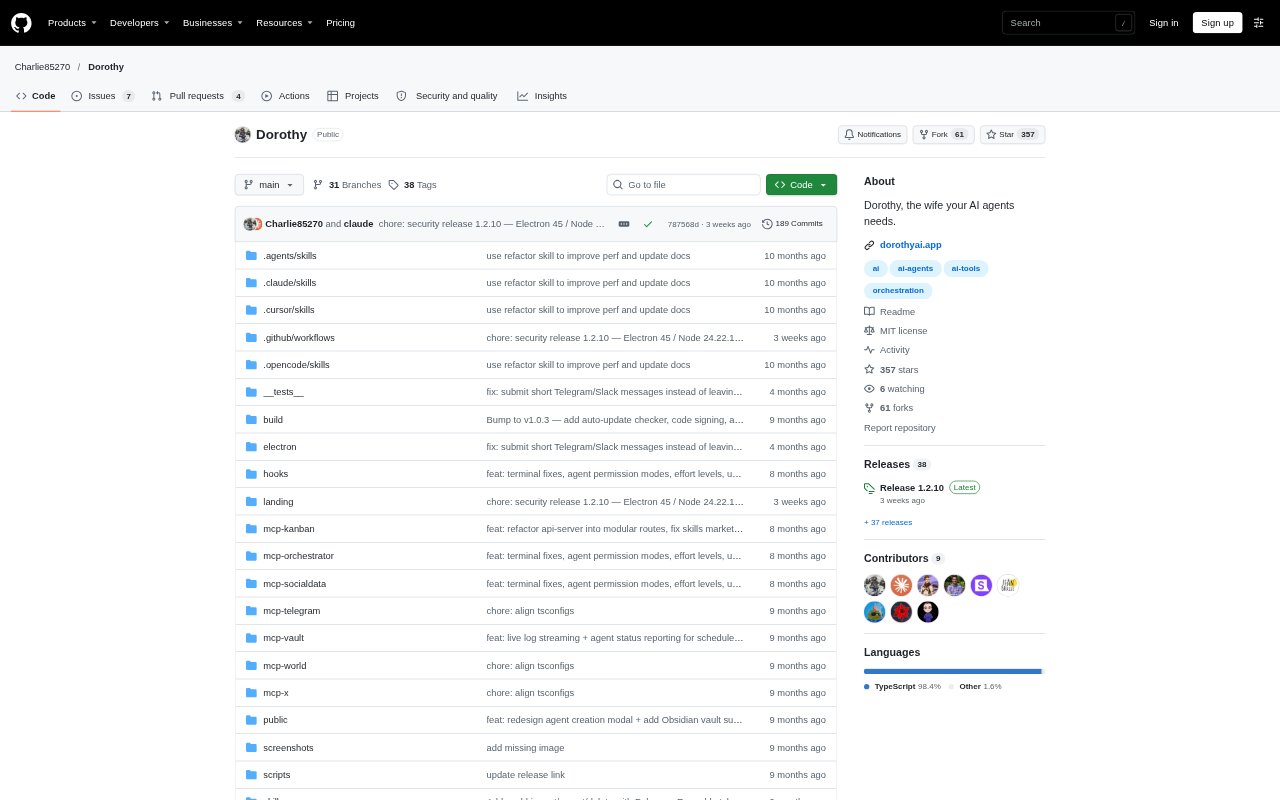
What is Dorothy?
Dorothy is a desktop app for managing and coordinating AI coding agents across projects. It brings agent terminals, task management, automations, and remote controls into one interface, with support for Claude, Codex, Gemini, Grok, and local agents. Developers can use it to run agents in parallel, delegate work to a Super Agent, and track activity; Dorothy is free, open source, and does not require an account.
Dorothy Features:
Parallel Terminals: Run multiple agents in isolated interactive terminal sessions, stream their output, send input, and manage their status across projects.
Super Agent: Give an orchestrator a high-level task and it can create, start, stop, and monitor other agents through MCP tools.
Kanban Board: Organize work in backlog, planned, ongoing, and done columns, with priorities, progress tracking, labels, skill requirements, and agent assignment.
Event Automations: Poll GitHub pull requests, issues, and releases or JIRA work items, then run agents on new or updated items and deliver results.
Scheduled Tasks: Set recurring cron-based work for autonomous agent runs, with background execution supported through launchd on macOS and cron on Linux.
Remote Controls: Use Telegram or Slack to check agent status, start or stop agents, and send tasks to the Super Agent.
Dorothy Benefits:
Fewer Context Switches: Keeping terminals, task tracking, and agent status in one app makes it easier to oversee work without juggling separate interfaces.
Parallel Progress: Independent agent sessions let developers move work forward on several projects or tasks at the same time.
Clearer Ownership: Skill-based task matching helps route work to agents suited to its requirements and makes assignments easier to follow.
Less Manual Triage: Automations can send incoming GitHub and JIRA items to agents, reducing the need to manually start each workflow.
Work From Anywhere: Remote controls let users check progress and direct agents through messaging apps instead of returning to the desktop.
Use Cases:
Pull Request Reviews: Set up an automation to review incoming GitHub pull requests and return its results through a GitHub comment or a connected messaging channel.
JIRA Issue Work: Route open JIRA bugs, stories, or tasks to agents for processing, with comments or issue transitions as possible outputs.
Recurring Maintenance: Schedule periodic development work, such as recurring maintenance or monitoring, to run without manually launching an agent each time.
Multi-Project Development: Run separate coding agents on different codebases while monitoring their terminal output and progress from one desktop app.
Remote Agent Direction: Check an agent's state or delegate a new task from Telegram or Slack when away from the development machine.