

What is DYZ MedPaper?
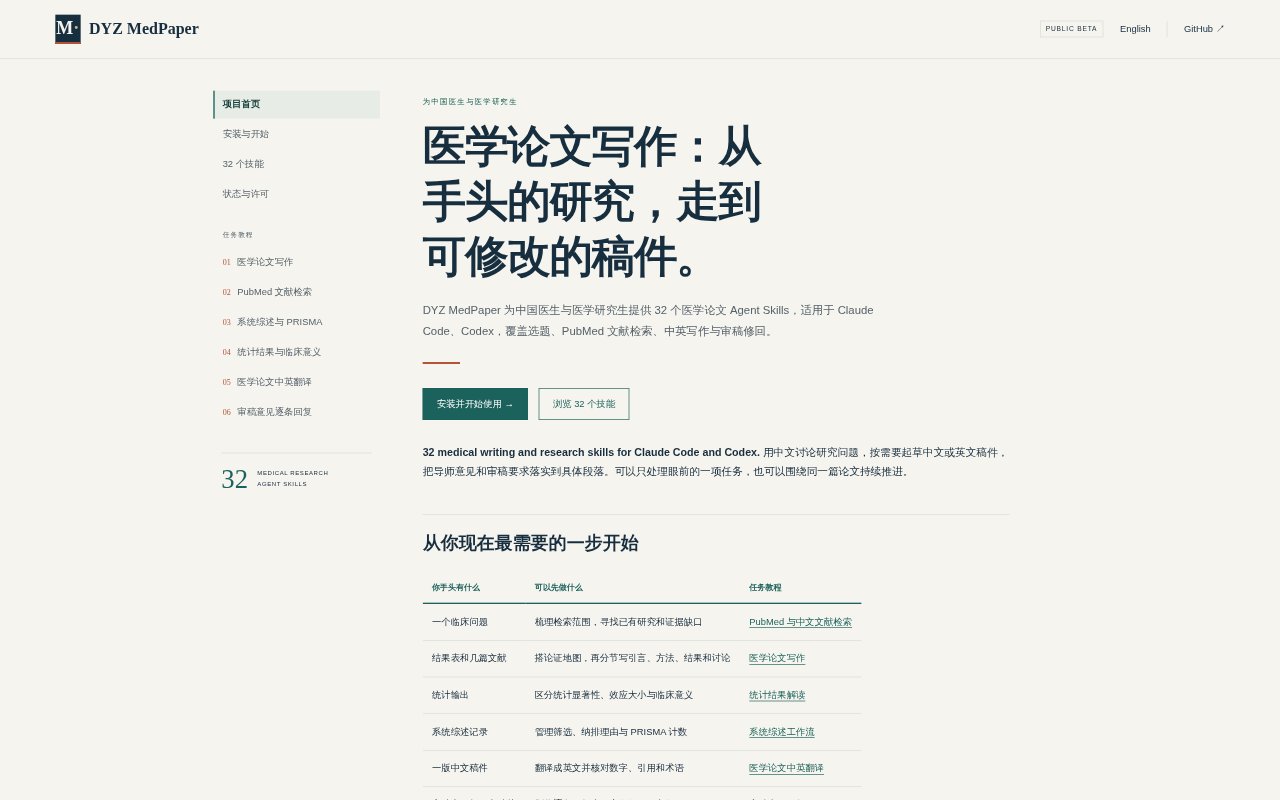
DYZ MedPaper is a collection of 32 agent skills for Chinese doctors and medical graduate students working toward a revisable research manuscript. It runs in Agent Skills-compatible hosts such as Claude Code and Codex, rather than as a standalone writing app. Its skills cover research questions, PubMed searches, study design, statistical interpretation, Chinese and English writing, journal submission, and reviewer responses. The project is in public beta, and users remain responsible for final medical judgments and research decisions.
DYZ MedPaper Features:
Research Question Scoping: Skills help define a clinical research question, consider the available data and follow-up conditions, and identify a workable search scope.
PubMed Literature Search: Online search scripts cover PubMed, while access to other databases depends on the user's own permissions.
Evidence Mapping: A workflow organizes findings and verified literature into an argument map that can guide sections of a manuscript.
Statistics Result Interpretation: Skills help distinguish statistical significance from effect size and clinical meaning, while statistical execution requires an appropriate environment and an approved analysis plan.
Bilingual Manuscript Work: Users can develop Chinese or English sections, translate a Chinese draft, and check numbers, citations, and terminology.
Review Revision Workflow: A reviewer-response workflow creates a point-by-point reply table and links each requested change to revisions in the manuscript.
DYZ MedPaper Benefits:
Manageable Next Steps: Starting with a specific task lets researchers work on the most urgent part of a paper without needing to plan the entire manuscript at once.
More Traceable Reasoning: Keeping evidence, explanations, and limitations distinct makes it easier for researchers and supervisors to inspect the basis for a draft.
Reusable Project Work: Writing outlines, literature records, chapters, and revision lists can remain in the project folder for continued review with supervisors and collaborators.
Clearer Revision Decisions: Connecting reviewer requests to manuscript changes helps authors check that each point has been addressed in the relevant text.
Better Scope Awareness: The workflows make it easier to see where database access, software, or human judgment is still needed before treating work as complete.
Use Cases:
Plan a Clinical Study: A doctor with a clinical question can narrow the literature search and look for gaps before deciding how to develop the research idea.
Draft From Results: A researcher with results tables and verified papers can organize the main findings before writing the introduction, methods, results, or discussion.
Review Statistical Output: A graduate student can examine statistical results with attention to significance, effect size, and clinical relevance.
Prepare a Systematic Review: A review team can organize screening records, exclusion reasons, and PRISMA counts as it manages the review workflow.
Revise After Peer Review: An author can turn reviewer comments into a response table and identify the manuscript changes needed for resubmission.