
What is Embeddings is all you need?
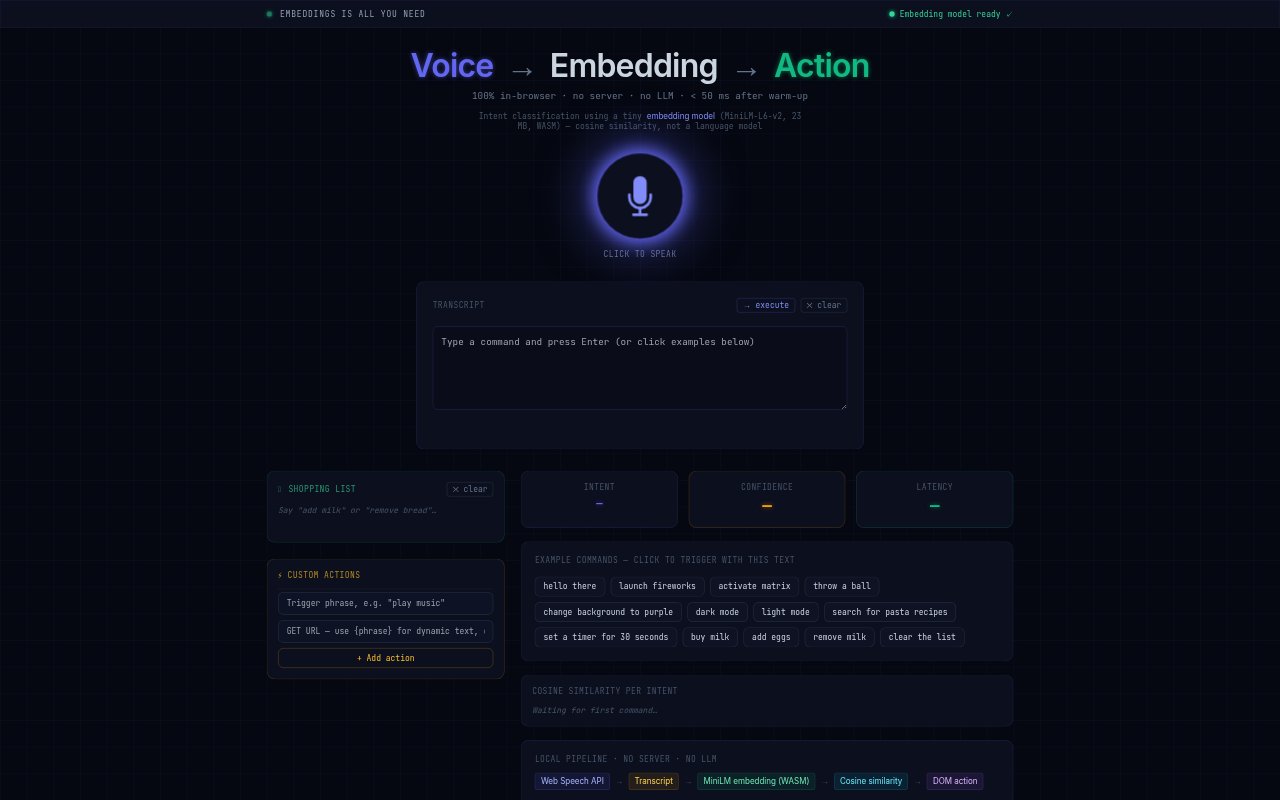
Embeddings is all you need is a browser-based demo of voice intent classification that turns a spoken phrase into an action. It uses a small MiniLM embedding model and cosine similarity rather than a language model, with example commands such as adding milk or removing bread. It is suited to people exploring lightweight voice interactions or prototyping simple command-based experiences without a server.
Embeddings is all you need Features:
Voice Commands: The demo takes a spoken phrase through a voice-to-embedding-to-action flow, with adding milk and removing bread shown as example commands.
Intent Classification: It classifies a phrase by comparing its embedding with candidate intents, instead of generating an answer with a language model.
MiniLM Model: The classifier uses MiniLM-L6-v2, a compact embedding model listed at 23 MB and run through WebAssembly.
Cosine Similarity: Cosine similarity provides the method for matching an input phrase to an intent.
Browser Processing: The demo runs entirely in the browser, with no server or LLM in its processing path.
Quick Response: After warm-up, the page reports response times under 50 milliseconds for its intent-classification flow.
Embeddings is all you need Benefits:
Lower Setup: A server is not needed for the demo, making it easier to try a small voice-command interaction without building backend infrastructure.
No LLM Dependency: The embedding-based approach lets teams examine a command-classification pattern without relying on a language model.
Fast Feedback: The reported post-warm-up response time makes the demo useful for judging whether a simple voice interaction feels immediate.
Small Experiment: A compact model keeps the example focused on testing command recognition rather than setting up a larger AI system.
Clear Comparison: Using similarity instead of text generation gives developers a concrete alternative to consider when choosing how to map phrases to actions.
Use Cases:
Shopping List Demo: Try the example flow with spoken requests to add milk or remove bread from a simple shopping-list interaction.
Voice UI Prototype: Use the page to explore how a browser interface might turn a small set of spoken commands into actions.
Intent Matching Test: Evaluate an embedding-and-similarity approach for mapping short phrases to predefined intents before designing a larger command system.
Browser AI Exploration: Show a team how an AI-assisted interaction can run in a browser without sending the classification flow to a server.
Latency Review: Check whether a post-warm-up response under 50 milliseconds suits a lightweight voice-command experience.