

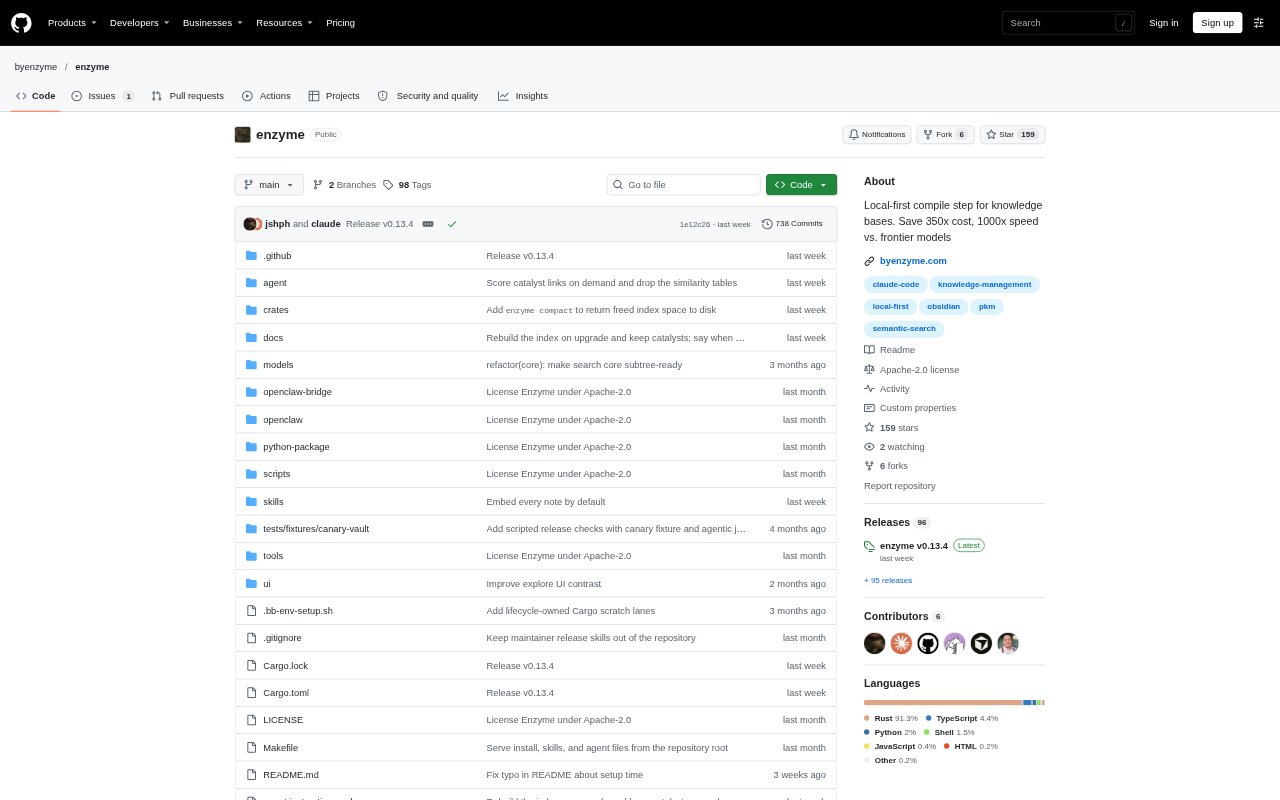
What is Enzyme?
Enzyme is a local-first indexing and retrieval tool for people who keep knowledge in Markdown vaults, meeting notes, journals, or other growing archives and want AI agents to use that material over time. It builds a persistent conceptual map from notes, then helps an agent find relevant passages without rebuilding context from scratch each session. The command-line workflow can be set up with agents such as Claude and Codex, while hosted memory connections are available for team and product workspaces.
Enzyme Features:
Local Knowledge Index: Enzyme compiles notes and other knowledge sources into an index that runs locally, keeping vault files on the device during local CLI use.
Temporal Sampling: The index considers how tags, wikilinks, folders, and dates give context to notes accumulated over time.
Catalyst Questions: In the background, Enzyme generates and embeds questions that help connect related documents and orient an agent to a knowledge base.
Hybrid Retrieval: A query ranks notes using both wording and meaning, and results include passages plus the catalyst that connects them to the question.
Incremental Refresh: New documents can be ingested locally and quickly, while catalyst updates happen separately on a periodic basis.
Multiple Sources: Enzyme supports Markdown, Apple Notes, Are.na, and SQLite sources such as dated message archives.
Enzyme Benefits:
Persistent Context: Agents can draw on a conceptual map that persists between sessions instead of having to rediscover the knowledge base each time.
Lower Token Use: The indexed approach can reduce token use by up to 50% compared with plain agentic search using grep.
Less Manual Tracing: Connections across dated notes can help surface how a topic, decision, or relationship developed without manually opening every related file.
Local Data Control: Keeping vault files on the device during local CLI use gives individuals a way to work with their notes without publishing them to a hosted vault.
Deployment Choice: Teams and product builders can scope deployment around data requirements, with self-hosting as the default for supported deployments.
Use Cases:
Trace Project Blockers: Review project notes across months to identify recurring obstacles, unresolved ownership questions, or reasons work repeatedly stalled.
Revisit Decisions: Search decision records for the assumptions behind a choice and the conditions that might prompt a team to change it.
Review Relationships: Bring together meeting notes and people pages to understand ongoing conversations, shared interests, or unfinished follow-ups.
Explore Journal Themes: Look across dated journal entries for ideas or concerns that keep returning in different contexts.
Connect Saved Reading: Find links between saved articles and current work when looking for relevant background or a fresh perspective on a project.
Study Work Patterns: Use feedback notes or activity logs to examine which preferences and constraints recur across past work.