
What is EpochGo?
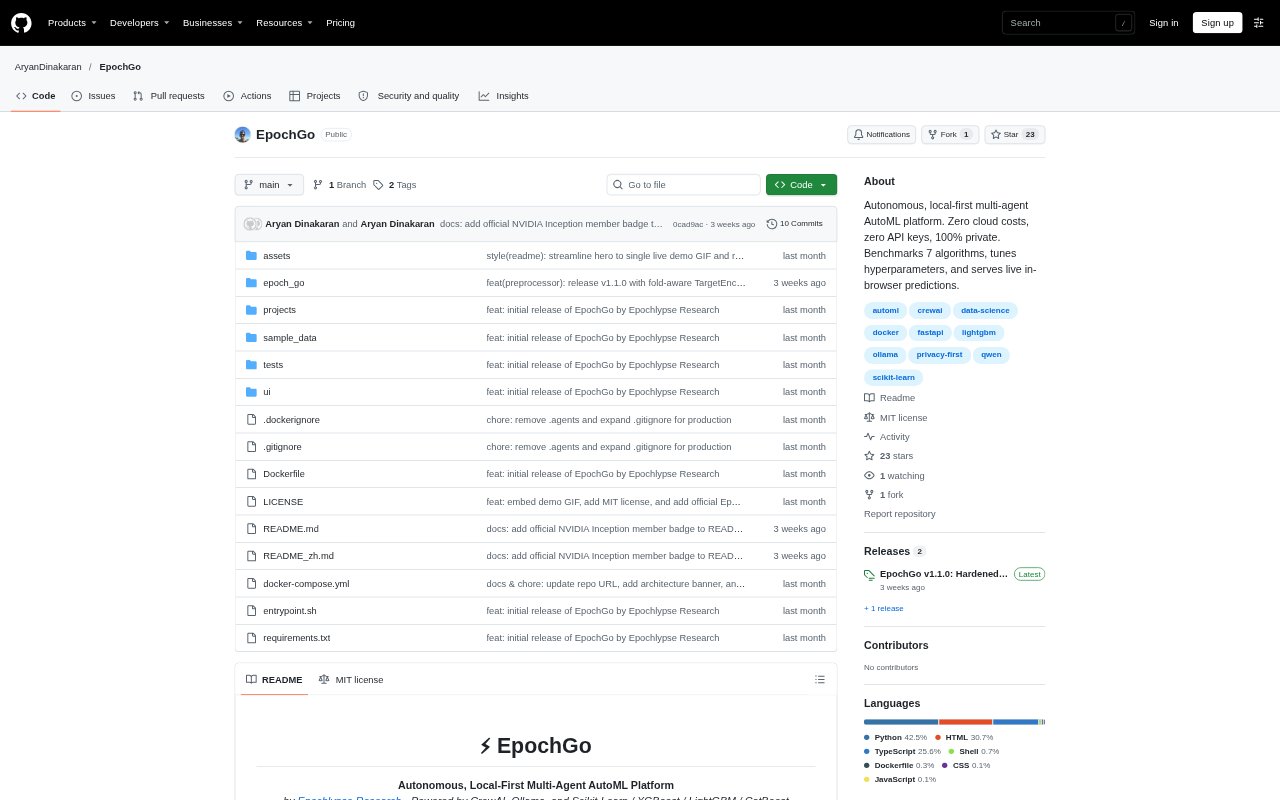
EpochGo is an open-source, local-first AutoML platform for people who want to build and serve machine-learning models from CSV data. It coordinates three AI agents to prepare data, compare and tune models, then create a prediction service. The platform runs on a local machine with Ollama and provides a browser dashboard for managing projects, reviewing results, and testing predictions. Docker is supported, and the project is licensed for personal, commercial, and research use.
EpochGo Features:
CSV Project Workflow: Create a project in the browser by uploading a raw CSV, then let the agent pipeline process it from data preparation through model serving.
Data Preparation: The preprocessing agent detects missing values, outliers, categorical features, scaling needs, multicollinearity, and identifiers, then creates a Scikit-Learn pipeline.
Model Benchmarking: For classification or regression, EpochGo evaluates seven baseline algorithms, compares their metrics, and selects three leading candidates.
Hyperparameter Tuning: The platform applies RandomizedSearchCV to the selected models and saves the chosen model as a serialized artifact.
Project Artifacts: Each project can include cleaned data, preprocessing and training scripts, Markdown reports, a model file, and a generated FastAPI service.
Prediction Serving: A browser-based playground tests predictions and probabilities, while the generated service includes a validated input schema and curl and Python examples.
EpochGo Benefits:
Local Data Control: Keeping the workflow on a local machine helps teams work with datasets without relying on a cloud AutoML service or external API keys.
Lower Service Costs: Using the local Ollama setup avoids cloud costs for the platform’s AI workflow, according to EpochGo’s stated operating model.
Reproducible Work: Saved scripts and serialized preprocessing and model files give users concrete materials to inspect, rerun, and carry into later work.
Clearer Model Choices: Baseline metrics and a ranked set of candidates make it easier to see how alternatives performed before choosing a model.
Smoother Handoff: A generated serving script and example requests help move a trained model from experimentation toward use in an application.
Use Cases:
Churn Classification: Upload a customer dataset with a churn target to prepare the data, compare classification models, and test the resulting predictions.
House Price Regression: Use a property dataset with a price target to benchmark regression algorithms and produce a model that can return price estimates.
CSV Model Prototyping: Explore whether a tabular dataset is suitable for classification or regression without manually assembling each preprocessing and training step.
Model Comparison: Compare candidate algorithms on a dataset and review their reported metrics before deciding which trained model to keep.
Local Prediction API: Generate a FastAPI service and try sample requests when preparing a trained model for integration into a separate application.