

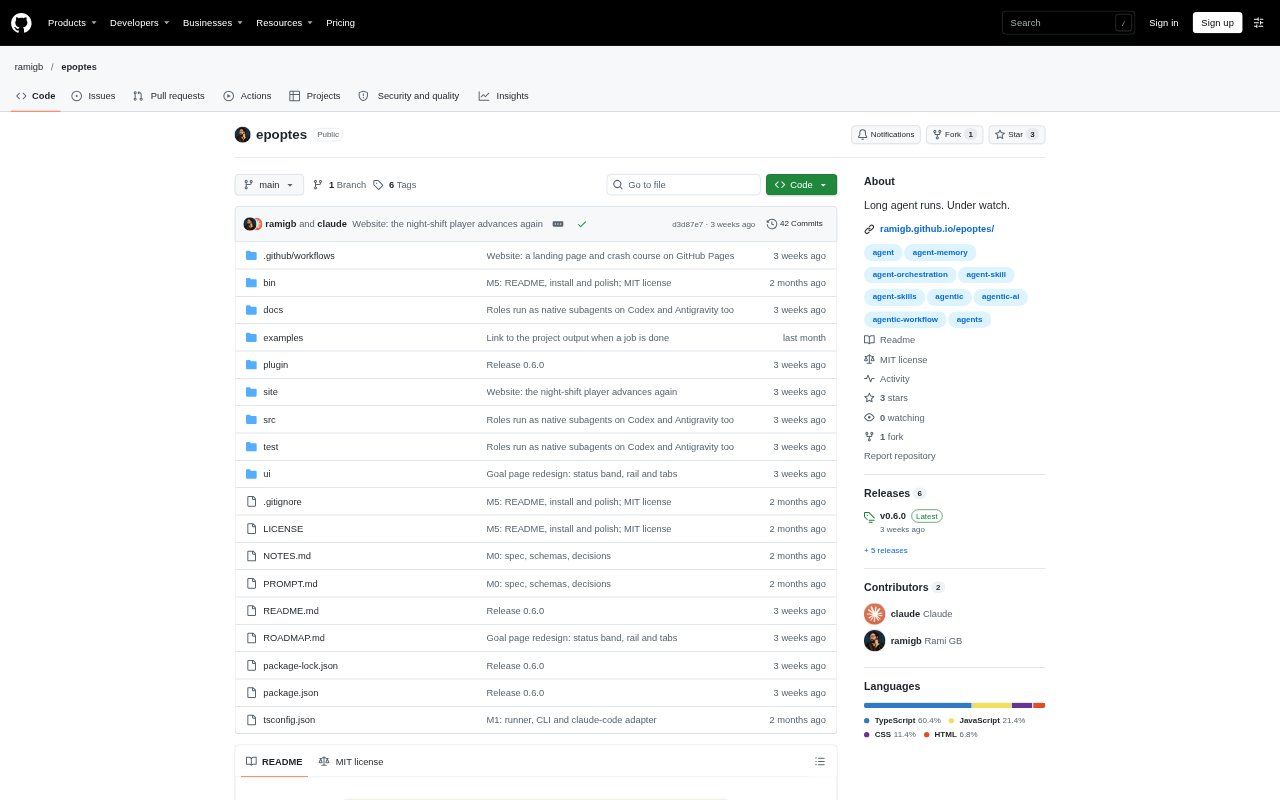
What is Epoptes?
Epoptes is a command-line tool for running long autonomous work sessions with Claude Code, Codex, pi or Antigravity. It turns a goal into a harness that runs the agent through repeated cycles, while giving you a dashboard and kanban board to monitor and steer the work. It is aimed at people delegating extended coding, research, writing or data tasks. It requires Node.js 22.18 or newer and runs on Linux, macOS or WSL2; the project describes itself as early-stage software.
Epoptes Features:
Goal Harness Setup: Describe the goal in a chat and the agent interviews you about the outcome, completion checks, time box, team, approvals and feedback before generating the harness files.
Fresh Context Cycles: The runner starts a fresh agent context for each cycle, which reads the goal's state and board, works on a slice of the task, verifies it and records progress.
Kanban Work Board: Each harness has a board where the orchestrator sorts feedback into work, tracks items through TODO, DOING, REVIEW and DONE, and lets you comment on cards.
Live Run Controls: A local dashboard shows a live ticker and lets you give feedback, pause or stop a run while it is in progress.
Time And Round Caps: Runs can be bounded by a time box and cycle limits, with wrap-up and overtime stages near the end of the allotted time.
Multiple Agent CLIs: Epoptes runs Claude Code, Codex, pi or Antigravity through their installed command-line tools and uses their saved logins rather than handling credentials.
Completion Reports: When a run finishes, you can generate a report from the command line or use the dashboard's Report button.
Epoptes Benefits:
Sustained Progress: Detached runs can continue through repeated cycles even after you close the dashboard or terminal, making extended work less dependent on keeping a session open.
Clearer Oversight: The board and live ticker make it easier to see what the agent is doing and direct its next steps without treating the run as a black box.
More Manageable Runs: Fresh contexts and capped state files help keep long jobs organized instead of relying on one increasingly large conversation.
Bounded Effort: Time and cycle limits, along with the option to use cheaper models for mechanical work, help keep extended tasks within defined constraints.
Reviewable Results: Recorded cycles, board activity and an end-of-run report give you material to inspect when assessing what the agent completed.
Use Cases:
Overnight Build: Set an autonomous coding agent to work on a build overnight, with checkpoints and a time box to structure its progress.
Research Sweep: Run a multi-step research task that benefits from repeated work cycles, recorded progress and opportunities to redirect the agent.
Long-Form Documentation: Have an agent draft a substantial guide, such as a field guide to internal APIs, with completion checks and a place to give feedback.
Data Cleanup: Delegate a data-cleanup job as a series of bounded cycles, then inspect its progress and report when the run ends.