

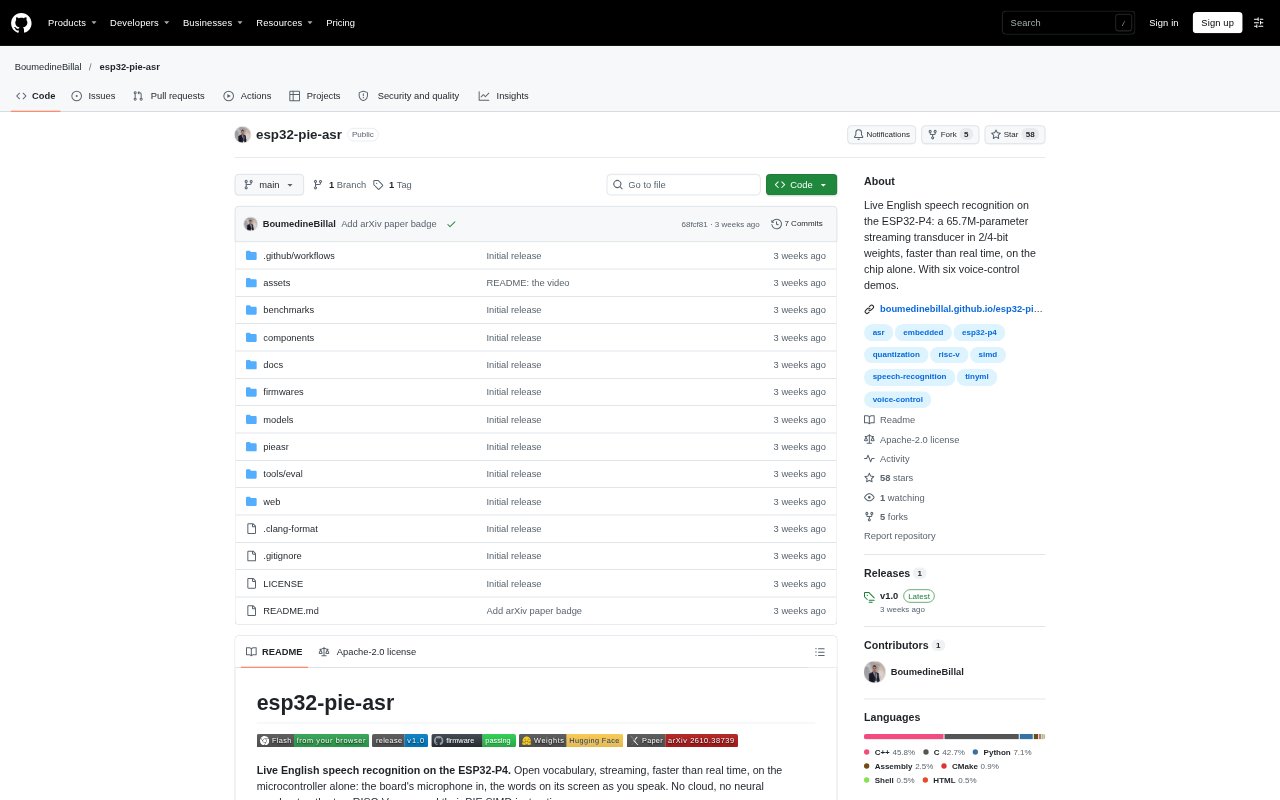
What is ESP32-P4 ASR?
ESP32-P4 ASR is firmware and an inference engine for live English speech recognition on an ESP32-P4 microcontroller. It runs a streaming Kroko transducer locally, using the board’s two RISC-V cores rather than a cloud service or neural accelerator. The project is aimed at developers building embedded speech interfaces, and includes a live transcriber plus six voice-control demos. It requires an ESP32-P4 revision v3 board with 32 MB PSRAM, a microphone, a screen and a microSD card.
ESP32-P4 ASR Features:
Streaming Transcription: The engine processes open-vocabulary English speech in 1.28-second chunks and displays recognized words as the speaker talks.
On-Device Inference: Recognition runs on the ESP32-P4’s two RISC-V cores without sending audio to the cloud or using a neural accelerator.
Compact Model Weights: The 65.7-million-parameter model uses 2- and 4-bit weights totaling 26.65 MB, loaded from microSD into PSRAM at startup.
Editable Phrase Lists: Text files on the microSD card define words and sentences to listen for, with alternate spoken forms and on-screen toggles.
Voice Control Demos: Six demos apply word rules to spoken commands for simulated devices, including a robot vacuum, smart home, car cabin and kitchen.
Browser Firmware Flashing: A browser-based flashing option installs the firmware without separate tools, while an ESP-IDF build path is also available.
ESP32-P4 ASR Benefits:
Local Speech Processing: Keeping recognition on the board avoids a cloud dependency for speech input and lets the device operate as a self-contained interface.
Compact Deployment: Quantized weights fit within the board’s 32 MB PSRAM, making this model usable on the microcontroller rather than requiring a PC.
Faster Prototyping: The included firmware, live transcriber and device demos give developers a working base for exploring embedded speech interactions.
Custom Vocabulary: Phrase lists let builders adapt recognition toward relevant names and commands without retraining the model.
Testable Results: Bit-exact output between the chip and host build helps developers reproduce recognition results while testing and debugging.
Use Cases:
Embedded Transcription: Add live English captions to a device with a microphone and display, with recognized words appearing during speech.
Smart Home Commands: Prototype spoken control for home devices using word rules for actions, rooms and commands such as excluding a bedroom.
Appliance Interfaces: Explore voice-driven controls for kitchen equipment, car-cabin functions or a simulated robot vacuum without a cloud connection.
Factory Voice Input: Test spoken commands for a simulated production line, using the factory demo’s rules and phrase list.
Presenter Controls: Build a proof of concept for voice-operated presentation actions using the included presenter demo as a starting point.