
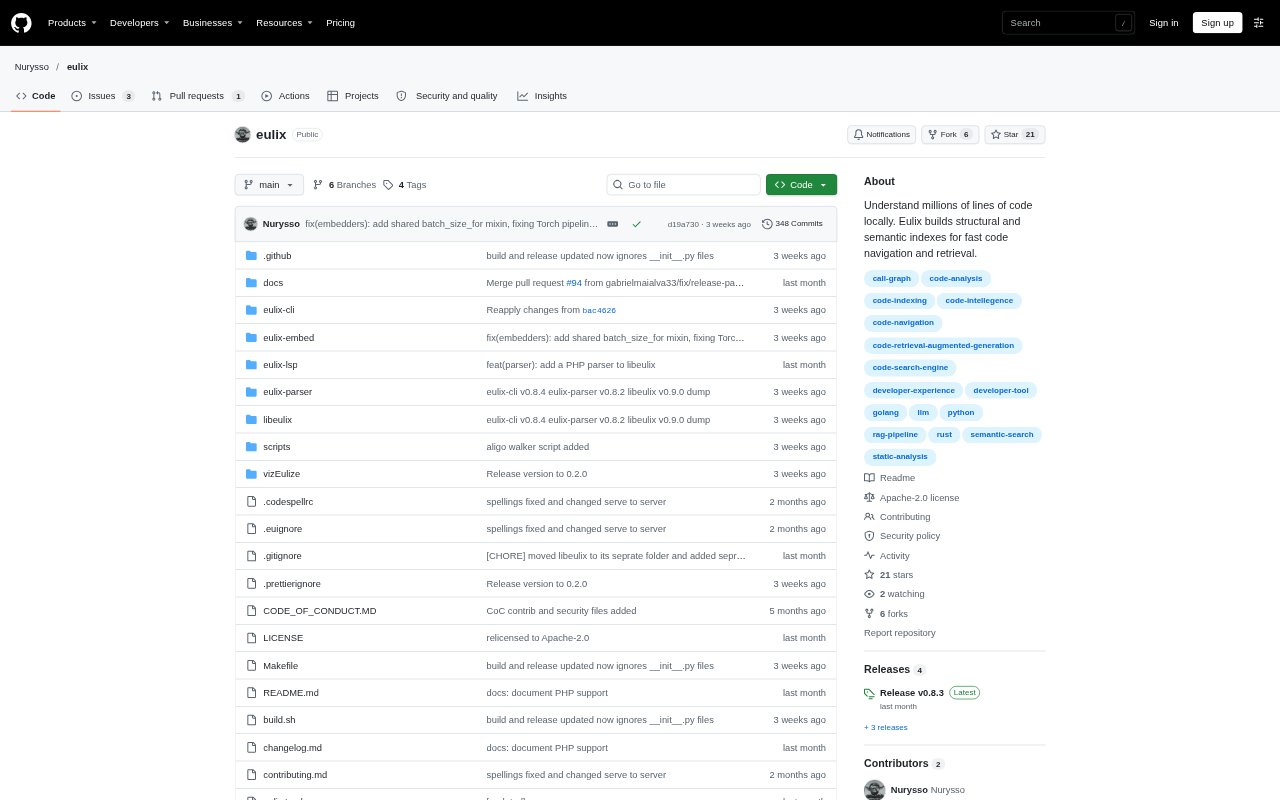
What is Eulix?
Eulix is a local-first code intelligence tool for developers working in large repositories. It parses code into a searchable index of symbols, dependencies, call relationships and, optionally, semantic embeddings, then uses that data to answer questions about the codebase. Its command-line interface supports repository analysis, interactive chat and one-off queries, while integrations include an MCP server for coding agents, a beta language server and a browser-based call-graph explorer. An LLM is optional.
Eulix Features:
Structural Index: Eulix extracts functions, classes, methods, symbols, imports, dependencies, entry points and project metrics into a repository index.
Call Graph: The index records call relationships so you can navigate callers and callees with surrounding structural context.
Hybrid Retrieval: Search combines exact symbol lookup, lexical matching, optional semantic vectors, subsystem signals, graph expansion and diversity ranking.
Query Routing: Queries are directed to deterministic lookups, structural data or retrieval with optional LLM reasoning, depending on what they ask.
Local Processing: Parsing, indexing, retrieval and embedding can run on-device, with support for local models or a configured remote LLM provider.
Developer Interfaces: Use the CLI, a beta language server, an MCP server for coding agents, a Rust library or the browser-based call-graph explorer.
Language Support: The parser supports C, C++, Go, Java, JavaScript, PHP, Python, Rust and TypeScript, but not JSX or TSX.
Eulix Benefits:
Faster Navigation: A single index helps you move from a symbol to its callers, callees and dependencies without piecing together those connections manually.
Fewer Model Calls: Direct repository facts and navigation questions can be answered without an LLM, reserving model use for questions that need reasoning.
Grounded Answers: Retrieved repository code gives answers a concrete basis in the project instead of relying only on a model's general knowledge.
Local Control: Keeping analysis and retrieval on-device lets teams work without a cloud account or API key when they do not configure a remote provider.
Less Manual Exploration: Combining text, symbol and relationship searches reduces the need to inspect files one by one to understand how code connects.
Use Cases:
Find a Symbol: Locate a function, class or other symbol in an unfamiliar repository using an exact lookup.
Trace Callers: Check which parts of a codebase call a particular function, or follow the functions it calls.
Understand Subsystems: Explore how a subsystem works by combining semantic retrieval with structural relationships in the repository.
Investigate Code Paths: Follow an implementation path across files when a question involves dependencies, entry points or connected symbols.
Ask Project Questions: Query repository metrics or ask an open-ended question about behavior, such as how correlated-subquery table aliases are handled.