
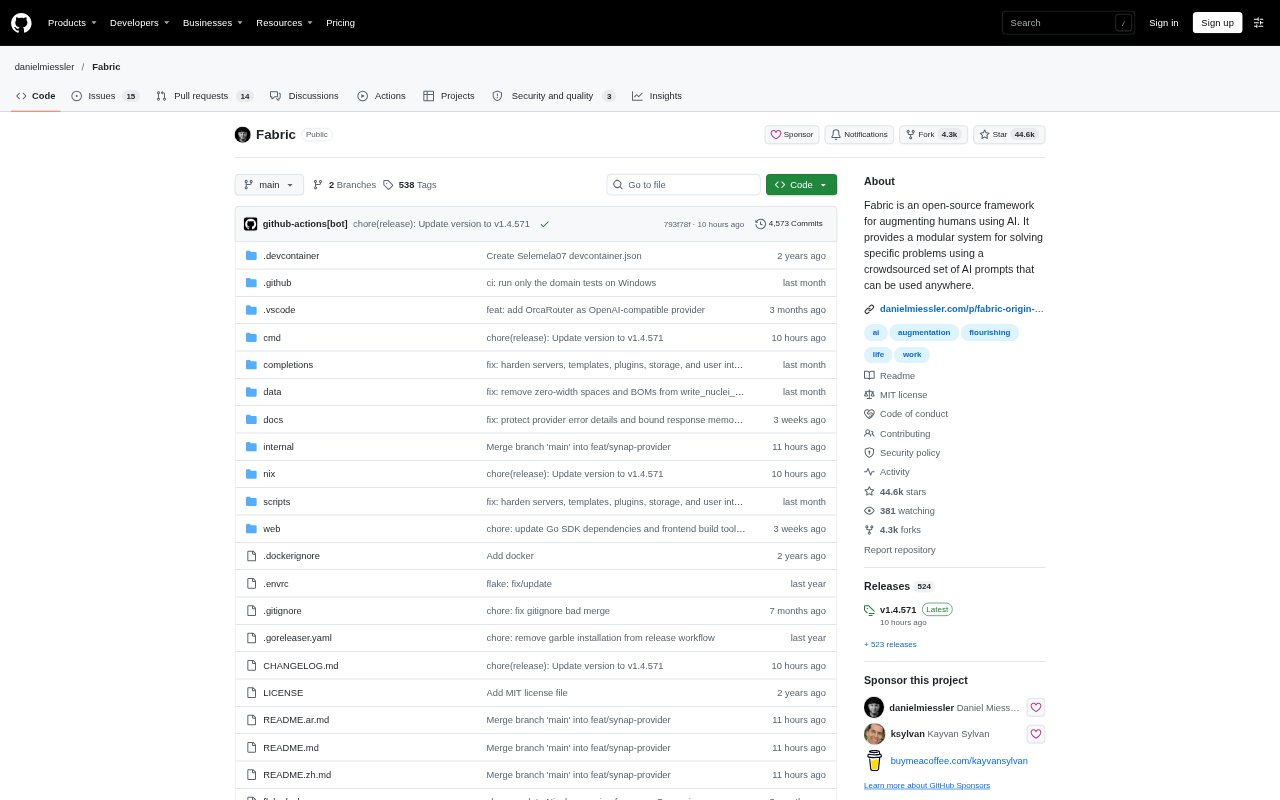
What is Fabric?
Fabric is an open-source AI framework for people who want to use prompts as practical tools for specific tasks. It organizes prompts into reusable patterns that can run through its command-line interface or be used in other tools. Users can build a workflow by breaking work into smaller steps and chaining AI commands together, and can connect Fabric to supported AI providers. It is aimed at people who want to bring AI into their work without relying only on separate chat apps.
Fabric Features:
Task-Based Prompts: Fabric organizes prompts into patterns for real-world tasks, giving users a collection of reusable AI instructions to run or adapt.
Command-Line Runs: The command-line interface lets users send input through a selected pattern and use Fabric directly from their terminal.
Chained Workflows: Users can connect AI commands into workflows, applying separate patterns in sequence to handle a larger task in parts.
Custom Patterns: Users can create their own patterns, adding task-specific prompts to the same system they use for existing patterns.
AI Provider Support: Fabric supports multiple AI backends, with options that include OpenAI, Anthropic, Azure OpenAI, Google Vertex AI, and Ollama.
Speech Transcription: The command-line tool can transcribe audio files using speech-to-text support, with options for selecting a model and splitting media files.
Fabric Benefits:
Repeatable Tasks: Keeping task prompts as patterns makes it easier to reuse an approach instead of rewriting instructions each time.
Fewer Tool Switches: Running patterns from the command line lets users apply AI to work without moving every task into a separate chat interface.
Clearer Workflows: Breaking a larger job into smaller prompt steps can make the process easier to shape, repeat, and adjust.
Personalized Prompts: Custom patterns let users reflect their own requirements in AI instructions rather than depending only on a shared set.
Flexible Backends: Support for multiple AI providers gives users room to work with different backends within the same prompt framework.
Use Cases:
Summarizing Material: Run a summarization pattern on written material when you need a concise version to review or share.
Transcribing Audio: Use the transcription command on a media file when you need its spoken content converted to text.
Building AI Workflows: Chain prompts together when a project needs several distinct AI steps rather than one broad instruction.
Saving Team Prompts: Create patterns for recurring work so people can keep useful AI instructions organized and ready to reuse.
Terminal-Based AI: Use Fabric from the command line when you want to apply task-specific prompts as part of a terminal-focused workflow.