

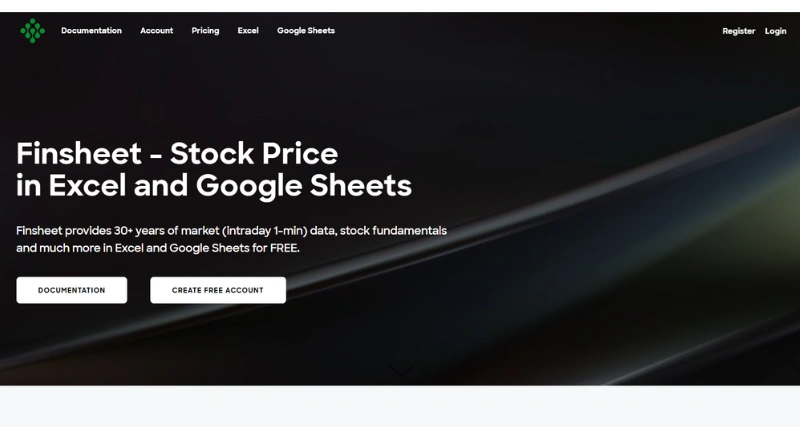
What is Finsheet ?
Finsheet is a powerful financial data platform that integrates directly with Excel and Google Sheets, providing users with access to over 30 years of market data, including intraday (1-minute) stock prices, comprehensive financial statements, analyst estimates, and more. Designed for investors, analysts, and financial professionals, Finsheet simplifies data retrieval and analysis without the need for coding.
Finsheet Features:
Extensive Market Data: Access to 30+ years of historical intraday (1-minute) data for U.S. markets, 15-minute delayed LSE data, and end-of-day tick-level data for international markets.
Global Coverage: Data from over 60 major exchanges, covering 61,000+ global companies, including equities, ETFs, mutual funds, forex, and cryptocurrencies.
Financial Statements & Ratios: Comprehensive access to financial statements, 25+ years of analyst estimates, EPS/Sales surprises, and precomputed financial ratios.
Real-Time Streaming: Stream live price data for U.S. stocks, ETFs, mutual funds, cryptocurrencies, and forex directly into Excel or Google Sheets.
User-Friendly Functions: Simple and consistent function names across Excel and Google Sheets, requiring no coding knowledge.
ETF Holdings Data: Access comprehensive historical ETF holdings for global ETFs, updated daily.
Technical Analysis Tools: Includes pattern recognition, support/resistance levels, aggregate indicators, and technical indicators.
Alternative Data: Offers earnings calendars, ESG scores, earnings quality scores, and institutional portfolios.
Finsheet Benefits:
Seamless Integration: Directly integrates with Excel and Google Sheets, eliminating the need for manual data imports.
Time-Saving: Automates data retrieval processes, allowing users to focus on analysis and decision-making.
High-Quality Data: Provides institutional-grade data used by hedge funds, investment banks, and other financial institutions.
User-Friendly: Designed for users with no coding experience, utilizing simple functions for data access.
Use Cases:
Investment Analysis: Conduct in-depth analysis of stocks, ETFs, and other financial instruments using historical and real-time data.
Financial Modeling: Build and maintain financial models with up-to-date market data directly in spreadsheets.
Portfolio Management: Monitor and analyze portfolio performance with live data feeds and comprehensive financial metrics.
Academic Research: Utilize extensive historical data for research projects and educational purposes.