
What is Flightdeck?
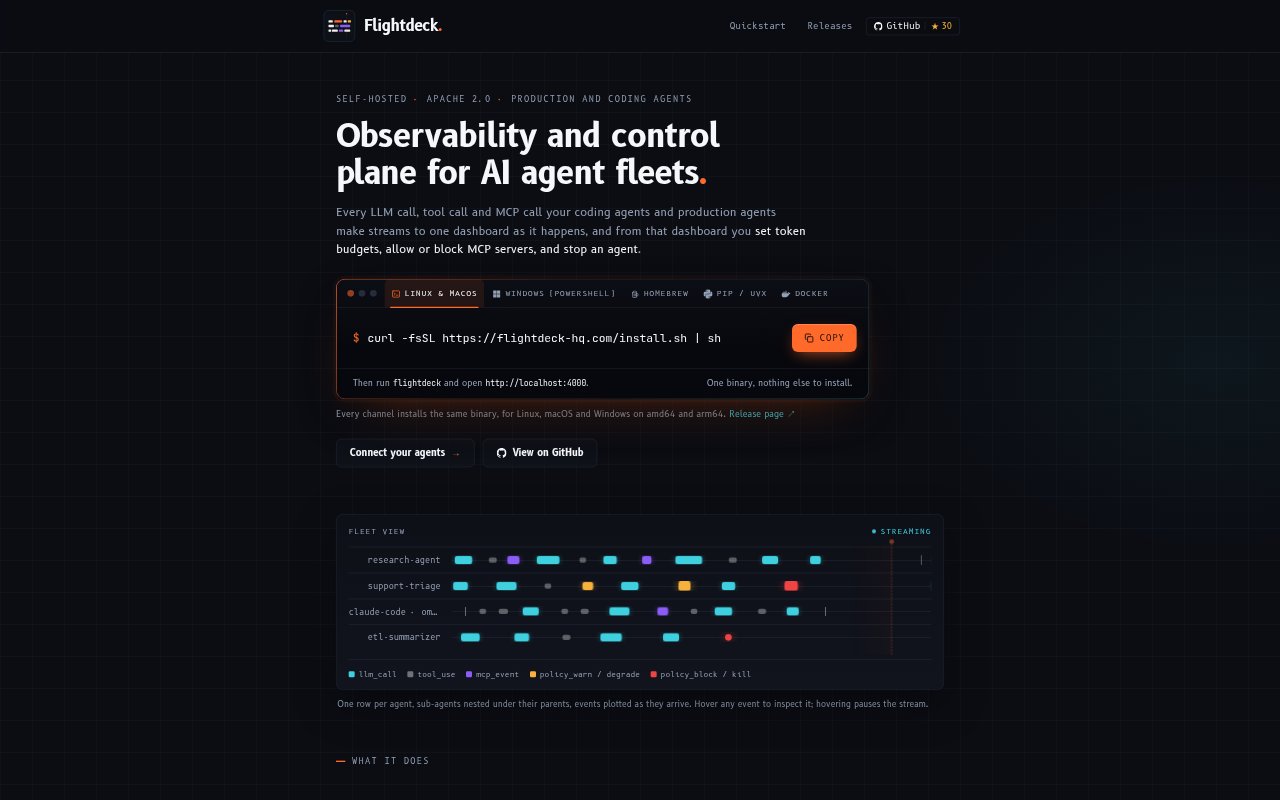
Flightdeck is a self-hosted observability and control plane for teams running AI coding agents and production agent fleets. It streams agent activity to a shared dashboard, where teams can inspect calls, review usage and apply controls. A single binary runs on Linux, macOS or Windows, and Python agents can connect through a sensor that wraps supported SDK clients. Flightdeck is designed for teams that want visibility into agent activity without routing provider calls through a proxy.
Flightdeck Features:
Live Fleet View: A shared timeline streams LLM calls, embeddings, tool uses, MCP events and structured errors as agents run.
Token Budgets: Set configurable per-flavor budgets that warn at 80 percent, switch to a cheaper model at 90 percent or block at 100 percent.
Remote Controls: Stop an individual agent or an entire flavor from the dashboard, or register custom Python directives for remote invocation.
MCP Server Rules: Allow or block MCP servers per flavor, with warnings or blocks for unrecognized or misconfigured servers before a call leaves the process.
Agent Trees: View multi-agent runs as linked parent and child sessions, with sub-agents labeled by role.
Usage Analytics: Review token consumption, latency, model distribution, policy volume and estimated cost, grouped by dimensions such as framework, host or team.
Flightdeck Benefits:
Faster Investigation: Inspecting individual events on a live timeline helps teams trace errors and agent behavior while a run is still underway.
Spending Guardrails: Automatic budget actions help limit unwanted token consumption and give teams a chance to shift work to a cheaper model.
Clearer Ownership: Nested sessions and role labels make it easier to see how work is divided across an orchestrator and its sub-agents.
Reduced Exposure: MCP rules can prevent agents from contacting servers that a team has not approved for their flavor.
Less Setup Work: The single-binary deployment and sensor-based connection let teams add monitoring without changing the rest of a Python agent's code.
Use Cases:
Claude Code Oversight: Track Claude Code sessions across a team and inspect their events, run boundaries and activity from one fleet view.
Python Agent Monitoring: Connect Python agents that use Anthropic or OpenAI SDKs, or litellm, directly or through a framework, to review their activity.
Multi-Agent Debugging: Follow a CrewAI or LangGraph run from its orchestrator through child sessions when investigating which agent produced an event.
Production Fleet Operations: Monitor production agents for latency, errors and estimated cost, then intervene when a run needs to be stopped.
MCP Governance: Set server access rules for agent flavors when teams need to control which MCP services their agents can contact.