

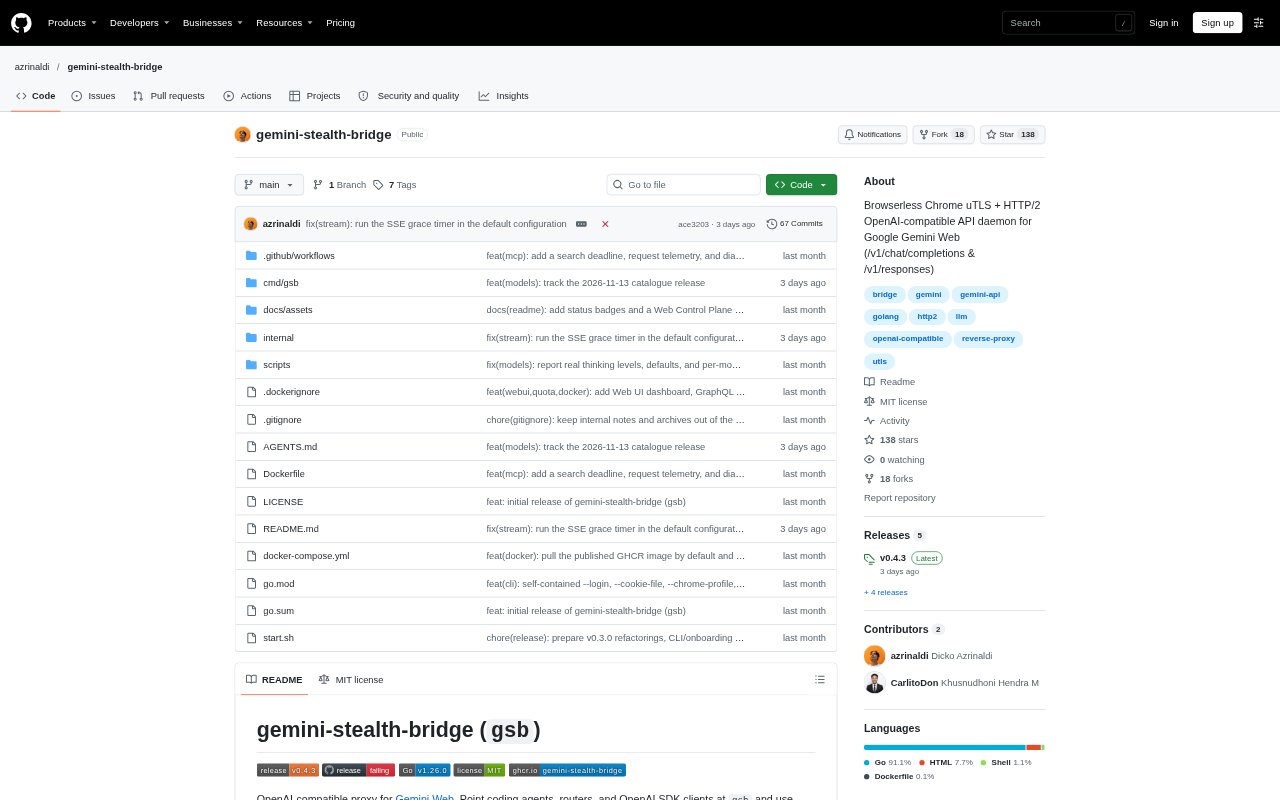
What is Gemini Stealth Bridge?
Gemini Stealth Bridge is a self-hosted API daemon that lets OpenAI-compatible clients use Gemini Web through a Google account’s session cookies. It translates Chat Completions and Responses requests into Gemini Web requests and returns JSON or streaming responses. It is aimed at developers running coding agents, routers, or applications that already use OpenAI-style APIs. This is an unofficial bridge, and operation can be interrupted by changes to Google’s web protocol, sign-in requirements, account restrictions, or quotas.
Gemini Stealth Bridge Features:
OpenAI-Compatible API: The daemon supports Chat Completions and Responses endpoints, with JSON and Server-Sent Events output.
Function Calling: It translates tool definitions into prompts, checks returned arguments against JSON Schema, and emits OpenAI-style tool calls.
Image Input: Requests can include images as base64 data URLs, remote HTTPS images, or Anthropic-style image parts.
Account Pooling: Pool keys route requests across accounts using rotation, least-recently-used, or fill-first strategies, with quota-aware failover.
Search Grounding: Gemini Web search citations can be added to answers as a numbered Sources list, or exposed through the built-in MCP web_search tool.
Media Generation: The bridge supports Imagen or Nano Banana image generation and Veo video generation through API endpoints and agent tool calling.
Web Dashboard: An embedded control panel supports account onboarding, quota views, priority ordering, account pauses, quarantine actions, and runtime configuration.
Gemini Stealth Bridge Benefits:
Reuse Existing Clients: Teams can connect compatible OpenAI SDK clients and coding agents without switching to a separate client interface.
Manage Quota Limits: Account pooling and quota-aware failover help keep requests moving when an account’s available quota is exhausted.
Simpler Operations: A single daemon and its embedded dashboard bring account setup and runtime controls into one place.
Flexible Deployment: Static binaries and a container option give operators different ways to run the bridge on supported systems.
Fewer Manual Checks: Session maintenance can refresh cookies, models, and quotas in the background and save updated credentials.
Use Cases:
Coding Agent Setup: Point a coding agent that accepts OpenAI-compatible endpoints at the bridge to use Gemini Web for coding conversations.
Multi-Account Routing: Route requests across authorized Google accounts when operating a service that needs account pooling and quota-aware failover.
Tool-Using Workflows: Connect an agent that expects OpenAI-style function calls and have it execute the tool calls returned by the bridge.
Image-Based Prompts: Send an image alongside a prompt when building a client workflow that needs Gemini Web to respond to visual input.
Grounded Research: Use the search grounding endpoint or MCP tool when an agent needs web-search citations included with its answer.
Generated Media: Generate images or video from an application or coding agent using the bridge’s media endpoints and tool-calling support.