

What is GLM?
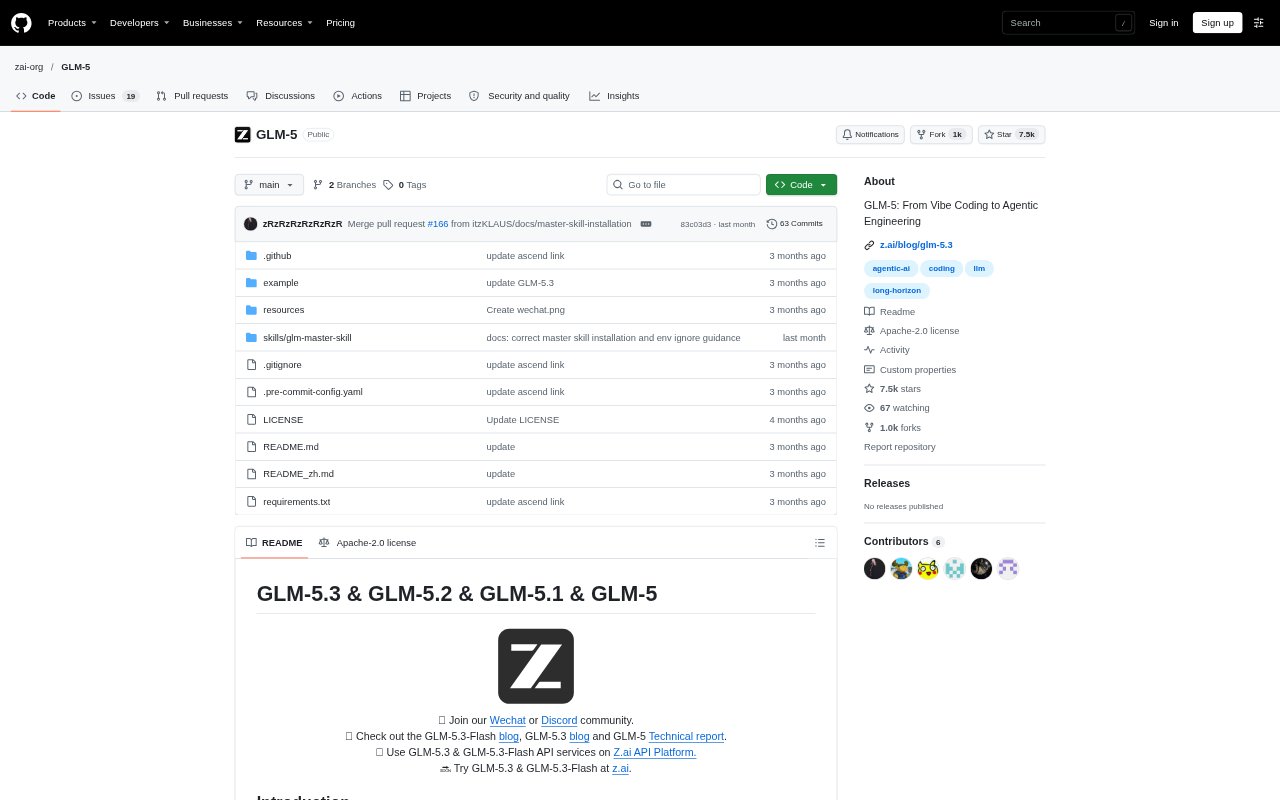
GLM-5 is an open-weight language model for complex systems engineering and long-horizon agentic tasks. It is part of a model family that includes GLM-5.1, GLM-5.2 and GLM-5.3, with versions available for download in BF16 and FP8 formats. Teams can use the models through supported inference frameworks for local serving, or fine-tune them with supported training frameworks.
GLM Features:
Long-Horizon Tasks: GLM-5 is designed to work on tasks that require sustained planning and execution, rather than only answering a single prompt.
Systems Engineering: The model targets complex systems engineering work across frontend, backend and extended task benchmarks.
Coding and Reasoning: GLM-5 is built for coding, reasoning and agentic tasks, including real-world terminal work and repository generation.
Long Context: DeepSeek Sparse Attention reduces deployment cost while preserving the model's capacity to handle long contexts.
Local Deployment: The GLM-5 family can be served locally using supported inference frameworks, including vLLM, SGLang and Transformers.
Model Fine-Tuning: Fine-tuning is supported through Slime for reinforcement learning and ms-swift for supervised fine-tuning, PPO and GRPO.
GLM Benefits:
Fewer Manual Steps: For work that spans several stages, the model's focus on long-horizon tasks can reduce the need to break every part into separate prompts.
Broader Engineering Work: Its emphasis on frontend, backend and systems tasks gives engineering teams one model family to evaluate across different parts of a project.
Deployment Choice: Downloadable weights and local serving options let teams choose a deployment approach that fits their infrastructure needs.
Adaptable Models: Fine-tuning options give teams a way to adjust a model for their own training objectives and workflows.
Cost-Aware Serving: Sparse attention is intended to lower deployment cost while retaining long-context capacity, which can help with extended inputs.
Use Cases:
Complex Code Changes: Use GLM-5 to work through engineering tasks that involve changes across frontend and backend systems.
Repository Generation: Evaluate the model for turning a natural-language description into a software repository.
Terminal Workflows: Try it on tasks that require working through commands and results in a development terminal.
Extended Agent Tasks: Use the model for workflows that involve multiple stages of planning and execution over a longer task.
Private Model Serving: Download a model and serve it locally when you want to run inference within your own deployment environment.