
What is Goethe?
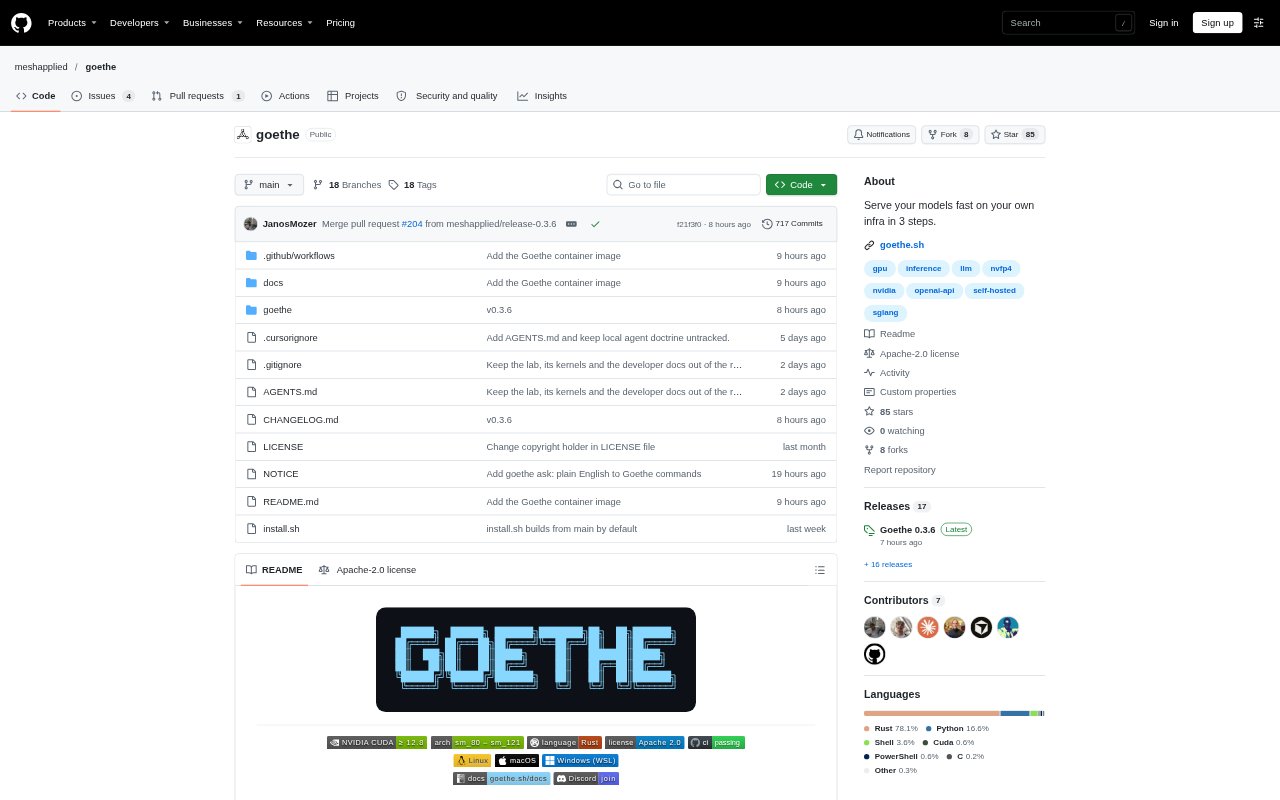
Goethe is a self-hosted inference engine for serving and managing models on GPU hardware you control. It connects GPU machines into a managed cluster and exposes loaded models through one private API compatible with OpenAI, Anthropic, and LiteLLM clients, so teams can use compatible apps and SDKs. It runs on Linux, Apple Silicon macOS, or Windows through WSL2, and is designed for people operating their own workstations, servers, GPU containers, or cloud GPU machines.
Goethe Features:
Unified Model Gateway: Loaded models are served at the same address, and each request selects a model by name.
GPU Cluster Management: Goethe connects GPU nodes into a managed cluster for serving models across your infrastructure.
Multiple Runtimes: Optimized kernel packs accelerate supported models on supported GPUs, with a plain runtime available for other cases.
Flexible GPU Placement: Run several models side by side, split large models across GPUs, and keep other GPU software running alongside Goethe.
API Key Controls: Create keys that can be scoped, rate-limited, expired, renewed, or revoked, with key values stored only as hashes.
Local Metrics: View request and token counts, time to first token, decode speed, and GPU use by model and key, with metrics kept on the machine.
Restart Recovery: Models that were loaded before a reboot or crash are brought back automatically.
Goethe Benefits:
Data Stays Local: Keeping prompts, data, and models on hardware you control gives teams more direct control over where inference happens.
Reuse Existing Clients: Compatible APIs let teams connect supported apps and SDKs without adopting a Goethe-specific client.
Clear Usage Picture: Per-model and per-key metrics make it easier to understand how the inference service is being used and performing.
Controlled Access: Adjustable key permissions and limits give operators options for managing who can use the API and how.
Flexible Hardware Use: Running models side by side or across multiple GPUs lets teams adapt inference to the hardware they have.
Use Cases:
Internal AI Services: Give staff applications a private API for models running on company-controlled GPU machines.
Cloud GPU Hosting: Deploy models on a cloud GPU machine and expose the API through a VPN or public address.
Model Comparison: Serve several models behind one gateway so an application can select between them by model name.
Large Model Serving: Run a model that needs to be split across multiple GPUs on a supported machine.
Embedding Workflows: Serve a supported GGUF embedding model from infrastructure managed by your team.