

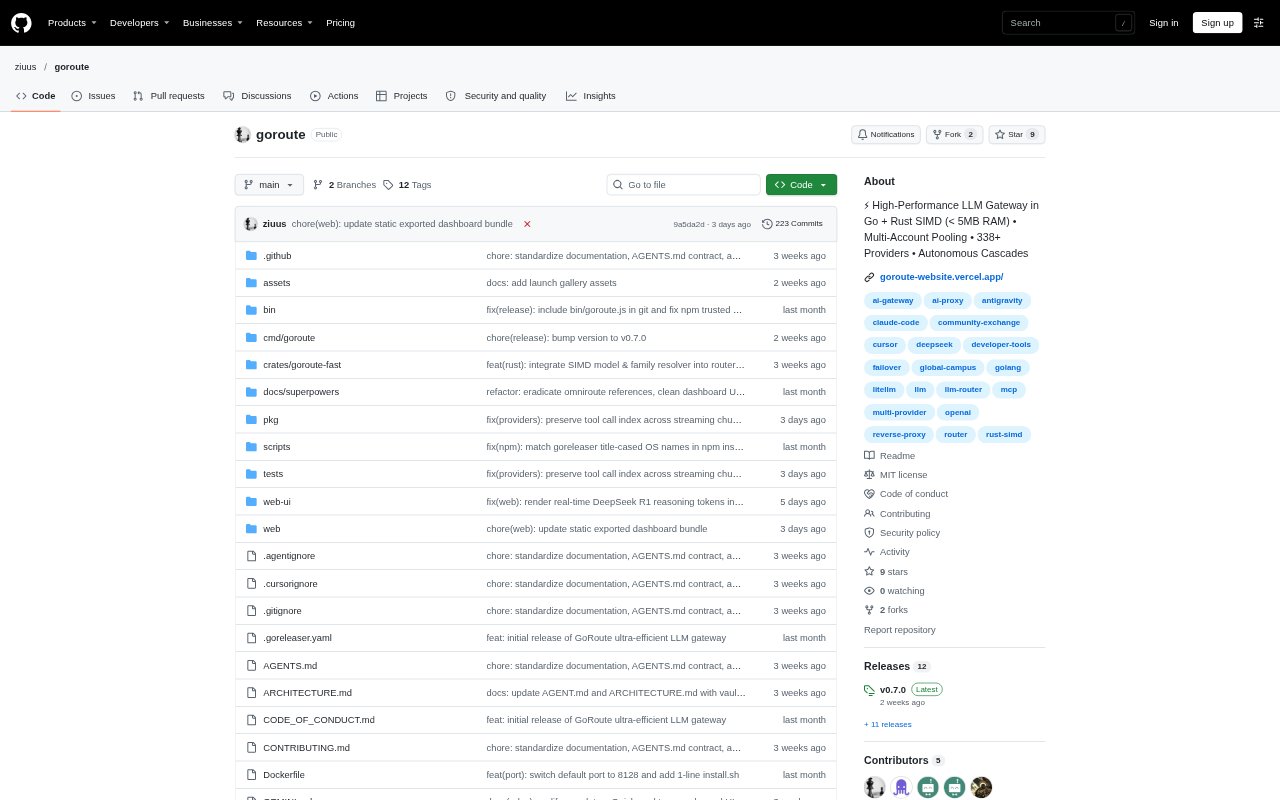
What is GoRoute?
GoRoute is a local AI gateway that sits between coding agents and AI models, routing requests across provider accounts and translating between OpenAI, Anthropic, and Gemini formats. It is aimed at developers using tools such as Claude Code, Cursor, and other coding agents, as well as teams running multiple agents. The single-binary service includes a web dashboard for managing providers, routing combinations, and testing requests.
GoRoute Features:
Protocol Translation: GoRoute translates requests among OpenAI Chat Completions, Anthropic Messages, and Google Gemini formats, including tool calling and Anthropic thinking-token support.
Account Pooling: Connect multiple provider accounts and use round-robin or priority routing, with OAuth token refresh for supported accounts and SQLite WAL persistence.
Recursive Failover: Create nested routing combinations that switch to another account or model when an upstream returns errors or reaches rate limits.
Health Controls: Circuit breakers and cooldowns isolate unhealthy endpoints, while latency-based selection helps choose among accounts in a pool.
Embedded Dashboard: The local web portal lets users manage providers, reorder routing priorities, inspect quotas and cooldowns, and test streaming completions.
Agent Setup: A CLI command can configure supported developer tools, while the gateway exposes standard endpoints for chat completions, messages, model discovery, and token counting.
GoRoute Benefits:
Less Manual Switching: Automatic routing and failover can keep coding workflows moving without requiring developers to change providers whenever an account is unavailable.
Lower Background Use: The native single-binary gateway is designed to run with under 5 MB of RAM, limiting the resources used by a persistent local proxy.
Reuse Existing Clients: Protocol translation lets teams connect compatible coding tools and SDKs without modifying their integrations to match each upstream provider.
Simpler Provider Management: The dashboard and CLI bring account connections, routing priorities, health checks, and request testing into one local control point.
Use Cases:
Parallel Coding Agents: Route requests from several Claude Code, Cursor, or other supported coding-agent sessions through shared provider accounts and failover combinations.
Rate Limit Recovery: Set up a cascade across models or accounts so an agent can continue its request path when a provider reports a rate limit or service error.
Mixed Provider Workflows: Connect tools expecting different supported API formats to a local gateway that translates requests for the selected upstream model.
Local Model Routing: Include a self-hosted Ollama instance alongside hosted providers when configuring model access for developer tools.