
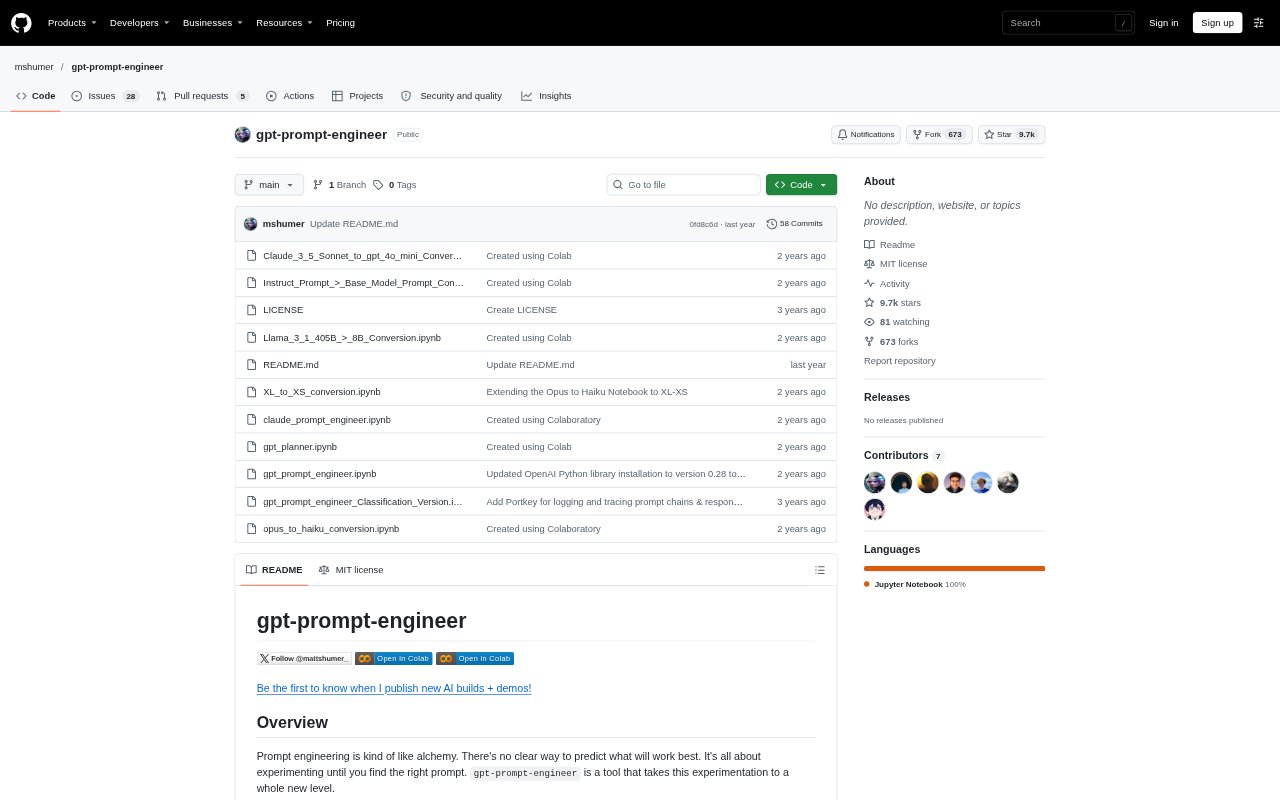
What is GPT Prompt Engineer?
GPT Prompt Engineer is a notebook-based tool for generating and evaluating prompts for AI tasks. You describe the task and provide test cases, then the system creates candidate prompts, runs them against those cases, and ranks their performance. It offers versions for GPT-4, GPT-3.5-Turbo, and Claude 3 Opus, including a classification notebook and a Claude version that can generate test cases. It suits people who want to compare prompt designs using their own examples.
GPT Prompt Engineer Features:
Prompt Generation: Generate multiple candidate prompts from a task description and test cases using GPT-4, GPT-3.5-Turbo, or Claude 3 Opus.
Prompt Testing: Run each candidate prompt against the supplied test cases to compare the responses it produces.
ELO Rankings: Rank candidate prompts by performance in comparisons, with ratings displayed in descending order.
Classification Notebook: Evaluate classification prompts against test cases with expected true or false outputs and view a score table.
Claude Test Generation: Use the Claude 3 Opus notebook to generate test cases from a task description and defined input variables.
Optional Logging: Send configuration details, prompts, test cases, and final ELO ratings to Weights & Biases, or trace prompt chains and responses with Portkey.
GPT Prompt Engineer Benefits:
Compare Prompt Options: A ranked set of candidates makes it easier to identify which prompt performed better on the examples that matter to your task.
Test Against Examples: Using your own test cases gives you a concrete basis for judging prompt behavior instead of relying only on an initial impression.
Review Classification: Scores for true-or-false test cases help you inspect how candidate prompts handle a defined classification task.
Reuse Task Inputs: Multiple input variables in the Claude version let you define task details separately when testing prompts for variable-based tasks.
Inspect Experiment Details: Optional logging provides a record of prompt and test-case details alongside configuration settings and final rankings.
Use Cases:
Landing Page Headlines: Compare prompts for generating headlines across different products, services, or campaign descriptions.
Email Responses: Test prompts for personalized replies using input fields such as sender name, recipient name, and topic.
Sentiment Classification: Evaluate prompts that label example messages as positive or negative using expected true-or-false outputs.
Marketing Copy: Run candidate prompts against examples for promoting an app, course, book, or other offering.
Prompt Experiments: Compare prompt designs for a described AI task before choosing one to use with a set of sample inputs.