
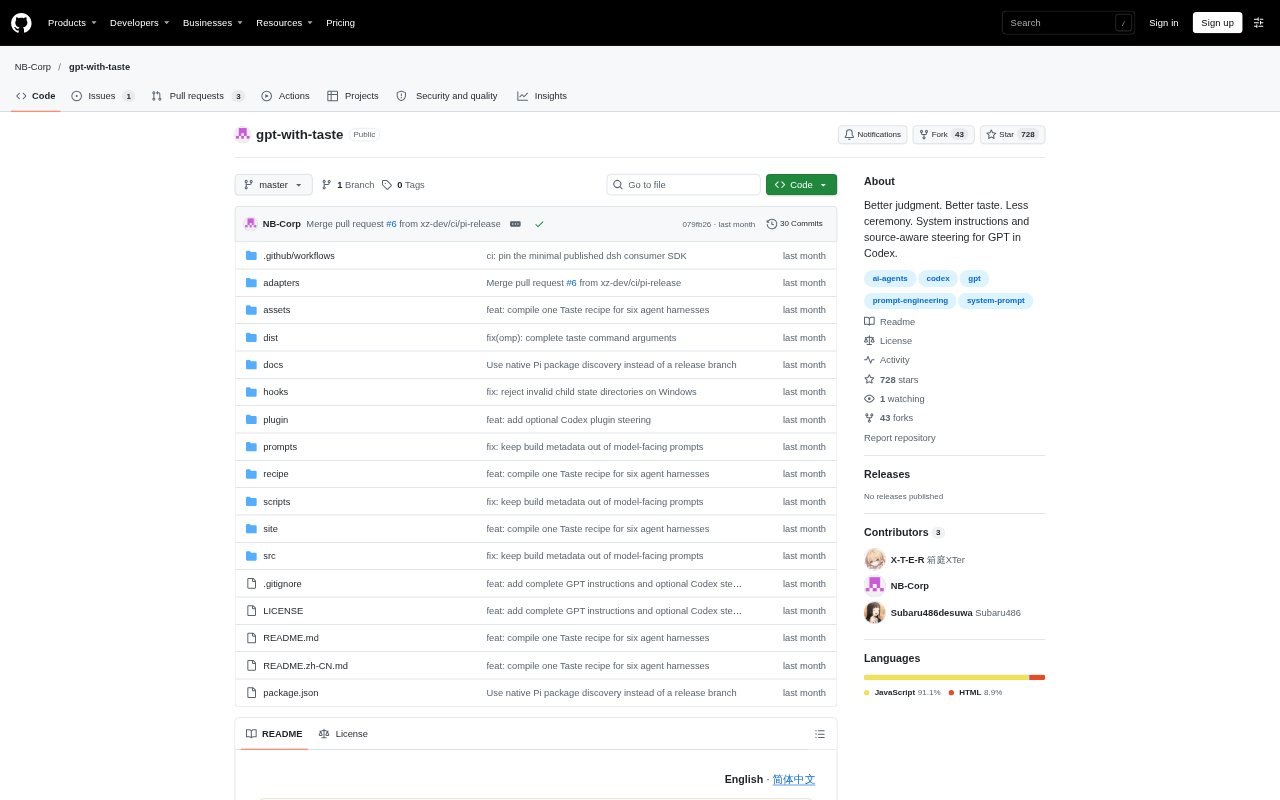
What is gpt with taste?
GPT with Taste is a behavioral recipe for GPT-based coding assistants, designed to guide everyday decisions, task execution, collaboration, and the craft of written and visual work. It installs into supported coding harnesses, including OpenAI Codex, Claude Code, Kiki, Pi, Oh My Pi, and DeepSeek Harness. The project is aimed at the GPT reasoning family, with particular compatibility for GPT-6.1 Sol and GPT-6 Astra, and replies follow the language of the latest user message.
gpt with taste Features:
Harness Support: The recipe compiles into host-specific instructions and steering for Codex, Claude Code, Kiki, Pi, Oh My Pi, and DeepSeek Harness.
Behavioral Recipe: One shared recipe sets priorities for judgment, continuous execution, collaboration, and engineering and visual craft across supported hosts.
Event Steering: Hooks, extensions, or native recipe events can refresh reminders at supported points such as user submissions, child startup, and collaborator results.
Role Instructions: Standalone prompt definitions provide complete behavior for each agent role, while supported harnesses connect the corresponding reminder paths.
Codex Installer: A Node.js 22-or-newer installer writes managed prompt files to the active CODEX_HOME and can add hooks without requiring npm packages.
Language Matching: The instructions are written in English, while generated replies follow the language used in the latest user message.
gpt with taste Benefits:
Fewer Micromanaged Choices: The recipe encourages sensible defaults, so users can leave ordinary decisions to the assistant instead of spelling out every small choice.
Focused Deliverables: Prioritizing the requested outcome helps keep work direct, with installation details and process explanations out of the way when they are not needed.
More Useful Collaboration: Guidance for processing collaborator findings helps turn delegated work into practical next steps rather than leaving results disconnected.
Consistent Working Style: Using one recipe across supported hosts gives teams a shared set of behavioral priorities when they switch coding environments.
Use Cases:
Codex Setup: Install the recipe into Codex when you want its standing instructions and optional hooks to guide work across new sessions.
Cross-Host Work: Use the matching integration when a coding workflow moves between Codex, Claude Code, Pi, Kiki, Oh My Pi, or DeepSeek Harness.
Delegated Tasks: Apply it to coding tasks that involve child agents or collaborator results, so the assistant has reminders for handling each contribution.
Getting-Started Guides: Give the assistant notes and ask it to prepare a colleague-facing guide, such as a Chinese getting-started document after installation.