

What is Grim Prompter?
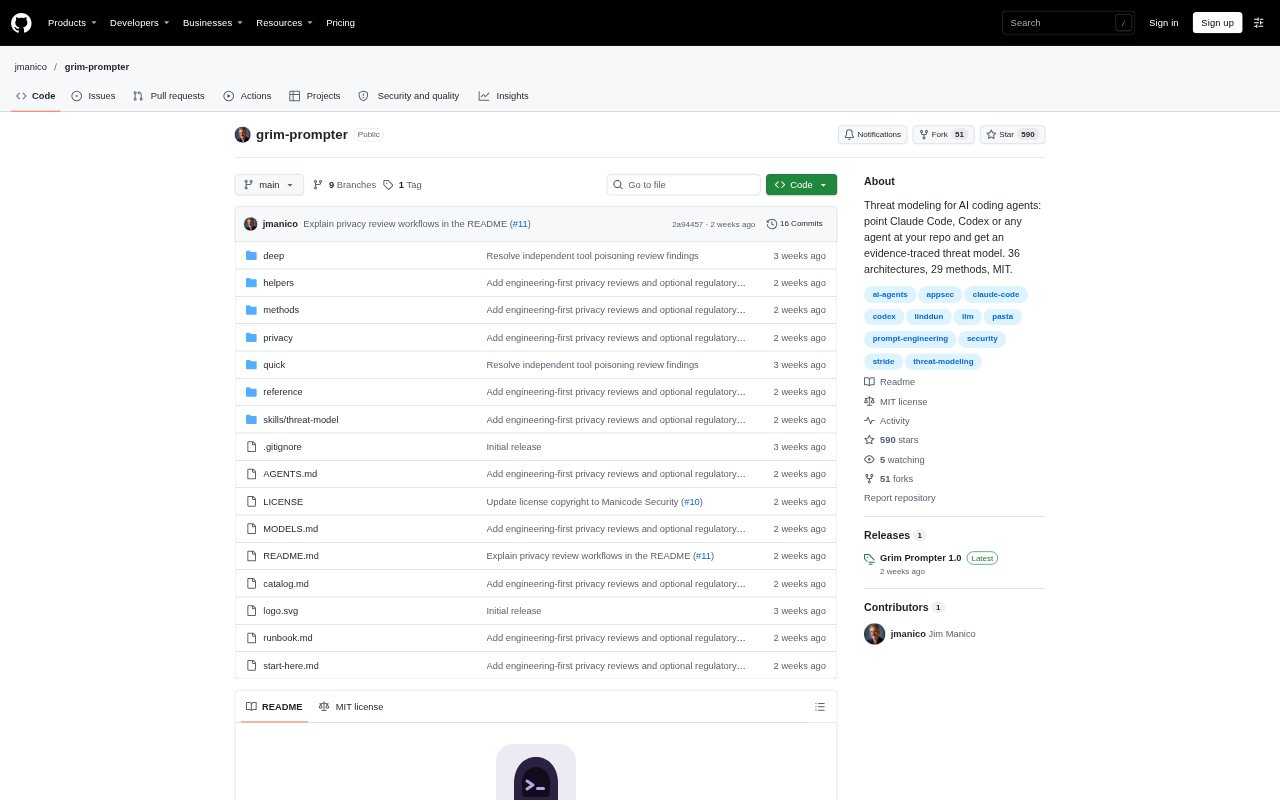
Grim Prompter is a set of workflows and prompts that guides Claude Code, Codex, or another coding agent through threat modeling a software repository. It helps developers and security teams examine system architecture, trust boundaries, threats, existing controls, and possible mitigations, with findings tied to code evidence. Teams can run a focused review, follow a six-stage analysis, assess privacy alongside security, or use the prompts to review how a code change affects an existing model.
Grim Prompter Features:
Architecture Workflows: The prompts cover 36 architecture types, including web applications, APIs, microservices, cloud platforms, AI systems, and payment systems.
Analysis Methods: A set of 29 method and analysis prompts supports structured techniques such as STRIDE and privacy reviews using LINDDUN.
Quick and Deep Reviews: Users can choose a bounded quick review or a six-stage workflow covering scope, system modeling, threat analysis, challenge, treatment planning, and reporting.
Evidence and Reports: The runbook directs agents to inspect code read-only and produce file-and-line citations, a coverage summary, findings, proposed mitigations, and verification plans.
Privacy Analysis: Privacy workflows examine data collection, use, sharing, retention, and potential harms, either independently or alongside a security architecture review.
Change Reviews: A change review compares a code branch with a saved JSON report so the agent can assess updates to an existing threat model.
Grim Prompter Benefits:
Clearer Review Scope: Architecture-specific workflows help teams focus an analysis on the systems and boundaries that matter instead of beginning with an open-ended review.
Traceable Findings: File-and-line evidence gives reviewers a concrete basis for checking whether a reported threat is supported by the inspected code.
More Careful Decisions: Separate prompts for challenging threats, setting risk criteria, and verifying fixes help teams distinguish an analysis from an approved or tested result.
Ongoing Model Updates: Saved reports and branch comparisons make it easier to revisit prior analysis as the codebase changes.
Broader Risk Coverage: Combining privacy and security review can help teams consider effects on people as well as technical threats within one cumulative model.
Use Cases:
New Application Review: A team building a web application can run a quick review or use the deeper workflow to examine its architecture, trust boundaries, and proposed mitigations.
AI System Assessment: Developers can review an AI, machine-learning, or RAG project for threats by directing an agent to inspect the relevant repository.
Privacy Review: A product team can examine how its service handles personal data, including analytics, logs, retention, and deletion paths.
Release Change Check: Before merging a feature branch, engineers can compare its code changes with an earlier JSON report and update the threat model.
Agent Tool Review: A team using MCP servers or agent tools can examine backend credentials, permissions, shared-token risks, and tool boundaries.