
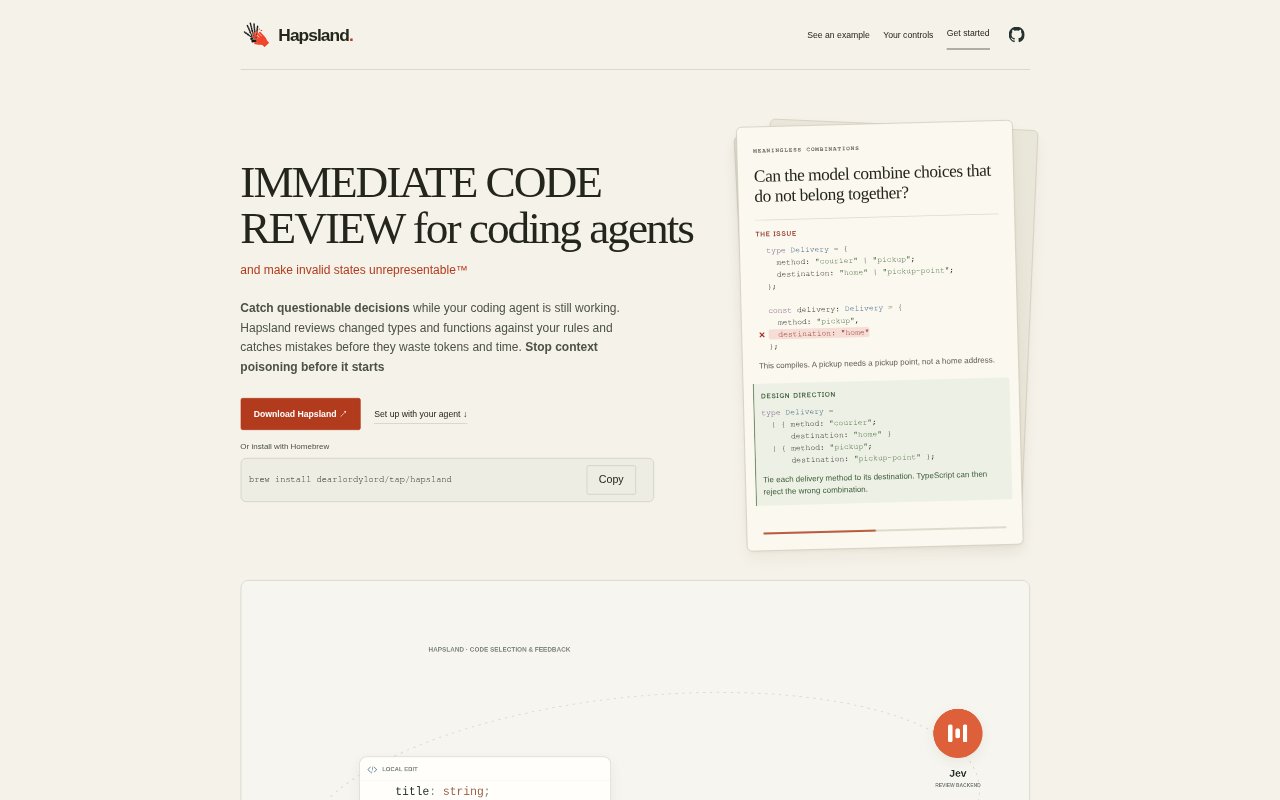
What is Hapsland?
Hapsland adds real-time code review to supported coding agents, checking changed types and functions against design questions and rules. It gathers related definitions to give the review more context, then prepares feedback for the agent to consider while it is working. Developers can use built-in checks or define local rules for their team's concerns. Setup supports Claude Code and Codex CLI, with file settings to control which source code can enter a review.
Hapsland Features:
Changed Declarations: Hapsland selects eligible changed types and functions according to file settings, so review focuses on declarations affected by an edit.
Related Code Context: It enriches the diff with related definitions before sending code for classification against the configured questions.
Built-In Design Rules: Default checks examine what values a type permits and whether a function body relies on structure its declaration does not reveal.
Custom Team Rules: Teams can add local rules and choose each rule's scope, threshold, and feedback message, with checks running when the code provides the needed evidence.
File Privacy Controls: Includes, exclusions, and privacy exclusions determine which files can be reviewed, and supporting files go through the same checks before reading.
Agent Hook Setup: Setup can configure Claude Code, Codex CLI, or both, previews hook changes, and asks before applying them.
Hapsland Benefits:
Earlier Design Feedback: Questionable decisions can be reconsidered before more code depends on them, reducing avoidable rework later in development.
Fewer Hidden Inconsistencies: Attention to duplicated facts and invalid combinations can help developers keep data models easier to reason about.
Less Agent Rework: Feedback during an agent's work can help it correct a weak approach before spending more effort building on it.
Team-Specific Guidance: Local rules let teams focus reviews on their own design concerns instead of relying only on generic questions.
Controlled Source Sharing: File selection settings give teams a way to keep excluded or privacy-sensitive files out of review requests.
Use Cases:
Modeling Delivery Options: Check a change that connects delivery methods to destinations, such as requiring a pickup point for pickup orders.
Reviewing Calculations: Catch a function that calculates a discount from an already reduced amount instead of the original price.
Keeping Items Together: Review edits to product and quantity data structures where removing a product should also remove its quantity.
Normalizing Identifiers: Check comparisons for identifiers such as SKUs when the domain treats letter case and surrounding spaces as insignificant.
Avoiding Duplicate Facts: Review a type change that stores the same detail in multiple places, such as cover width alongside nested dimensions.