
What is Higherlevel?
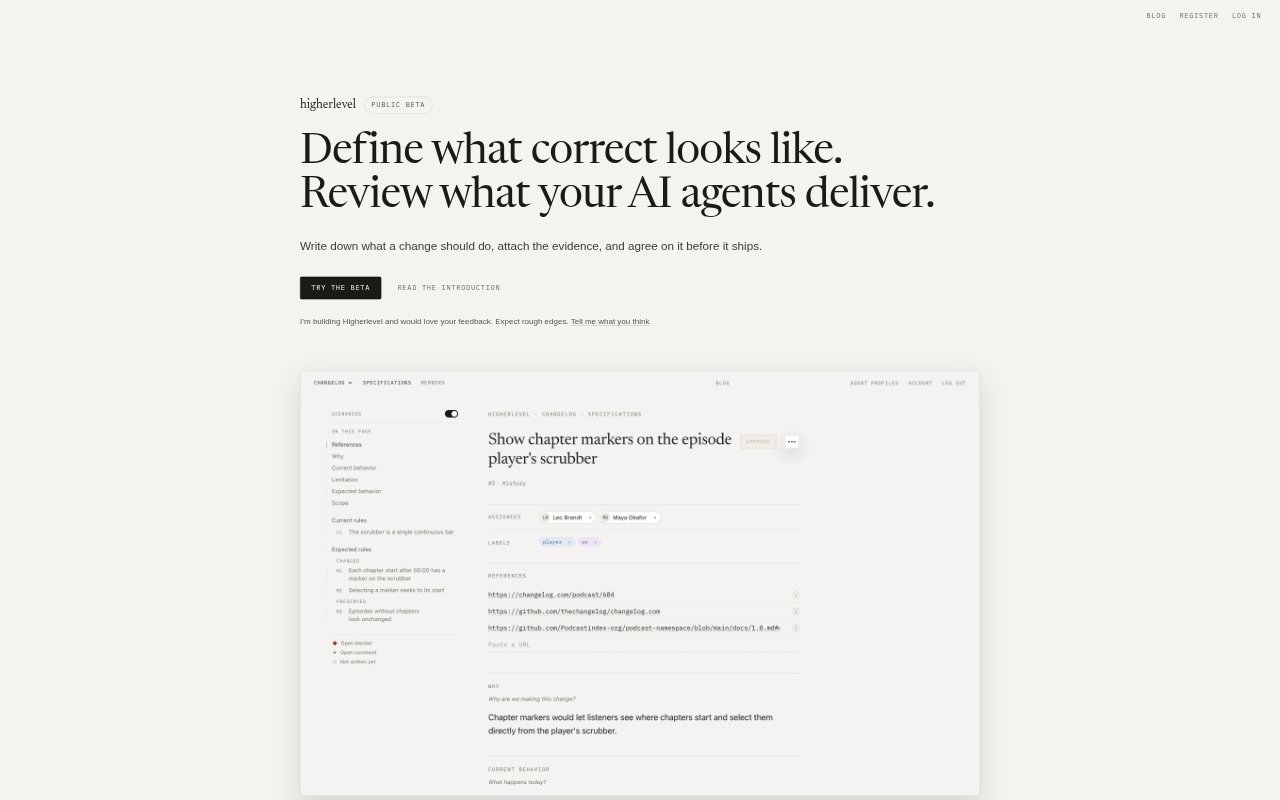
Higherlevel is a workspace for builders, engineers, and product teams to define intended product behavior and review changes made by coding agents. Teams describe current and expected behavior through Given, When, Then examples, then attach screenshots or recordings as evidence. Reviewers can discuss details, resolve blockers, and record approval before a change ships; agents can use the API to create specs, add evidence, and reply to comments.
Higherlevel Features:
Behavior Examples: Describe how a product works now and how it should work after a change using Given, When, Then examples.
Visual Evidence: Attach screenshots and recordings from before and after a change to show the product behavior being reviewed.
Side-by-Side Comparison: Compare before-and-after screenshots and recordings side by side while reviewing the proposed product change.
Focused Comments: Comment directly on a sentence, a section of a screenshot, or a particular moment in a recording.
Blocker Resolution: Keep a spec from being approved while a blocker remains open, then approve it after every blocker is resolved.
Agent API: Let agents use the API to write specs, attach evidence, and respond to comments on the work.
Higherlevel Benefits:
Shared Expectations: Teams can align on what a change should do before it ships, reducing ambiguity between the people building and reviewing it.
Evidence-Based Reviews: Reviewers can assess a proposed change against concrete examples and product captures instead of relying only on verbal descriptions.
Clear Accountability: A recorded approval makes it easier to see who signed off on a spec once its blockers are resolved.
Precise Feedback: Comments tied to specific text or media locations help reviewers explain issues without vague back-and-forth.
Visible Blockers: Keeping approval closed until blockers are addressed helps teams avoid treating unresolved concerns as accepted work.
Use Cases:
Agent-Written Changes: Define expected behavior for a change written by a coding agent, then review its evidence and responses to feedback.
Product Behavior Specs: Document how an existing flow works and specify the intended behavior of that flow after an upcoming change.
Before-and-After Reviews: Review a change to a product interface by comparing screenshots or recordings from before and after the work.
Distributed Feedback: Gather product and engineering feedback on a spec by letting reviewers comment on the exact text or media detail at issue.
Pre-Ship Approval: Use a spec review to resolve blockers and record reviewer approval before a product change is shipped.