
What is homie?
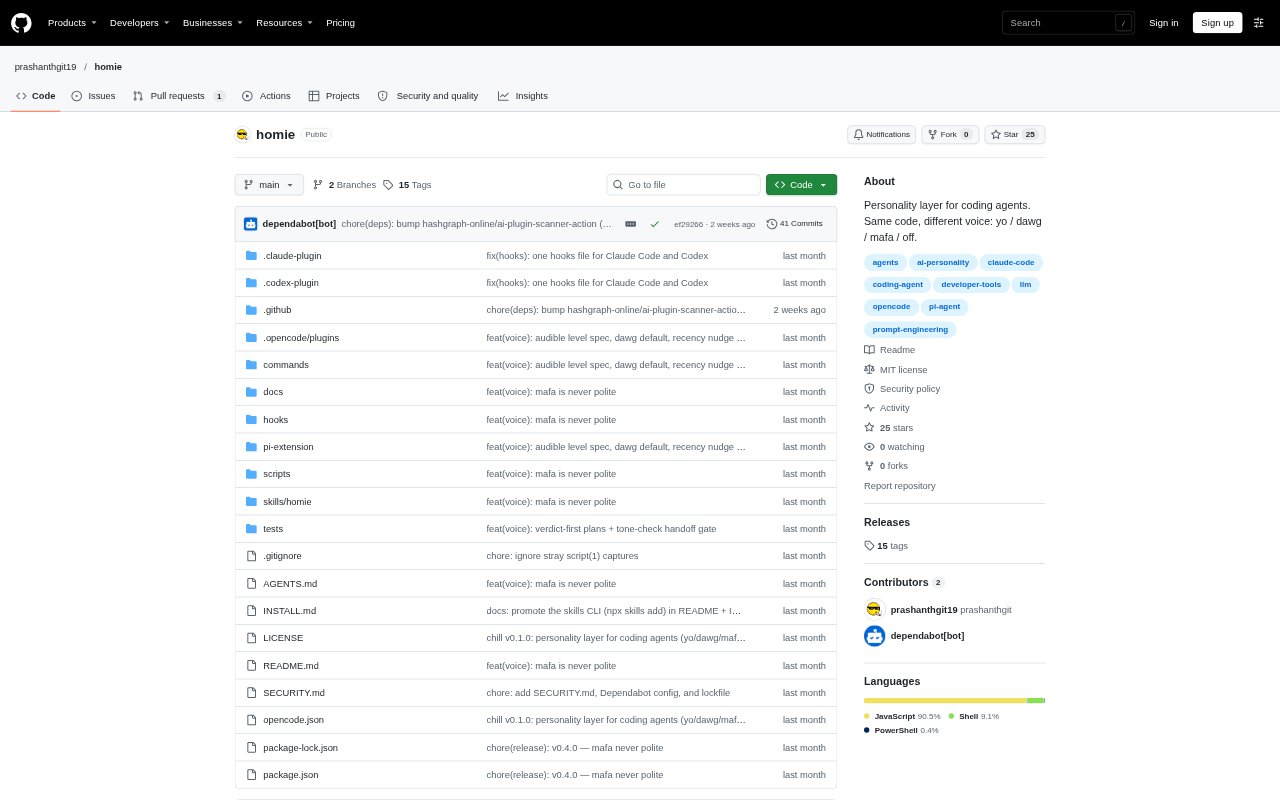
Homie is a personality layer for coding agents that changes their conversational voice without changing technical answers, code, commands, or safety judgments. Developers can choose yo, dawg, mafa, or off, ranging from friendly and direct to deliberately harsh. It works with Claude Code, OpenCode, Codex, Pi, and other agents through plugins or an installable skill, giving developers control over the tone of coding conversations.
homie Features:
Voice Levels: Choose yo for friendly talk, dawg for playful bluntness, mafa for harsh opinions, or off for the agent’s normal voice.
Level Commands: Use slash commands to switch levels, turn Homie off, or set the default for new sessions; plain requests can also nudge the tone.
Persistent Defaults: Set the starting level with an environment variable or configuration file, and retain level choices across a session.
Prose Boundaries: The voice applies to conversational prose, while code, diffs, commit messages, pull request descriptions, docstrings, and permission warnings stay plain.
Serious Situations: When production is down, someone is stuck, or credentials or destructive actions are involved, Homie switches to calm, direct language.
Agent Installation: Install through plugins for Claude Code, OpenCode, Codex, or Pi, or add the skill to agents including Cursor, Windsurf, Cline, and Gemini.
Policy Loading: A prompt and agent-specific hooks or plugins load the selected voice into the agent’s context and keep it active across turns.
homie Benefits:
More Direct Feedback: A blunt conversational style can make objections and weak ideas harder to miss during technical discussions.
Consistent Advice: Keeping recommendations and safety judgment unchanged lets developers choose a tone without having to trade away the agent’s technical answer.
Cleaner Project Artifacts: Plain code and project documentation avoid carrying jokes or profanity into shared work and git history.
Tone on Demand: Switching between levels makes it easier to match the conversation to personal preference, mood, or the task at hand.
Calm in a Crisis: Dropping the persona for serious situations keeps urgent guidance focused rather than playful or abrasive.
Use Cases:
Architecture Reviews: Ask a coding agent whether a proposed design is appropriate and choose a more blunt level for its critique.
Code Troubleshooting: Work through a bug with a conversational tone that feels more like a teammate than a formal assistant.
Production Incidents: Use the agent during an outage, when Homie switches to calm, direct language instead of maintaining its usual persona.
Learning Programming: Get explanations and technical guidance in a friendlier register while keeping the underlying answer unchanged.
Shared Code Changes: Use a chosen voice for discussion while keeping generated diffs, commit messages, and pull request descriptions plain.